






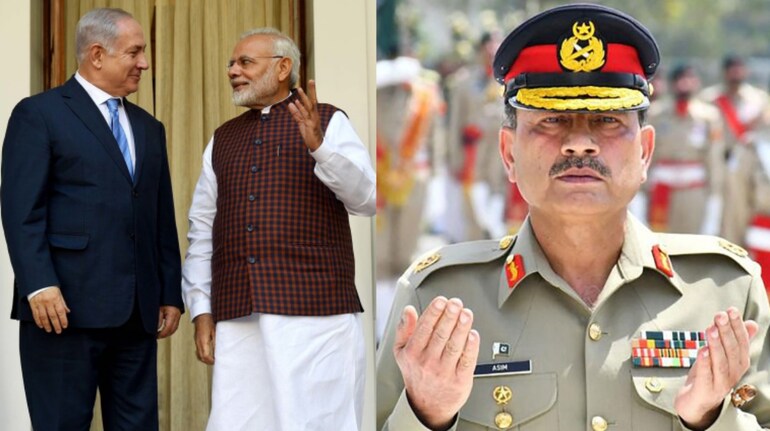

Israel’s proposal for a new strategic framework called the Hexagon of Alliances, in which India is publicly named as a key member, has triggered strong reactions from Pakistan, exposing Islamabad’s deep unease over shifting power alignments in West Asia and beyond.
The initiative was articulated by Benjamin Netanyahu ahead of Indian Prime Minister Narendra Modi’s two-day state visit to Israel, which began on February 25. Netanyahu described the visit as historic and repeatedly referred to Modi as a "dear friend."
The Hexagon of Alliances would involve six nations linked through security, diplomatic and economic cooperation and is designed to counter “radical axes” of influence in the Middle East, particularly what Netanyahu describes as the “radical Shia axis” and an “emerging radical Sunni axis.”
Pakistan’s Senate condemns the proposed bloc
The reaction in Islamabad has been unusually swift and strongly worded.
On Tuesday, Pakistan’s Senate, the upper house of Parliament, passed a resolution rejecting the Hexagon of Alliances, according to Pakistani media reports. The Senate described the plan as a “vile proclivity of the leadership of the Israeli occupying power towards diminishing the unity and integrity of the Muslim Ummah on political and ideological grounds.” The motion was introduced by Palwasha Mohammad Zai Khan of the Pakistan Peoples Party. The resolution was passed unanimously, signalling rare political unity in condemning the initiative.
A PPP leader, speaking about the resolution, said Islamabad “deplored the continued provocative steps and statements by the Israeli leadership that threatened regional and international peace and stability, including the latest statement about forming alliances against Muslim nations.” Pakistani English daily The Express Tribune reported this reaction.
Islamabad frames it as an ‘anti-Muslim Ummah bloc’
Pakistan’s Senate list of grievances went further than condemning the alliance framework. It rejected any “attempts by Israel to undermine what it described as the sovereignty, unity and territorial integrity of brotherly Islamic countries,” as reported by Dawn.
The resolution also slammed Israel’s recent diplomatic recognition of Somaliland as a sovereign nation. Israel announced recognition of the breakaway region in December 2025, prompting Pakistan to align with the Organisation of Islamic Cooperation and more than 20 other countries in rejecting the move as showing “full and blatant disregard for international law.”
The Senate reaffirmed Islamabad’s “unwavering” support for the Palestinian people’s “inalienable” right to self-determination and the establishment of an “independent, viable, and contiguous” State of Palestine based on pre-1967 borders, with East Jerusalem as its capital. It also demanded full Israeli withdrawal from “the occupied territories.”
What Israel’s ‘Hexagon of Alliances’ entails
Netanyahu unveiled the Hexagon of Alliances as part of his strategic vision for security cooperation ahead of Modi’s visit. He said it would bring together countries that “see eye-to-eye on the reality, challenges and goals” posed by extremist forces and other security threats in and around West Asia. The bloc is envisioned to include Israel, India, Greece and Cyprus, along with unspecified Arab, African and Asian nations.
“In the vision I see before me, we will create an entire system, essentially a ‘hexagon’ of alliances around or within West Asia,” Netanyahu said, according to The Times of Israel. “The intention here is to create an axis of nations that see eye to eye on the reality, challenges, and goals against the radical axes, both the radical Shia axis, which we have struck very hard, and the emerging radical Sunni axis.”
The alliance is expected to operate across three core tracks: economic cooperation, diplomatic alignment and security collaboration. Analysts have noted that the framework carries a far stronger security dimension than similar economic initiatives such as the India–Middle East–Europe Economic Corridor.
Netanyahu and Israeli officials see the Hexagon of Alliances as a long-term architecture that counterbalances the influence of Iran and its regional networks, which include groups such as Hezbollah and Houthis, collectively referred to as the Axis of Resistance.
Why India’s inclusion has alarmed Pakistan
Islamabad’s concern seems rooted in the public naming of India as a strategic pillar of the Hexagon of Alliances. Pakistan perceives India’s growing security cooperation with Israel and other nations as a direct challenge to its own influence in West Asia and as a departure from what Islamabad frames as Muslim unity.
Pakistan’s ruling coalition has also linked the alliance framework to broader changes in regional alignments involving Saudi Arabia and Turkey. Netanyahu’s announcement came amid rising tensions between Israel and Iran and as Pakistan and Saudi Arabia pursue their own collective security arrangements.
Broader diplomatic backdrop
National reactions in Pakistan reflect a longstanding diplomatic posture that strongly supports Palestinian sovereignty and rejects any moves seen as legitimising Israeli actions in occupied territories. Islamabad’s uncompromising stance on Palestine and its criticism of Israel’s recent diplomatic steps add further fuel to its opposition to the Hexagon proposal.
For Israel, the Hexagon of Alliances is intended as a strategic counterweight to hostile forces and an evolution of its diplomatic reach in a volatile region. For India, inclusion in the framework signals a growing strategic partnership with Israel that extends beyond bilateral ties toward multi-national cooperation.
Regional implications
Pakistan’s alarmist response suggests that the Hexagon of Alliances has not only annoyed Islamabad but is viewed there as a structural shift in regional power dynamics that could diminish Pakistan’s diplomatic standing among Muslim countries.
Whether the framework evolves into a formal security alliance or remains a conceptual platform for cooperation, its political resonance has already stirred significant controversy, particularly in capitals like Islamabad that see it as an affront to notions of Muslim unity and regional balance.
Discover the latest Business News, Sensex, and Nifty updates. Obtain Personal Finance insights, tax queries, and expert opinions on Moneycontrol or download the Moneycontrol App to stay updated!
Find the best of Al News in one place, specially curated for you every weekend.
Stay on top of the latest tech trends and biggest startup news.





