




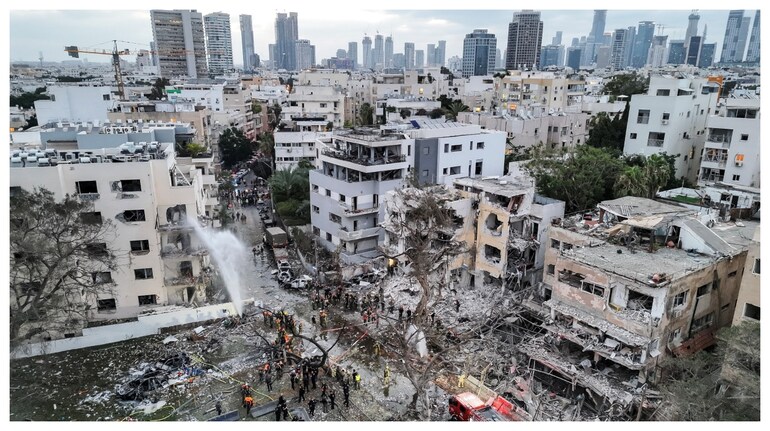
Since Friday, a tense and deadly rhythm has repeated itself in the skies above Israel: waves of Iranian ballistic missiles launch from across the region, met by a dense web of Israeli missile defence systems intercepting the majority—but not all—of the incoming threats. As the conflict stretches into its sixth day, military analysts say both countries are facing critical limits that may determine how long the fighting continues, the Washington Post reported.
Israeli intelligence officials estimate Iran had around 2,000 medium- to long-range missiles capable of reaching Israel at the outset of the conflict. But a surprise Israeli strike inside Iran on Friday destroyed a substantial portion of those munitions, reducing Iran’s ability to sustain high-intensity missile attacks. Since then, Israeli strikes have reportedly destroyed 120 Iranian launchers—roughly a third of its remaining capacity—and established air superiority over Tehran ahead of schedule.
The effects are already visible. After firing over 150 missiles on Friday night, Iran launched just 10 on Tuesday, reflecting both operational constraints and the risks of dwindling supply.
Despite this decline, analysts caution that Iran may still hold more than half of its original arsenal, including missiles stored in underground depots. Meanwhile, Israel's success in neutralizing attacks has come at a steep price.
Mounting costs and strained defences
Israel’s missile defence system—comprising the Iron Dome, David’s Sling, Arrow systems, and US-supplied Patriot and THAAD interceptors—is functioning at over 90% efficiency, according to official estimates. Only 35 out of the 400 Iranian missiles fired so far have made impact. But the costs are enormous. According to Israeli financial daily The Marker, defending against nightly barrages can cost as much as 1 billion shekels ($285 million) per night.
That level of spending, coupled with the finite number of interceptors, could force Israel to ration its defences in the days ahead. Intelligence assessments suggest Israel can sustain its current rate of interception for another 10 to 12 days without additional support from the U.S., after which officials may have to prioritize which threats to intercept.
In 2014, Israel reached the brink of running out of air defence interceptors during its war with Hamas. Missile expert Tal Inbar said that stockpile levels, while closely guarded, could again play a key role in determining when and how ceasefire discussions unfold.
Tactical success, but not total protection
Though Israel has intercepted the majority of missiles, some have still slipped through. Iranian projectiles struck a major oil refinery near Haifa and hit close to Tel Aviv, including the area near the Israel Defence Forces’ headquarters and the intelligence facility Camp Moshe Dayan. While Israel says Mossad’s main facility was not hit, social media footage verified by The Post shows nearby impacts and significant damage.
Iran’s Islamic Revolutionary Guard Corps claimed to have killed Israeli intelligence officials, though the IDF has not confirmed those claims. Israel, in turn, has targeted Iranian military leaders and infrastructure, including strikes on residential buildings housing nuclear scientists and military figures.
On Monday, Israeli missiles also hit the headquarters of Iran’s state broadcaster in a move framed as a strike on a military communication centre. Tehran said 224 people had died from Israeli strikes as of Sunday, though it did not specify how many were civilians or military personnel.
Iran’s missile program faces long-term damage
Even as the pace of missile launches slows, Israeli forces are increasingly targeting Iran’s ballistic missile production infrastructure. Former intelligence analyst Jim Lamson believes that Israel’s systematic attacks on these facilities could inflict long-term damage to Iran’s military capabilities. Without a regime change or negotiated arms rollback, Lamson said, “they’re going to have a huge problem reconstituting their ballistic missile forces.”
That pressure may be part of Israel’s strategy to shorten the war and weaken Iran’s long-term deterrence. But with each side absorbing economic, military, and human costs, analysts are beginning to question whether the conflict can sustain its current pace—or whether a ceasefire, perhaps dictated by logistical limits more than diplomacy, may arrive sooner than expected.
Discover the latest Business News, Sensex, and Nifty updates. Obtain Personal Finance insights, tax queries, and expert opinions on Moneycontrol or download the Moneycontrol App to stay updated!
Find the best of Al News in one place, specially curated for you every weekend.
Stay on top of the latest tech trends and biggest startup news.