






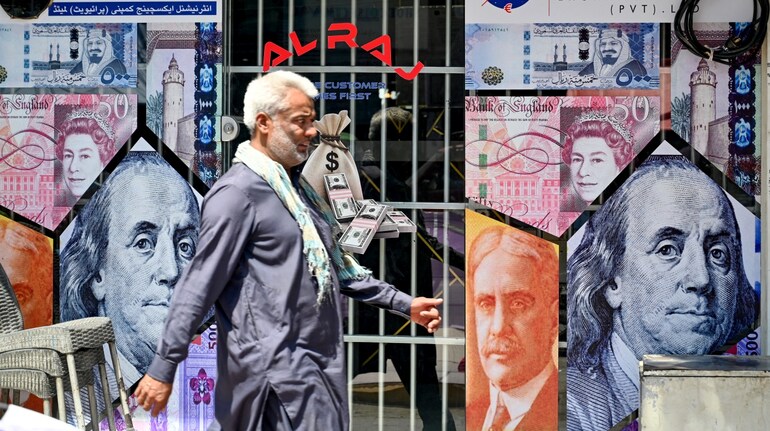

One of the most common shortcuts used to explain incomes in Pakistan is to convert them into Indian rupees. By that logic, earning 3 lakh Pakistani rupees a month is often portrayed as being equivalent to earning Rs 1 lakh in India, creating the impression that a small segment of Pakistanis lives at Indian upper middle-class standards.
However, this comparison is deeply flawed in reality. Exchange rates do not measure how people live. They do not capture what money actually buys, how far salaries stretch, or how severely inflation eats into household budgets. Once purchasing power is considered, the idea that a Pakistani earning 3 lakh rupees enjoys the same economic standing as an Indian earning Rs 1 lakh quickly collapses.
This gap between nominal income and real living standards is central to understanding Pakistan’s economic distress, and it exposes how a shrinking elite survives inside an economy where money itself is rapidly losing value.
In India, Rs 1 lakh a month can comfortably support a middle-class household in most cities, with room for savings, healthcare, schooling, and discretionary spending. In Pakistan, 3 lakh rupees does not stretch nearly as far. Inflation above 25 per cent, repeated currency devaluations, fuel price shocks, and imported inflation have steadily eroded real incomes. Basic expenses such as food, electricity, gas, transport, and education consume a far larger share of household income than they did even a few years ago.
Put simply, 3 lakh rupees in Pakistan may look impressive on paper, but it does not buy security, stability, or upward mobility in the way Rs 1 lakh does in India. Calling such earners “Indian-style lakhpatis” glosses over the reality that Pakistan’s economy has hollowed out the value of money itself.
What makes the picture more damning is how few Pakistanis even reach this income level. Despite a population of roughly 25 crore, Pakistan has only about 59 lakh registered taxpayers, according to data from the Federal Board of Revenue as of October 2025. Independent estimates suggest that just 4 to 10 lakh people earn more than 3 lakh rupees a month. That is barely 0.2 to 0.4 percent of the population.
Even these numbers likely understate the problem. Income concealment is widespread. Large landholders, traders, and politically connected business owners routinely under-report earnings, keeping Pakistan’s formal tax base artificially small and its inequality artificially hidden. The result is a system where wealth exists, but refuses to show up in official data or contribute meaningfully to the state.
Inequality data exposes how skewed the system has become. The World Inequality Database’s 2025 assessment shows that the richest 1 percent of Pakistanis capture 24 percent of national income. The bottom half of the population, tens of millions of people, share just 15 percent. This is not the profile of a developing economy climbing the ladder, but of one trapped in extraction and elite capture.
Government surveys reinforce this divide. The Pakistan Bureau of Statistics puts the average monthly salary at roughly 39,000 rupees. Against that baseline, a 3 lakh salary is nearly eight times the national average. Yet even at that multiple, purchasing power remains fragile, particularly in major cities where housing, utilities, and healthcare costs have surged.
High earners are clustered in narrow, insulated sectors. Senior IT professionals, specialist doctors, corporate executives, senior bankers, and multinational firm managers dominate the three-lakh-plus bracket. Outside these pockets, the broader economy offers little room for income growth, mobility, or stability.
For ordinary households, inflation has turned survival into a monthly calculation. Food prices fluctuate wildly, energy costs remain volatile, and public services continue to deteriorate. The World Inequality Report has warned that unless Pakistan brings its vast informal economy into the tax net and records real incomes honestly, the wealth gap will only widen further.
In that context, debating whether 3 lakh rupees makes someone an “Indian-equivalent lakhpati” misses the larger truth. The real story is not about currency conversion, but about economic decay. In Pakistan today, even high nominal incomes struggle to buy confidence in the future, while the vast majority of the population remains locked out of meaningful prosperity altogether.
Discover the latest Business News, Sensex, and Nifty updates. Obtain Personal Finance insights, tax queries, and expert opinions on Moneycontrol or download the Moneycontrol App to stay updated!
Find the best of Al News in one place, specially curated for you every weekend.
Stay on top of the latest tech trends and biggest startup news.





