






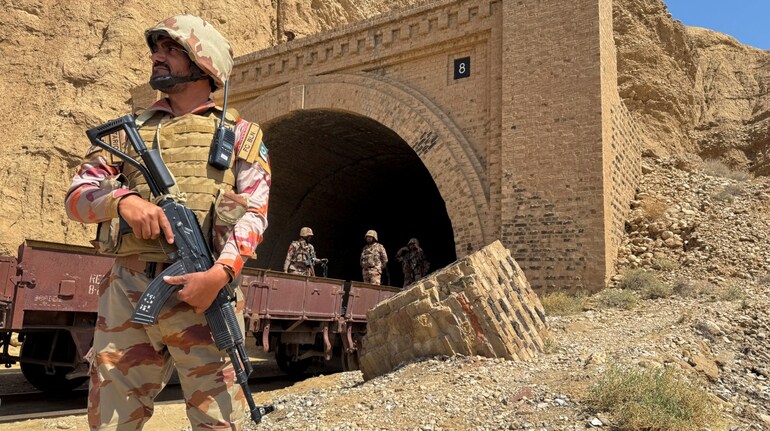

Pakistan’s deepening crisis in Balochistan is now being openly acknowledged by its own leadership. In remarks that have raised fresh questions about the military’s ability to control the insurgency, Defence Minister Khawaja Asif admitted that security forces are effectively “handicapped” when operating in the country’s largest province. His comments come amid an unprecedented escalation by the Baloch Liberation Army, which has carried out coordinated suicide and gun attacks across multiple districts, briefly overrunning key towns and security installations.
The admission of physical and operational constraints stands in sharp contrast to official claims of control. While Pakistan’s military says it has killed nearly 200 militants in counter operations, the BLA has claimed far higher casualties among Pakistani forces, exposing a widening credibility gap and underlining the scale of the challenge Islamabad is struggling to contain.
‘Physical handicap’ in Balochistan
Addressing Pakistan’s National Assembly on Monday, Asif painted a bleak picture of the security environment in Balochistan.
“Controlling this is way more difficult than a populated city or area, and there is a need for the deployment of our forces on a massive scale. Our forces are deployed there and taking action against them, but there is a physical handicap when it comes to guarding and patrolling such a large area,” he said.
Asif noted that Balochistan’s vast geography severely limits surveillance and control, pointing out that there is “a person residing every 35 kilometres” in the province, according to Dawn.
He ruled out negotiations with the BLA, declaring, “They are involved in mischief in the world (fasad-ul-ard) […] and talks cannot be held with them.”
“It is the bottom line of the state of Pakistan that nobody will be able to rationalise violence. When you try to rationalise violence or dress it up as a freedom movement, it is not acceptable because it is not true. This is a cover to legitimise criminal activities,” Asif added.
Internal failures and smuggling nexus
In a rare admission of internal rot, the defence minister blamed political and bureaucratic patronage for fuelling instability in the province.
“The province’s resources have been looted under this system. And this reaction is coming from those same people, it is the same nexus that tried to hamper Balochistan’s progress,” he said.
Balochistan, despite being rich in minerals and natural resources, remains Pakistan’s poorest province. The Baloch population of around 15 million has long accused Islamabad of exploitation, enforced disappearances and denial of political and economic rights.
Claims of advanced weapons and Afghan sanctuaries
Asif also alleged that Baloch militants were using sophisticated American made weapons, raising questions about Pakistan’s border security and intelligence failures.
He said the rebels possessed rifles worth PKR 2 million. “We don’t have that rifle. They also had thermal weapon sights worth $4,000-$5,000. The total military gear that they own is close to $20,000. Where is it coming from? Who is paying for it?” he asked.
Asif claimed the weapons were “American weapons” and alleged that the leadership of the insurgents was operating from Afghan soil. He further alleged that oil smuggling networks had hijacked the movement, saying, “Billions and trillions of rupees were being lost to smuggling, mainly oil smuggling. This criminal mafia […] began supporting the movement. And their leadership now comprises these elements.”
Operation Herof and competing claims
The remarks followed the BLA’s launch of Operation Herof, meaning “black storm”, which saw coordinated attacks across Quetta, Mastung, Noshki, Dalbandin, Kharan, Panjgur, Tump, Gwadar and Pasni, according to Pakistan military’s media wing ISPR.
Reuters reported that the attacks killed more than 22 security personnel and 36 civilians. Pakistani forces said they responded with large scale counter terror operations, killing 197 militants across more than a dozen locations.
However, the BLA has disputed Pakistan’s version. In a statement cited by Moneycontrol, the group claimed that at least 280 Pakistani personnel were killed during Operation Herof Phase II and said its fighters had seized key positions in districts such as Nushki. The BLA also claimed Pakistani forces were retreating under pressure, allegations Islamabad has not acknowledged.
In Nushki, militants briefly took control of a police station and other installations, triggering a three day standoff. “More troops were sent to Nushki,” a security official told Reuters. “Helicopters and drones were used against the militants.” Police said seven personnel were killed before control was restored.
Blame game and strategic drift
Islamabad has once again blamed India for the violence, an allegation rejected outright by New Delhi. India’s Ministry of External Affairs has said Pakistan should address the “long-standing demands of its people in the region” instead of externalising its failures.
As Pakistan’s own defence minister admits to operational handicaps, sprawling geography and internal complicity, the Balochistan crisis appears less like a temporary security challenge and more like a
Discover the latest Business News, Sensex, and Nifty updates. Obtain Personal Finance insights, tax queries, and expert opinions on Moneycontrol or download the Moneycontrol App to stay updated!
Find the best of Al News in one place, specially curated for you every weekend.
Stay on top of the latest tech trends and biggest startup news.





