







Pakistan’s fragile economy is once again under pressure as the escalating conflict in West Asia sends global oil prices soaring. With crude prices crossing the $100 mark and fears growing over disruptions to supply routes, Islamabad now faces the prospect of a sharp surge in its monthly oil import bill.
Finance minister Muhammad Aurangzeb has warned that Pakistan’s oil import costs could climb to $600 million per month if the crisis continues to intensify. The development exposes the deep vulnerability of Pakistan’s energy-dependent economy at a time when it is already struggling with inflation, currency instability and heavy reliance on international financial assistance.
The warning comes as global oil markets react sharply to the growing instability in the Middle East.
Oil prices surge amid conflict fears
Energy markets witnessed a dramatic spike on Monday as traders reacted to the escalating crisis.
Brent crude, the global benchmark, jumped to $118.22 per barrel, while US West Texas Intermediate rose nearly 30 percent from Friday’s close of $90.90 to reach $118.21.
The surge reflects growing fears that military escalation could disrupt energy infrastructure or threaten shipping routes in the region, particularly through the Strait of Hormuz, a critical chokepoint for global oil supplies.
For Pakistan, which depends heavily on imported fuel, the spike in prices threatens to widen its already fragile current account deficit.
Islamabad scrambling for relief
As the financial strain deepens, Pakistan’s government is now turning once again to international lenders for support.
Petroleum minister Ali Pervaiz Malik confirmed that Islamabad is seeking relief from the International Monetary Fund on the petroleum levy, a move that highlights the country’s continuing dependence on external financial assistance.
Speaking during a briefing, Aurangzeb acknowledged the growing pressure on the economy.
Pakistan’s monthly oil import bill could rise to $600 million if the conflict continues, he warned, adding that the government is preparing contingency plans to cope with the surge in global prices.
At the same time, Malik urged citizens to reduce fuel consumption in order to preserve the country’s limited reserves.
Supply disruptions raise further concerns
Pakistan’s energy security is also threatened by potential disruptions to fuel shipments.
Malik said that three petroleum shipments were expected to arrive on Monday, but warned that supplies of liquefied natural gas could face disruptions if tensions in the region escalate further.
The government is now attempting to secure alternative energy routes.
According to officials, Islamabad is in discussions with Oman, Saudi Arabia and the United Arab Emirates to explore supply options that could bypass the Strait of Hormuz if the situation deteriorates.
However, analysts say Pakistan’s limited bargaining power and financial constraints make it difficult to secure favourable energy deals.
Fuel price shock hits Pakistani consumers
The immediate impact of rising global oil prices is already being felt domestically.
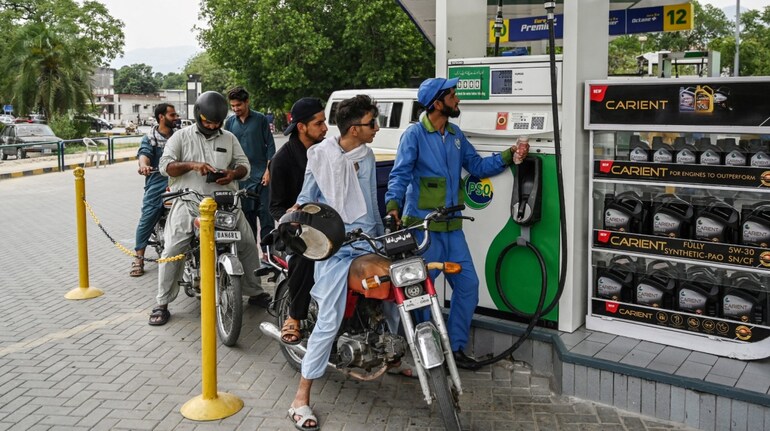
Pakistan has sharply increased fuel prices, pushing petrol and diesel rates to levels that are likely to worsen the cost-of-living crisis.
Petrol and high-speed diesel prices were increased by PKR 55 per litre, or roughly 20 percent, bringing prices to PKR 321.17 for petrol and PKR 335.86 for diesel as of March 7.
For many Pakistanis, the surge comes during Ramadan when household spending typically rises, further intensifying economic hardship.
Inflation fears return
Economists warn that the fuel price hike could trigger another wave of inflation across Pakistan’s already fragile economy.
With petrol prices now hovering around PKR 324 per litre, transportation and logistics costs are expected to rise sharply. This will inevitably push up the prices of food, agricultural produce and other essential goods.
Such increases could undo recent attempts to stabilise inflation and place additional pressure on households already struggling with rising living costs.
Government admits limited options
Officials in Islamabad have acknowledged that the government has little room to shield citizens from the global oil price shock.
Deputy Prime Minister Ishaq Dar said Pakistan had “little choice” but to pass on the impact of international oil price increases to consumers.
He argued that the decision was necessary to stabilise the country’s energy finances and comply with conditions linked to consultations with the International Monetary Fund.
The admission highlights Pakistan’s deep economic vulnerability and the extent to which external shocks can quickly destabilise its domestic economy.
Regional tensions expose Pakistan’s fragile position
The oil shock also comes at a time when Pakistan is navigating a complicated regional diplomatic environment.
As tensions rise between Iran, Israel and the United States, Islamabad has attempted to maintain a delicate balance while also reaffirming its security ties with Gulf allies such as Saudi Arabia.
Pakistan recently reiterated its defence cooperation agreement with Saudi Arabia, underscoring the kingdom’s importance for its economic and strategic interests.
However, the crisis has also exposed contradictions in Pakistan’s regional posture, with critics accusing the country’s leadership of trying to maintain competing alignments in a volatile geopolitical environment.
At home, the economic fallout has added to growing public frustration over rising prices and deteriorating living standards.
A familiar cycle of crisis
For Pakistan, the latest energy shock reflects a broader pattern.
The country remains heavily dependent on imported fuel while lacking sufficient domestic energy production and foreign exchange reserves to absorb global price spikes.
Each surge in global oil prices therefore risks triggering a new round of economic instability.
As the West Asia conflict continues to unfold, Pakistan may once again find itself trapped in a familiar cycle of rising import bills, inflationary pressure and dependence on international financial support.
Discover the latest Business News, Sensex, and Nifty updates. Obtain Personal Finance insights, tax queries, and expert opinions on Moneycontrol or download the Moneycontrol App to stay updated!
Find the best of Al News in one place, specially curated for you every weekend.
Stay on top of the latest tech trends and biggest startup news.





