






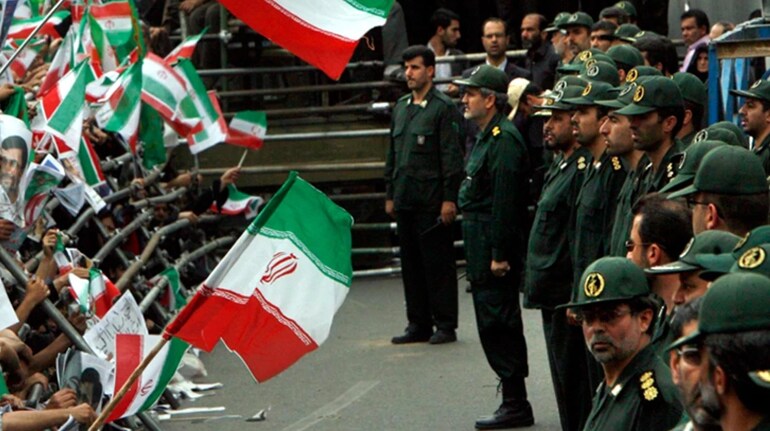
For nearly four decades, Iran’s political system has revolved around one man, Ali Khamenei. As supreme leader, he has sat above presidents, parliaments and clerics, arbitrating disputes inside a sprawling theocratic system.
But after this month’s mass protests, in which crowds openly called for the end of the regime and Khamenei’s removal, attention inside Tehran has shifted, the Financial Times reported. Diplomats and analysts increasingly point to a different centre of gravity: the Islamic Revolutionary Guard Corps.
A state within the state
Created after the 1979 revolution to protect the Islamic system, the Revolutionary Guards have long been more than a military force. Over time, they have grown into a parallel state: commanding ground, air and naval units, running a powerful intelligence arm, and overseeing a vast economic empire whose full scale remains opaque.
They control major infrastructure projects, dominate sectors such as construction, energy and telecommunications, and operate through networks of front companies. In doing so, they are not just defenders of the system, but major beneficiaries of it.
That combination of ideology, force and money has made them uniquely resilient.
The crackdown that changed the equation
The recent protests marked the most serious challenge to the Islamic republic in decades. Demonstrators crossed lines rarely breached before, calling for the fall of the regime itself.
The response was brutal. Security forces, including units linked to the guards, moved beyond crowd control to live ammunition. Hospitals filled with the wounded. Morgues filled with bodies.
Iranian state media later said more than 3,100 people were killed before the unrest was crushed, including security personnel whom officials described as victims of foreign-backed “terrorists”. Human rights groups and protesters say many of the dead were unarmed civilians.
For many Iranians, the scale of violence ended any illusion that street protests alone could bring change without enormous bloodshed.
From street revolt to internal calculation
That reality has forced an uncomfortable question, even among some who want the regime gone: if change is going to come, could it only come from within the system?
Some Iranians now speak, often reluctantly, about the possibility of a future shaped not by clerics but by the guards. The hope, in this line of thinking, is not democracy but a more pragmatic, secular authoritarianism focused on economic recovery, fewer social restrictions and less ideological isolation.
One western diplomat in Tehran described this as a possible evolution rather than a revolution: a system dominated by the guards instead of the clergy.
“The Revolutionary Guards are not going anywhere,” the diplomat said. “The state is weakened, but it’s not collapsing.”
A force that still holds the levers
Despite recent setbacks, the guards remain the most organised and disciplined institution in Iran.
They oversee the Quds Force, which manages Iran’s regional network of allies and proxies, and the Basij, a vast domestic force that protesters say played a role in suppressing demonstrations. Their intelligence wing continues to detain journalists, activists and political figures.
They also retain control of Iran’s missile programme, which Tehran sees as a core deterrent. During the June conflict, Iran fired hundreds of missiles at Israel, underlining that capability even after suffering losses.
Wounded, but not weakened
Those losses have been significant. Israel has struck hard at Iran’s regional allies, including Hizbollah and Hamas, and killed senior Iranian military figures.
In June, Israel killed the guards’ top commander, Major General Hossein Salami, in the opening hours of a 12-day war. The speed with which Iran replaced him, appointing Major General Mohammad Pakpour within hours, showed both vulnerability and institutional muscle.
Still, questions remain about the next generation of guards. Many younger commanders were shaped by wars in Syria, Iraq and Lebanon, and some analysts believe they may be more hardline than their predecessors.
The Trump factor
External pressure adds another layer of uncertainty. The United States designated the Revolutionary Guards a terrorist organisation in 2019. President Donald Trump has repeatedly threatened intervention and, during the protests, openly backed demonstrators.
Some diplomats believe Washington ultimately cares less about Iran’s political form than its behaviour. Stability, even under an authoritarian system backed by the guards, may be preferable to chaos.
“Trump doesn’t care what the regime is,” one diplomat said. “He cares about what it does.”
A bitter outcome for protesters
For those who took to the streets, risking and losing their lives, the idea that the guards could emerge even stronger is deeply painful.
Many reject any future in which power simply shifts from clerics to generals. After the bloodshed, they argue, no faction tied to the current system has legitimacy left.
“Their hands are too bloody,” said one protester, speaking anonymously. “All of them should go.”
Yet Iran’s history suggests that power rarely disappears; it moves. And right now, after the protests, the Revolutionary Guards look better placed than anyone else to decide where it moves next.
Discover the latest Business News, Sensex, and Nifty updates. Obtain Personal Finance insights, tax queries, and expert opinions on Moneycontrol or download the Moneycontrol App to stay updated!
Find the best of Al News in one place, specially curated for you every weekend.
Stay on top of the latest tech trends and biggest startup news.




