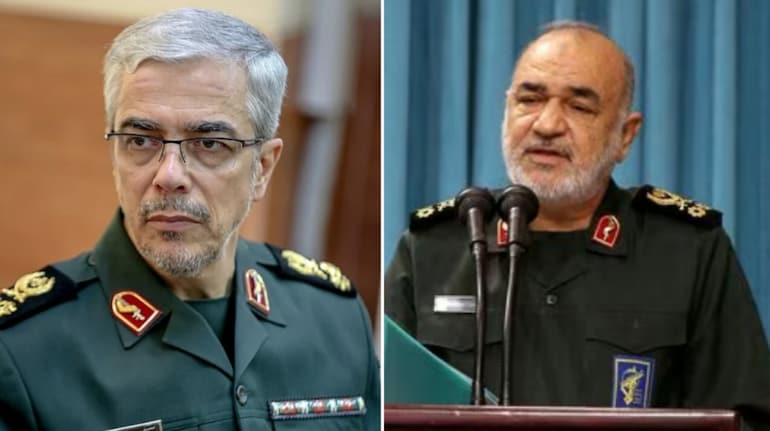
In a shocking escalation of hostilities, Israel pounded Iran in a series of air raids, striking targets including Tehran's nuclear and military sites. The raids killed the armed forces' chief of staff, the head of Iran's Revolutionary Guards and top nuclear scientists long linked to Iran’s controversial nuclear program.
The targeted assassinations mark one of the most significant developments in the long-running shadow war between the two regional rivals, sending shockwaves across the Middle East and prompting global concern over the potential for a broader conflict.
Let’s take a closer look at the key figures eliminated in the strikes, and why their deaths matter.
Maj Gen Mohammad Bagheri
He was the chief of staff of Iran’s armed forces and the highest-ranking officer after Supreme Leader Ayatollah Ali Khamenei. A key architect of Iran’s military doctrine, Bagheri coordinated operations across the IRGC, the regular army, and the Basij paramilitary. His role was pivotal in both strategic planning and Iran’s regional military posture, particularly in countries like Syria, Iraq, and Lebanon. His death marks one of the most severe blows to Iran’s command structure in decades.
Gen Hossein Salami
He was the Commander-in-Chief of the Islamic Revolutionary Guard Corps (IRGC). Known for his hardline stance and fierce anti-Israel rhetoric, Salami oversaw Iran’s missile program and proxy network across the Middle East. Under his leadership, the IRGC intensified operations through Hezbollah, Hamas, and the Houthis, positioning Iran as a formidable asymmetrical force in the region.
Gen Gholamali Rashid
He was the Deputy Commander-in-Chief of the Armed Forces, who played a behind-the-scenes role in shaping Iran’s military doctrines, particularly in hybrid warfare. Rashid was part of the elite command circle that advised the Supreme Leader on matters of war strategy, nuclear posture, and deterrence. His elimination further deepens the leadership vacuum created by Friday’s strikes.
Fereydoun Abbasi
A nuclear physicist and former head of the Atomic Energy Organisation of Iran, he was long regarded as a core figure in Iran’s nuclear advancement. He survived a previous assassination attempt in 2010 and was a key proponent of Iran’s uranium enrichment program. Abbasi was deeply involved in nuclear planning during and after the early 2000s, and Western intelligence had flagged him as instrumental in bridging civilian nuclear research with potential weapons capabilities.
Mohammad Mehdi Tehranchi
He was a theoretical physicist and president of Islamic Azad University. Though less prominent publicly than Abbasi, Tehranchi was widely believed to be connected to academic programs supporting Iran’s nuclear R&D. His role at one of Iran’s largest academic institutions made him a vital link between education, theoretical research, and state-sponsored nuclear science, particularly in advanced physics and weapons modelling.
Discover the latest Business News, Sensex, and Nifty updates. Obtain Personal Finance insights, tax queries, and expert opinions on Moneycontrol or download the Moneycontrol App to stay updated!
Find the best of Al News in one place, specially curated for you every weekend.
Stay on top of the latest tech trends and biggest startup news.