






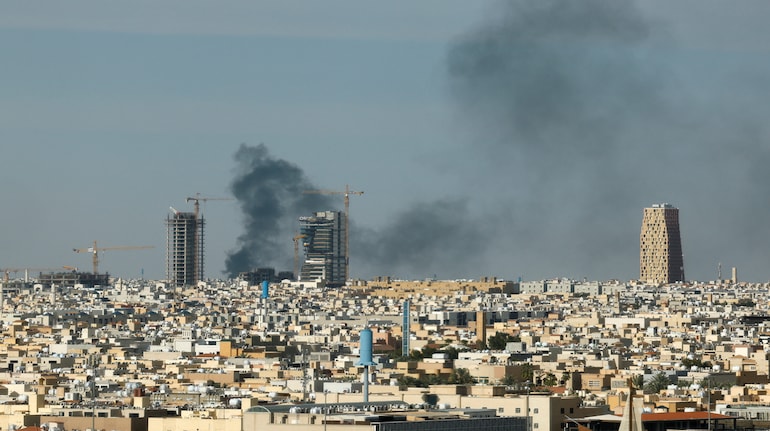
The confrontation triggered by the United States–Israeli strikes on Iran has rapidly expanded beyond the initial battlefield, threatening to engulf much of the Middle East. According to strategic expert Major General A. K. Siwach, Tehran has deliberately widened the conflict by targeting American military infrastructure across the region, a move designed to force Washington’s Gulf partners to push for de-escalation.
Speaking to Moneycontrol, Siwach said Israel and the US misjudged Iran’s ability to absorb the initial shock and retaliate strategically.
“Israel has underestimated the capability of Iran. And Iran, as on today, has very cleverly made this into a regional war by hitting the American bases in Middle East,” he said.
These bases are spread across several countries including Saudi Arabia, United Arab Emirates, Oman and Jordan.
Siwach said the logic behind the strikes is straightforward: by drawing these countries into the conflict indirectly, Tehran hopes to build pressure on Washington from within its own alliance network. “If he hits these bases which are having collateral damage to these countries, these countries will put pressure on US to stop the war,” he explained.
The strikes also send a broader strategic signal about the US military presence in the region. “Today, the US has become a liability for these countries because they are being attacked because there are bases there,” he said.
Iran has also attempted to widen the battlefield through its regional allies and by disrupting critical energy routes. Siwach noted that attacks and maritime disruptions have already begun affecting energy production and trade flows.
“What’s happening is that LNG which was being produced in Qatar is stopped. The oil production as well as storage is also being now affected adversely,” he said.
At the same time, Iran-backed groups have stepped up operations across key maritime routes. “Houthi rebels have now become very active in the Red Sea. They are not letting the ships pass… and in addition to that it has also closed the Strait of Hormuz where 20% of the oil of the world goes,” he added.
The disruptions are already rippling through regional trade networks. “Even the exports which were coming to these countries, like from India — foods, vegetables or rice — that has also been adversely affected,” Siwach noted.
Missiles and drones are Iran’s equaliser
Despite suffering significant losses in its air force and air defence systems, Iran still possesses a large arsenal of missiles and drones — weapons that Siwach believes form the backbone of its current strategy.
“The strong points of Iran is that it has got missiles, rockets and drones. It has missiles and rockets not less than about 5,000 to 10,000. And it has drones which are about 80,000,” he said.
These weapons allow Iran to sustain pressure on its adversaries while imposing a heavy financial burden on their defence systems.
“Iran is hitting with drones like Shahed-136 which is very effective. Whereas the US and Israel have to use a missile which is almost 100 times costlier than that,” Siwach said.
However, Iran also has significant vulnerabilities. “Iran air power is very weak. Iran air defence system has been totally neutralised. And the navy has also been adversely affected by the US Navy and US Air Force,” he said.
Even so, Tehran has prepared for a prolonged conflict by decentralising its command structure. According to Siwach, the country anticipated leadership losses and ensured continuity of operations. “They have decentralised the IRGC. There are 31 provinces and everywhere they are acting independently,” he said.
Iran has also created multiple layers of leadership succession. “In case the first cadre is killed, then the second one takes over, the third one takes over and the fourth one,” he explained.
This system ensured that the killing of senior commanders did not cripple Iran’s ability to continue the fight.
War likely to intensify but remain regional
While the conflict is widening geographically, Siwach believes it is unlikely to spiral into a global war. “This war will remain regional. It will not become a world war,” he said.
The main reason, he argued, is the absence of major powers willing to intervene militarily on Iran’s side. “Iran is all by itself. There are not too many friends of Iran. The only friend is China and Russia,” he said. Even that support, he added, is limited.
“China and Russia have given material support — air defence systems, drones, missiles and intelligence — but nothing more, nothing less. They are not going to go all out to support Iran in the war,” Siwach said.
Both countries have their own strategic priorities. Russia remains deeply involved in the Russia–Ukraine War, while China is primarily focused on tensions around Taiwan. As a result, Siwach expects the conflict to intensify in the coming days but remain geographically limited.
“The intensity of the war will increase… but the chances of this war getting out of regional war into a world war are almost negligible,” he said.
For now, the battle appears set to continue as long as Iran retains its stockpile of missiles and drones — weapons that allow it to keep the conflict alive while raising the economic and strategic costs for the United States and its regional partners.
Discover the latest Business News, Sensex, and Nifty updates. Obtain Personal Finance insights, tax queries, and expert opinions on Moneycontrol or download the Moneycontrol App to stay updated!
Find the best of Al News in one place, specially curated for you every weekend.
Stay on top of the latest tech trends and biggest startup news.




