






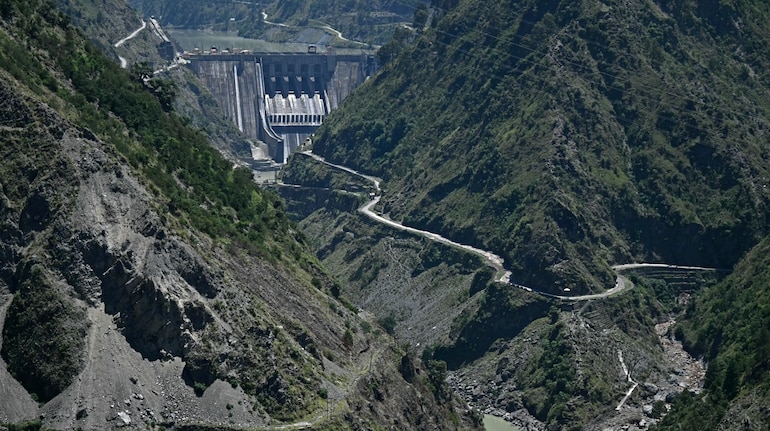

India is no longer speaking in hypotheticals when it comes to leveraging its upper riparian position over Pakistan. What was once discussed in strategic circles is now being executed on the ground, deep in the Himalayas of Jammu and Kashmir, with deadlines, inspections and irreversible construction milestones.
Following a recent two-day visit by Union Power Minister Manohar Lal Khattar, the Centre has issued clear instructions to speed up a cluster of hydropower projects on the Chenab river system. Officials have been told that timelines are no longer flexible. Two projects, Pakal Dul and Kiru, must be commissioned by December 2026. Kwar has been given a firm deadline of March 2028. Work on the long-delayed and highly disputed Ratle dam has been pushed into a higher gear.
This accelerated push is not just about electricity. It strikes at the heart of Pakistan’s structural vulnerability. Pakistan is a downstream state whose economy, agriculture and food security are overwhelmingly dependent on water flowing from India. The western rivers of the Indus basin form the backbone of Pakistan’s survival. Without them, its canal network collapses, its dams become redundant and its farms dry up. Nearly every major agricultural belt in Pakistan depends on water that originates in Indian territory.
Among the projects now being prioritised, Pakal Dul stands out as the most consequential. Located in Kishtwar district, it is India’s largest hydropower project on the Chenab basin and the tallest dam in the country. More importantly, it is a storage project on a river that eventually flows into Pakistan. That single fact changes the equation. Storage allows regulation, not diversion, but regulation alone is enough to alter seasonal flows, delay releases and disrupt downstream planning. For decades, Pakistan has viewed such projects as a red line. With the Indus Waters Treaty effectively frozen, that red line no longer constrains India.
Running alongside Pakal Dul is the Kiru project, also in Kishtwar. While classified as a run of the river project, Kiru gains strategic weight when viewed as part of a cascade. Multiple dams operating in sequence give upstream control over how and when water moves. The decision to synchronise the commissioning of Pakal Dul and Kiru by the end of 2026 is a signal that India intends to operationalise this control in tandem.
The Kwar project further strengthens this chain. Construction there crossed a major milestone in early 2024 when the Chenab was diverted to allow work to proceed. That diversion was quietly noted in Pakistan, where such moments are treated as strategic events rather than engineering ones. With a fixed deadline of March 2028 now in place, Kwar is no longer an open ended project that Islamabad can hope to stall through objections.
Ratle is where Indian resolve is most visible. The project has been a sore point for Pakistan for years, particularly over spillway design and drawdown capacity. Those objections have failed to slow progress. The foundation for major concreting works has now been laid, and the river has already been diverted through tunnels. Once Ratle is complete, it will add another large dam to the Chenab system, further tightening India’s grip upstream.
India is also moving ahead with Dulhasti Stage Two, building on an existing operational project. Pakistan has protested the clearance granted to this expansion, claiming it was not adequately consulted. New Delhi has dismissed the objection outright, reflecting a broader shift in posture. Consultation is no longer treated as a veto.
Taken together, these projects represent a structural shift. India is converting geography into leverage through infrastructure. Pakistan, by contrast, remains trapped in denial, still framing each project as an isolated violation rather than recognising the cumulative impact. The reality is simple. India is building, commissioning and locking in control. Pakistan is watching from downstream, with diminishing options and no meaningful ability to reverse what is already taking shape in concrete and steel.
Discover the latest Business News, Sensex, and Nifty updates. Obtain Personal Finance insights, tax queries, and expert opinions on Moneycontrol or download the Moneycontrol App to stay updated!
Find the best of Al News in one place, specially curated for you every weekend.
Stay on top of the latest tech trends and biggest startup news.





