






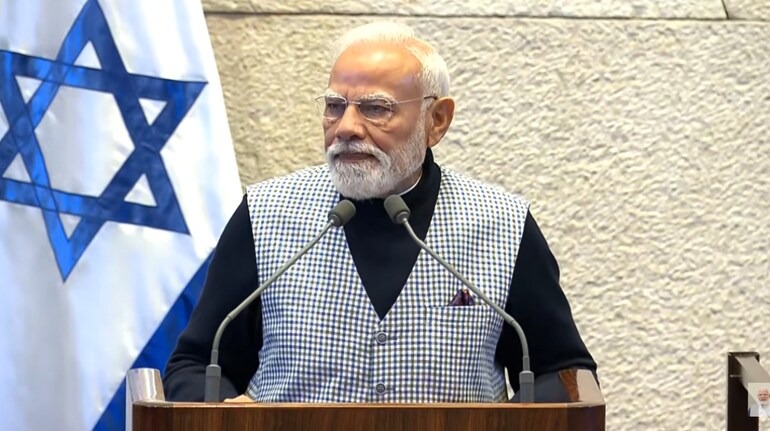

Addressing a special plenary session of Israel’s Parliament, the Knesset, Prime Minister Narendra Modi highlighted the expanding scope of India-Israel relations, underlining trade, defence, innovation, and cultural ties as key pillars of the partnership. He said the proposed Free Trade Agreement (FTA) between the two countries would open new avenues and fully realize the possibilities in bilateral commerce.
“That is why our teams are working hard to negotiate an ambitious Free Trade Agreement. It will unlock the vast untapped potential in our trade relationship,” the Prime Minister said, stressing that existing trade levels do not yet reflect the true scale of opportunity.
Modi pointed out that India has been actively strengthening economic ties globally, citing agreements with regions and nations across both western and eastern geographies. “We are committed to expanding trade, strengthening investment flows, and promoting joint infrastructure development. The Bilateral Investment Treaty signed last year will provide confidence and predictability to our businesses,” he stated.
The Prime Minister also underscored India’s economic trajectory, noting that the country has remained the fastest-growing major economy in recent years and is on track to rank among the world’s top three economies. In this context, he described Israel as a leader in innovation and technology, saying the two nations complement each other naturally in building a future-oriented collaboration.
Speaking about strategic cooperation, Modi emphasized the importance of defence ties. “In today's uncertain world, a strong defence partnership between trusted partners like India and Israel is of vital importance,” he said, referring to the Memorandum of Understanding on defence cooperation signed in November last year. He added that security collaboration continues to be a cornerstone of bilateral relations.
Beyond defence, he noted that both countries are working together through broader frameworks, including the India-Middle East-Europe Economic Corridor and the I2U2 grouping involving India, Israel, the UAE, and the United States.
Turning to innovation and technology, the Prime Minister recalled past initiatives and highlighted growing collaboration in emerging sectors. “I recall that in 2018, Prime Minister Netanyahu and I inaugurated the iCreate Technology Business Incubator in India. Since then, it has supported nearly 900 such start-ups,” he said.
He further pointed to India’s recent hosting of a global AI summit. “Our aspirational spirit aligns naturally with Israel's innovation ecosystem. I see a lot of synergies in areas such as quantum technologies, semiconductors, and artificial intelligence. We are also working with Israel on creating cross-border financial linkages using our Digital Public Infrastructure,” he said.
Agriculture and water management were cited as examples of successful cooperation. Modi said Israeli expertise has already had a significant impact in India. “Israeli expertise in precision irrigation and water management has already transformed agricultural practices in India. Together, we have established 43 Centres of Excellence across India that have provided training to more than half a million farmers,” he noted, adding, “We should now set an ambitious goal of expanding to 100 Centres to benefit millions of farmers and fishermen.”
The Prime Minister also spoke about people-to-people ties, calling them the core of the relationship. He noted the growing popularity of Indian cultural practices in Israel. “When I first visited Israel in 2006, there were a handful of Yoga centres in Israel. Today, Yoga seems to be practiced in almost every neighbourhood! I am told that interest in Ayurveda is also growing in Israel,” he said, inviting more Israeli youth to visit India.
He also acknowledged the role of Indian workers in Israel, particularly during difficult times. “They have displayed remarkable courage and dedication in times of crisis, including on October 7. We are proud of them,” Modi said, adding that their contribution reflects strong human connections between the two countries. “We will continue to facilitate the movement of workers and professionals across sectors that benefit both of our nations,” he added.
Drawing from philosophical traditions, Modi highlighted similarities between Indian and Jewish values. “In Israel, the principle of Tikkun Olam speaks of healing the world. In India, Vasudhaiva Kutumbakam affirms that the world is one family,” he said, explaining that both ideas promote responsibility beyond borders. He further noted parallels in ethical systems, stating, “Judaism emphasises Halakha, guiding everyday conduct through law and practice. Hindu philosophy speaks of Dharma, the moral order that shapes duty and right action.”
Cultural connections were also reflected in shared festive traditions. “You celebrate Hanukkah with the warm glow of candles. Around the same time, we celebrate Diwali, the festival of lights, with the gentle radiance of lamps. Soon, India will celebrate the festival of Holi, filled with happiness and colour. And around the same time, Israel will also celebrate Purim with enthusiasm and joy,” he said.
Highlighting historical connections, Modi recalled that Indian leaders after independence felt a strong affinity with Israel. He said parliamentary discussions in India during the 1950s reflected admiration for Israel’s agricultural achievements, particularly in desert regions. He also noted that movements such as the Kibbutz influenced Indian thinkers like Acharya Vinoba Bhave and Loknayak Jayaprakash Narayan.
Referring to developments in agriculture within India, he said, “First in my home state Gujarat, and now across India, I have seen the approach of 'Per Drop, More Crop' work wonders in agriculture.”
The Prime Minister also mentioned institutional engagement, noting the formation of a Parliamentary Friendship Group for Israel in India and extending an invitation to Israeli lawmakers to visit.
He recalled that bilateral ties were elevated to a “Strategic Partnership” during his 2017 visit to Israel, adding that cooperation has since broadened significantly. “And we are committed to further consolidate this relationship across many sectors,” he said.
PM Modi said that shared democratic values and historical experiences form the foundation of the partnership. “Our strong partnership not only serves national interests but also contributes to global stability and prosperity. Let us ensure that the friendship between India and Israel remains a source of strength in an uncertain world,” he said.
(With inputs from ANI)Discover the latest Business News, Sensex, and Nifty updates. Obtain Personal Finance insights, tax queries, and expert opinions on Moneycontrol or download the Moneycontrol App to stay updated!
Find the best of Al News in one place, specially curated for you every weekend.
Stay on top of the latest tech trends and biggest startup news.





