






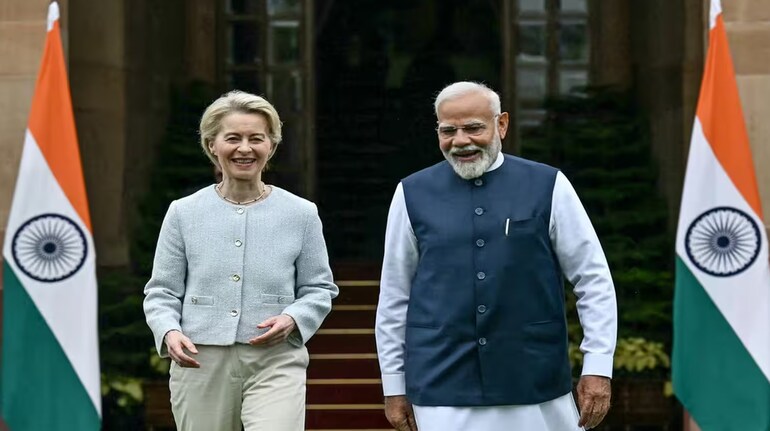
India and the European Union (EU) are expected to announce a long-awaited free trade agreement by Tuesday (January 27), a deal already being described as the “mother of all deals”. European Commission President Ursula von der Leyen and European Council President Antonio Costa were the chief guests at India’s Republic Day Parade 2026, underlining the political weight attached to the agreement.
Ahead of the expected announcement, von der Leyen said that a “successful India” makes the world more “stable, prosperous, and secure”. The agreement is expected to significantly deepen economic ties between India and the 27-nation EU bloc. Prime Minister Narendra Modi is set to host von der Leyen and Costa for the India–EU summit, where the deal is likely to be formally unveiled.
As momentum builds around the pact, attention has also turned to the European Commission — the EU institution that negotiates trade agreements on behalf of the bloc.
What is the European Commission?
The European Commission is the European Union’s main executive body and plays a central role in shaping the bloc’s policies. Its primary responsibilities include proposing new laws, overseeing their implementation and managing the EU’s budget.
According to its official website, the Brussels-based Commission also “ensures that EU policies and laws are correctly applied across Member States, negotiates international agreements on behalf of the EU, and allocates funding.” This makes it the driving force behind legislation and external trade arrangements, including free trade agreements such as the one nearing completion with India.
The Commission operates alongside six other major EU institutions: the European Parliament, the Council of the EU, the European Council, the Court of Justice of the EU, the European Central Bank and the European Court of Auditors.
Exclusive power to propose EU laws
One of the Commission’s most significant powers is its exclusive authority to propose legislation. No other EU institution can formally introduce laws. Once the Commission drafts a proposal, it must be approved by both the European Parliament and a council composed of ministers from all 27 member states.
If adopted, the legislation becomes binding across the EU. The Commission then monitors how the law is implemented at the national level and can initiate legal proceedings against member states that fail to comply.
The Commission also prepares the EU’s annual budget, which requires approval from the Parliament and the Council, and supervises how those funds are spent. This gives it substantial influence over economic priorities across the bloc.
Global representation and trade negotiations
The European Commission represents the EU in many international forums and has sole authority to negotiate trade agreements on behalf of member states. This means individual EU countries do not sign trade deals independently; instead, the Commission negotiates as a single bloc, giving the EU greater leverage in talks with large economies such as India.
The Commission is politically independent of national governments, a structure designed to ensure that EU-wide interests prevail over domestic political pressures.
In recent years, it has also taken on a stronger regulatory role in the digital economy. The Commission has stepped up action against major technology companies, launching investigations into Elon Musk’s Grok chatbot on X over sexual deepfake images of women and children. It also opened a formal antitrust probe into Google’s use of online content to train artificial intelligence models and generate search result overviews.
Who runs the European Commission?
The European Commission is made up of 27 Commissioners, one from each EU member state. Each Commissioner is assigned a specific policy portfolio, similar to ministers in a national government. Together, they form the College of Commissioners.
The Commission is led by a president, currently Ursula von der Leyen. As president, she organises the Commission’s work, allocates portfolios and sets the policy agenda. She also represents the Commission at European Council meetings, G7 and G20 summits, summits with non-EU countries, and key debates in the European Parliament and the Council.
After elections to the European Parliament, the European Council proposes a candidate for Commission president, usually from the political group with the largest presence in Parliament. The nominee must then secure approval by an absolute majority in Parliament before being formally appointed. The president-elect appoints most of the Commissioners, while the High Representative for Foreign Affairs and Security Policy is appointed separately with the president’s approval.
The sovereignty question
The European Union’s structure raises ongoing questions about national sovereignty. Sovereignty allows a country to govern itself without external interference, but participation in multilateral organisations inevitably involves shared decision-making.
As the Council on Foreign Relations has noted, countries involved in such bodies agree to “forfeit their right to set their own rules and instead delegate specific powers to those bodies in return for the benefits of international cooperation.”
In the EU’s case, member states benefit from a single market that allows the free movement of goods, services, capital and labour across borders. The bloc also operates a visa-free Schengen zone and negotiates trade deals collectively.
However, while trade, monetary policy and fishing are largely handled at the EU level, areas such as defence, healthcare, education and tourism remain primarily under national control, with the EU playing a supporting role.
Criticism and political tensions
Despite these arrangements, the EU has faced criticism over what some perceive as excessive interference by Brussels. The European Commission, headquartered in Brussels, is often portrayed by critics as a “nanny state” that undermines national sovereignty.
These concerns contributed to the United Kingdom’s exit from the EU and continue to fuel Euroscepticism across Europe, particularly with the rise of far-right political movements. As the EU moves forward with ambitious trade deals such as the one with India, questions about sovereignty and integration remain central to the bloc’s future direction.
Discover the latest Business News, Sensex, and Nifty updates. Obtain Personal Finance insights, tax queries, and expert opinions on Moneycontrol or download the Moneycontrol App to stay updated!
Find the best of Al News in one place, specially curated for you every weekend.
Stay on top of the latest tech trends and biggest startup news.




