






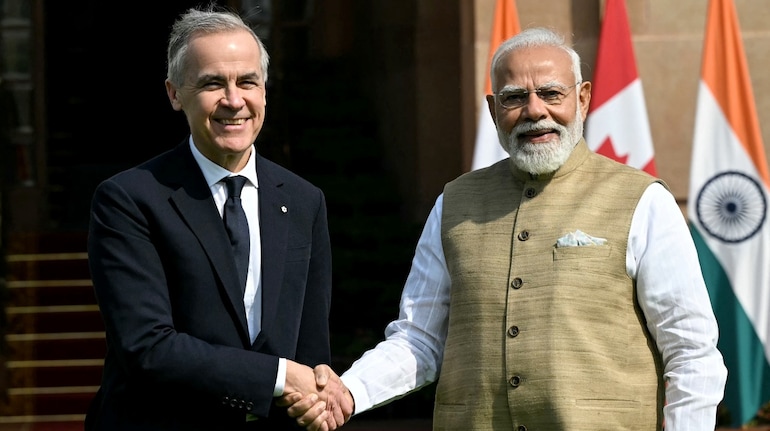

India and Canada have signed a major uranium supply agreement during Canadian Prime Minister Mark Carney’s visit to New Delhi, marking a significant step in both countries’ energy cooperation and diplomatic relations. The agreement comes as India expands its nuclear power ambitions and Canada seeks to diversify trade partnerships beyond the United States.
The pact was signed during Carney’s multi-nation tour that includes India, Japan and Australia. The visit also reflects Ottawa’s broader strategy to strengthen ties in the Indo-Pacific at a time when global geopolitics and trade dynamics are shifting under US President Donald Trump’s second term.
What the uranium agreement includes
The uranium supply pact is valued at about $2.6 billion, or roughly Rs 23,834 crore, according to Business Standard. The agreement will allow Canada to supply uranium to India to support its civilian nuclear power programme.
The uranium will be supplied by Cameco, a major Canadian uranium company based in Saskatchewan, according to The Independent. Canada is the world’s second largest uranium producer and accounts for roughly 13 to 15 percent of global output. Cameco is also among the world’s largest publicly traded uranium companies.
The deal is expected to provide a stable supply of uranium for India’s Pressurised Heavy Water Reactors, which form the backbone of the country’s nuclear energy infrastructure.
India’s demand for uranium significantly exceeds its domestic production. The country currently produces about 600 tonnes of uranium each year but requires nearly 1,800 tonnes annually to support its nuclear programme.
Imports therefore play a crucial role. According to Moneycontrol, India imported about 2,000.299 metric tonnes of uranium from Canada and Kazakhstan in 2021. It did not import uranium in 2022 and 2023. More recently, India imported 350 metric tonnes from Uzbekistan in 2024 and another 250 metric tonnes in 2025.
Why nuclear fuel matters for India
The uranium agreement is closely tied to India’s long term energy strategy. The country has set a target of achieving 100 gigawatts of nuclear power capacity by 2047.
At present, India’s nuclear power capacity stands at about 8.78 gigawatts. According to Business Standard, this could increase to roughly 22.38 gigawatts by 2031–32 as new 700 MW and 1,000 MW reactors are commissioned.
India’s rapidly growing economy is placing increasing pressure on its energy resources. The country is already the third largest energy consumer in the world. As reported by The Independent, India consumes about 5.5 million barrels of crude oil each day and imports around 80 percent of its oil requirements.
Electricity demand is also projected to rise sharply. Estimates suggest India’s power demand could grow by about 66 percent by 2030 compared with 2024 levels.
Expanding nuclear power is therefore seen as an important strategy for India. Nuclear energy produces minimal carbon emissions and can provide stable baseload electricity, helping India reduce reliance on coal while pursuing its net zero target by 2070.
Although India has around 76,000 tonnes of uranium reserves, government data suggests these deposits could only support about 10,000 MW of nuclear power generation for around 30 years. This makes long term uranium imports essential for sustaining expansion.
The Canada agreement also signals that India is broadening its nuclear partnerships beyond traditional suppliers such as Russia and the United States.
India had signed a landmark civil nuclear deal with the United States in 2008 under then Prime Minister Manmohan Singh and US President Barack Obama. That agreement opened the door for US companies such as Westinghouse Electric Company to collaborate with Nuclear Power Corporation of India Ltd to build six AP1000 reactors in India. However, regulatory and financial challenges delayed those projects.
Canada sees economic opportunity
For Canada, the deal offers an opportunity to strengthen trade ties with one of the world’s fastest growing major economies while reducing reliance on the US market.
Canada’s Energy and Natural Resources Minister Tim Hodgson highlighted the advantages of Canadian uranium resources. Speaking to Forbes before the visit, Hodgson said, “Canada has the highest quality, purest concentration of uranium of any country in the world. We have historically supplied uranium to India.”
He added that expanding supply could benefit both countries. “We supply uranium for peaceful purposes to countries all over the world. There’s a tremendous opportunity for us to increase our supplies. That gives India an additional source of low-cost, high-quality uranium. That gives us another buyer. That makes India more secure, more resilient. That makes us more secure, more resilient. I’d say that’s a win-win.”
Trade ambitions and a diplomatic reset
The uranium agreement is also part of a broader push to strengthen economic ties. India and Canada have agreed to accelerate negotiations on a Comprehensive Economic Partnership Agreement.
Prime Minister Narendra Modi said both countries aim to increase bilateral trade to $50 billion by 2030.
Carney described the visit as a turning point in bilateral relations. According to The Independent, he said, “This visit marks the end of a challenging period and, more importantly, the beginning of a new, more ambitious partnership between two confident and complementary nations.”
He added that negotiations on a trade agreement were moving forward. “We are advancing towards a Canada-India Economic Partnership Agreement with an aim to conclude it by the end of this year.” Carney also described India as a “natural partner”.
Modi echoed the sentiment and called the development a key milestone in relations between the two countries.
“Since our first meeting, our relationship has been infused with new energy, mutual trust, and positivity. I credit my friend, Prime Minister Carney, for the growing momentum in every area of cooperation,” Modi said.
Moving past tensions
The renewed cooperation also comes after a difficult period in India–Canada relations.
Ties deteriorated during the tenure of former Canadian Prime Minister Justin Trudeau, who accused Indian intelligence agencies of involvement in the killing of Khalistani extremist Hardeep Singh Nijjar in British Columbia. India strongly rejected the allegations, describing them as “absurd” and “politically motivated”.
The diplomatic dispute led both countries to expel diplomats and stalled trade negotiations.
The new uranium agreement and Carney’s visit are being seen as a step toward rebuilding trust and restarting cooperation across strategic sectors.
For India, the deal supports its long term energy goals. For Canada, it opens the door to deeper economic engagement with a rapidly growing global power.
Discover the latest Business News, Sensex, and Nifty updates. Obtain Personal Finance insights, tax queries, and expert opinions on Moneycontrol or download the Moneycontrol App to stay updated!
Find the best of Al News in one place, specially curated for you every weekend.
Stay on top of the latest tech trends and biggest startup news.





