






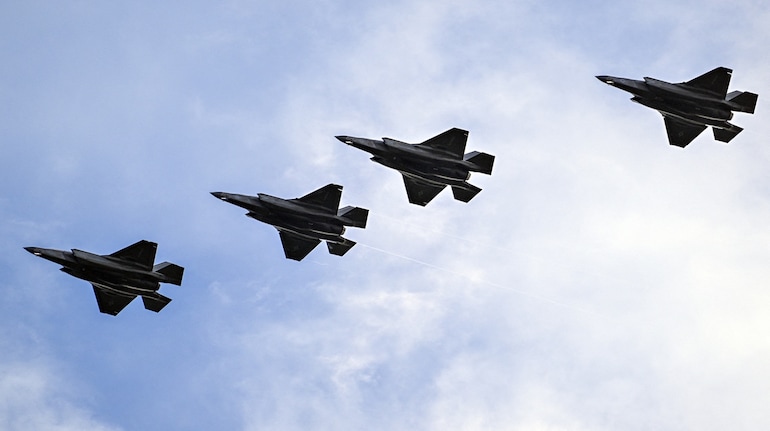

As the United States deploys a large concentration of combat aircraft across the Middle East amid its ongoing military operations against Iran, a separate strategic debate has resurfaced in India: why New Delhi has consistently avoided buying American fighter jets despite expanding defence ties with Washington.
A detailed analysis by NDTV noted that several of the aircraft currently operating over Iran, including the F/A-18 Super Hornet, F-15E Strike Eagle, F-16 Fighting Falcon, F-22 Raptor, F-35 Lightning II and B-2 stealth bombers, have at various points over the past two decades been offered to India.
According to the report, India declined each of those fighter aircraft proposals even as it purchased a range of other US military platforms.
The US military deployment in the region currently includes carrier-borne F/A-18 Super Hornets, F-15E Strike Eagles operating from Gulf bases, F-16s conducting sustained air defence patrols, F-22 stealth fighters deployed from Israel, B-2 stealth bombers flying long-range strike missions and F-35 stealth fighters operating against layered air defence systems, NDTV reported.
The concentration of platforms represents one of the largest assemblies of US combat airpower in recent decades.
India’s expanding defence purchases from the US, except fighters
Despite declining American fighter jets, India has significantly expanded defence procurement from the United States over the past decade.
India has purchased several major US platforms including:
C-17 Globemaster strategic transport aircraft
C-130J Super Hercules tactical transport aircraft
P-8I Poseidon maritime surveillance aircraft
AH-64 Apache attack helicopters
CH-47 Chinook heavy-lift helicopters
India is also expected to induct MQ-9B Predator drones for surveillance and strike roles.
These acquisitions represent billions of dollars in defence purchases, making the United States one of India’s largest arms suppliers in recent years.
However, fighter aircraft remain the one major category where India has consistently avoided US platforms.
Historical roots of India’s fighter procurement strategy
According to NDTV, India’s reluctance to depend on American fighter aircraft is shaped by Cold War history.
During that period, the United States supplied Pakistan, India’s primary regional adversary, with several frontline aircraft including the F-86 Sabre, F-104 Starfighter, F-86D, A-37 and later the F-16 Fighting Falcon.
Pakistan operated these aircraft in conflicts with India.
As a result, India diversified its fighter procurement away from US systems and built its air force around aircraft from other sources.
Over the decades, the Indian Air Force inducted platforms such as the MiG-21, MiG-23, MiG-29, and the Su-30MKI, along with Western aircraft including the Jaguar, Mirage 2000, and Hawker Hunter, NDTV reported.
The Su-30MKI remains the backbone of India’s fighter fleet today.
The 1998 nuclear tests and sanctions
Another major factor shaping India’s strategic thinking was the US response to India’s nuclear tests in May 1998.
Following the tests, the Clinton administration imposed sanctions and restricted technology transfers to India.
The episode reinforced concerns within India’s strategic establishment about dependence on foreign suppliers for critical defence capabilities.
Although relations between New Delhi and Washington improved significantly in the following decades, the legacy of that period has remained part of India’s defence planning considerations.
Concerns over operational dependence
NDTV reported that Indian defence planners have long viewed fighter aircraft differently from other military platforms.
Unlike transport aircraft or helicopters, fighter jets form the core of a country’s air combat capability.
Acquiring such platforms from a foreign supplier can create dependencies in areas such as spare parts supply, software updates and export approvals.
India has also observed cases where access to spares or upgrades for US-origin equipment became subject to political tensions.
NDTV cited past episodes where Pakistan’s F-16 fleet faced restrictions on spare parts and where Turkey encountered pressure related to defence cooperation with the United States.
US fighter offers to India over the years
The United States has repeatedly pitched fighter aircraft to India in major defence tenders.
During India’s multi-role fighter aircraft competition in the 2000s, the US offered the F-16 and F/A-18 Super Hornet.
In later years, the US proposed an advanced variant of the F-16 branded as the F-21 specifically for India.
More recently, Washington also offered the F-15EX Eagle II, an upgraded version of the F-15 air superiority fighter.
India did not pursue these proposals further.
Rafale selection and naval fighter evaluation
India ultimately selected the Dassault Rafale from France for its medium multirole fighter requirement.
The Indian Navy also evaluated the F/A-18 Super Hornet for aircraft carrier operations.
However, the Rafale acquisition by the Indian Air Force influenced the broader fighter procurement trajectory.
Balakot air combat episode
The report also referenced the aerial engagement that followed India’s airstrike on a terrorist camp in Balakot, Pakistan, in February 2019.
During the subsequent air combat, Pakistan scrambled F-16 fighters, while India deployed aircraft including the MiG-21 Bison.
The incident became part of the broader strategic discussion surrounding fighter procurement.
Emerging stealth fighter considerations
The United States has also signalled openness to offering the F-35 stealth fighter to India.
However, India has not formally engaged with the proposal.
Recent reports have suggested that the Indian Air Force has been evaluating the Russian Su-57 stealth fighter as a potential option, although no final decision has been announced.
A long-standing procurement pattern
India’s defence purchases from the United States have grown steadily over the past decade, particularly in transport aircraft, helicopters and maritime surveillance platforms.
However, successive Indian governments have maintained a consistent approach toward fighter aircraft procurement.
India has sourced fighters primarily from Russia, France and domestic programmes, including the Tejas light combat aircraft.
Discover the latest Business News, Sensex, and Nifty updates. Obtain Personal Finance insights, tax queries, and expert opinions on Moneycontrol or download the Moneycontrol App to stay updated!
Find the best of Al News in one place, specially curated for you every weekend.
Stay on top of the latest tech trends and biggest startup news.





