






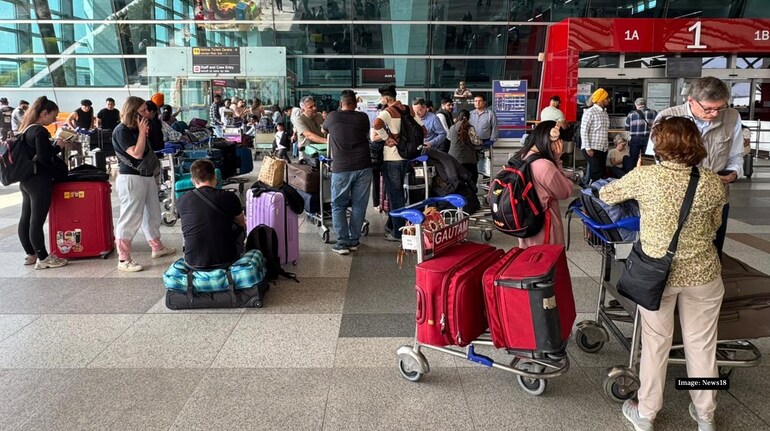

The unfolding conflict involving the US, Israel and Iran has triggered one of the most widespread disruptions to global aviation in recent years, with Indian airlines, passengers and authorities grappling with cascading effects. Here’s a detailed look at what has happened, why it matters, and how India is responding.
Airspace closures trigger massive disruption
A large portion of West Asia’s skies has been shut following military escalation, forcing airlines worldwide to suspend, reroute or cancel flights. Countries including Iran, Iraq, Israel, Syria, Kuwait, Qatar and the United Arab Emirates announced full or partial airspace closures.
The impact has been immediate and severe. Within just three days starting February 28, Indian airlines cancelled 1,117 international flights. Globally, thousands more were affected.
According to aviation data, at least 1,560 inbound flights to the Middle East were cancelled on a single day, while another day saw 2,000 cancellations -- affecting nearly 900,000 seats.
Air corridors that once handled dense traffic -- particularly over Iraq’s Euphrates Valley -- have fallen silent. Airlines connecting Europe and Asia are now taking longer, more complex routes via Egypt, Saudi Arabia and Oman, or detouring north through the Armenia–Azerbaijan corridor.
Air India suspends Middle East operations
Air India has extended its suspension of all flights to and from the Middle East until the end of March 3.
“In view of the continued closure of multiple airspaces over the Middle East, Air India has extended the temporary suspension of all its flights to and from the region up until 2359 Hrs (IST) of 3 March 2026,” the airline said.
At the same time, the carrier has resumed operations to destinations in the United States, Canada, Europe and the United Kingdom by avoiding conflict zones.
These flights are now taking longer routes through safer airspaces, including Oman, Saudi Arabia and Egypt.
Air India Express is preparing to cautiously restart services, beginning with flights to and from Muscat on March 3 -- making it the first Indian airline to resume operations in the region after the crisis began.
IndiGo plans relief flights
With thousands of Indians stranded, IndiGo has stepped in with special evacuation efforts.
“IndiGo has planned 10 special relief operations from Jeddah to India on 3 March to facilitate the return of stranded passengers, subject to required approvals and prevailing airspace conditions,” the civil aviation ministry said.
These flights are expected to connect Jeddah with cities such as Hyderabad, Mumbai, Delhi and Ahmedabad.
The airline is coordinating with Indian diplomatic missions to manage passenger movement amid uncertain and changing airspace conditions.
Government steps up evacuation preparedness
The Indian government has activated multiple channels to assist stranded citizens across the Gulf.
The Cabinet Committee on Security, chaired by Prime Minister Narendra Modi, reviewed the situation and emphasized the safety of Indian nationals in the region.
Authorities are in constant touch with Indian missions abroad, and preparations are underway for evacuation if required.
Union Minister Pralhad Joshi underlined the government’s approach, saying, “Whenever Kannadigas and other Indians face distress anywhere in the world, the Central Government has ensured their safe return.”
Indians stranded across Gulf hubs
The disruption has left a large number of Indians stuck in key transit and work hubs such as Dubai, Abu Dhabi and Jeddah.
From Maharashtra alone, hundreds are affected. Among them are tourists, professionals and even public representatives. A group of students and professors from Pune, who had travelled for an academic programme, remain stranded.
In Karnataka, over 100 people are reported stuck, prompting the state to activate emergency operations centres round the clock.
Andhra Pradesh authorities are working through dedicated NRI support systems, offering temporary accommodation and advising stranded citizens to reroute via Muscat for return flights.
Telangana and Punjab have set up control rooms and helplines, while Uttar Pradesh has reported students stranded in Iran with limited communication.
Airports and aviation infrastructure hit
The aviation crisis has been worsened by direct strikes affecting key infrastructure.
Dubai International Airport, Kuwait’s main airport and a British military airbase in Cyprus were among the locations hit during retaliatory attacks.
Although Dubai airports have resumed limited operations, several international carriers remain cautious. Air France, for instance, has extended its suspension of flights to multiple regional airports until March 5.
The situation remains volatile, with operations dependent on rapidly changing security conditions.
Safety concerns revive past aviation tragedies
The crisis has renewed fears about risks to civilian aircraft in conflict zones.
The International Air Transport Association (IATA) has urged restraint, stating, “It is critical that states respect their obligation to keep civilians and civil aviation free from harm.”
The situation brings back memories of past disasters, including the downing of Malaysia Airlines flight MH17 in 2014 and a Ukrainian passenger jet shot down in 2020.
Industry experts warn that the growing number of no-fly zones worldwide is making aviation planning increasingly complex.
“We have never been in such a difficult situation,” a senior pilots’ representative said, noting that even during the Cold War, airspace restrictions were far less extensive.
Ripple effects beyond the Middle East
The fallout has extended beyond the immediate conflict zone.
In Cyprus, a drone strike led to flight cancellations and evacuation at Paphos Airport. European carriers have also adjusted schedules due to safety concerns.
The Middle East plays a crucial role in global aviation, acting as a hub connecting Europe, Asia and the Americas through major transit airports like Dubai and Doha.
Airlines based in the region account for nearly a tenth of global air traffic, making any disruption particularly significant for worldwide connectivity.
Rising uncertainty for airlines
The aviation sector, already strained by geopolitical tensions such as the Russia-Ukraine war, is now facing fresh uncertainty.
With multiple no-fly zones across regions including West Asia, Eastern Europe and parts of Asia, airlines are dealing with longer routes, higher fuel consumption and scheduling challenges.
IATA had projected strong growth this year, with 5.2 billion passengers expected globally. However, the ongoing conflict has cast doubt over traffic levels and operational costs.
Fuel prices, route efficiency and passenger demand are all at risk of being impacted if the situation persists.
What lies ahead
For now, airlines are navigating a constantly shifting landscape of restricted airspaces and safety advisories.
Indian carriers are balancing caution with the need to restore connectivity, while the government focuses on assisting stranded citizens and preparing contingency plans.
Much will depend on how quickly tensions de-escalate and airspaces reopen.
Until then, global aviation -- and thousands of Indian passengers -- remain caught in the turbulence of a geopolitical crisis.
(With inputs from AFP)Discover the latest Business News, Sensex, and Nifty updates. Obtain Personal Finance insights, tax queries, and expert opinions on Moneycontrol or download the Moneycontrol App to stay updated!
Find the best of Al News in one place, specially curated for you every weekend.
Stay on top of the latest tech trends and biggest startup news.





