






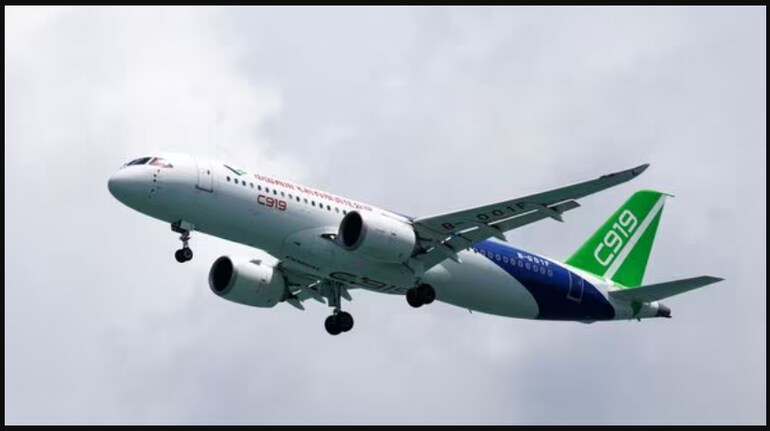

China’s state-owned aircraft manufacturer COMAC (Commercial Aircraft Corporation of China) is accelerating its global expansion, positioning itself as a long-term challenger to aviation giants Boeing and Airbus, with a sharp focus on the fast-growing Asia-Pacific market.
The company is showcasing its flagship C919 passenger jet at the Singapore Airshow, marking a key milestone in its international outreach. The narrow-body aircraft, designed to compete with the Boeing 737 MAX and Airbus A320neo, first flew outside China nearly two years ago and is now being actively pitched to airlines beyond the domestic market. COMAC has said it is “setting sights on the Southeast Asian aviation market”.
The timing of COMAC’s push is significant, as airlines across Asia-Pacific grapple with prolonged delivery delays from Boeing and Airbus, compounded by engine shortages and supply chain disruptions. Trade tensions and tariff uncertainty have further complicated fleet expansion plans, increasing demand for alternative aircraft suppliers.
“I think in time, Comac will be a global competitor... but it's going to take them time,” Willie Walsh, Director General of the International Air Transport Association (IATA), told the BBC. “I think 10 years, 15 years from now, we'll be talking about Boeing, Airbus and Comac.”
COMAC currently has two aircraft in service, the C919 and the smaller ARJ21, now rebranded as the C909. The C919 seats 158–192 passengers with a range of up to 5,555 kilometres, while the C909 is designed for short and narrow runways, seating 78–97 passengers. Both aircraft are positioned to serve regional and short-haul routes, particularly in emerging markets.
The company says it has delivered over 200 aircraft operating on nearly 800 routes and carrying more than 36 million passengers. Around a quarter of these jets are already flying in Laos, Indonesia and Vietnam. Brunei’s GallopAir has placed a major order, while Cambodia is planning to acquire nearly 20 aircraft.
“There is certainly a need for another planemaker in Asia Pacific,” analysts say, as fleet shortages push up costs and delay growth plans. “The problem with this industry is that the supply chain is an oligopoly and sometimes even a duopoly,” said Subhas Menon, Director General of the Association for Asia Pacific Airlines (AAPA), welcoming COMAC’s entry.
Despite growing interest, challenges remain. The C919 trails the Airbus A320neo in range, and COMAC is still awaiting European certification — a process that could stretch until 2028 or even 2031. Regulators are currently conducting test flights, while issues related to maintenance infrastructure, pilot training, and integration of Chinese and Western systems continue to pose hurdles.
At the same time, COMAC is ramping up production. China’s three largest airlines have each ordered 100 C919 jets, and the manufacturer is expected to deliver at least 28 aircraft this year, up from 15 last year.
While Boeing and Airbus continue to dominate the skies, industry watchers say COMAC’s growing presence signals a gradual shift in the global aviation landscape — especially in Asia-Pacific, where demand for aircraft continues to surge.
Discover the latest Business News, Sensex, and Nifty updates. Obtain Personal Finance insights, tax queries, and expert opinions on Moneycontrol or download the Moneycontrol App to stay updated!
Find the best of Al News in one place, specially curated for you every weekend.
Stay on top of the latest tech trends and biggest startup news.





