







Pakistan’s military leadership projected itself onto the global stage through 2025 and early 2026 with an unusually intense burst of overseas engagements. Framed as defence diplomacy, these visits came at a time when Pakistan was grappling with deep economic distress, political instability, and a visibly weakened civilian foreign policy apparatus.
With Islamabad dependent on bailouts and struggling to meet basic fiscal obligations, Rawalpindi stepped in to directly court foreign partners, blending military outreach with arms sales, training offers, and strategic bargaining. Critics say this was less about partnership-building and more about monetising military leverage to compensate for economic failure.
As reported by CNN-News18 and Moneycontrol, Pakistan’s armed forces increasingly positioned defence exports as an economic tool, offering fighter jets, drones, and training packages as substitutes for hard cash and, in some cases, even debt relief.
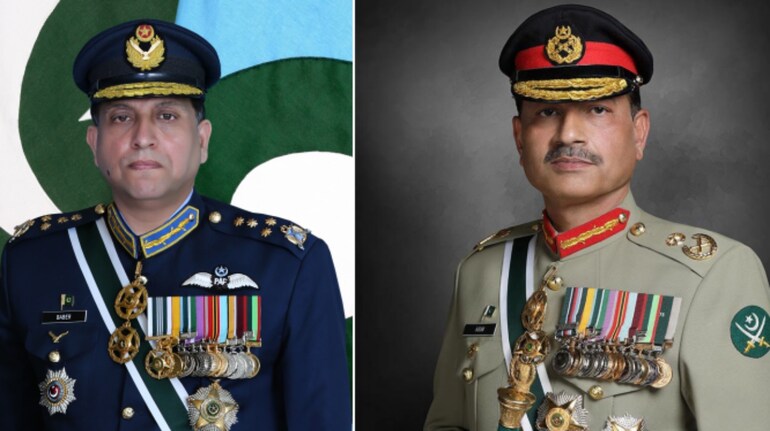
At the centre of this push was Zaheer Ahmed Baber Sidhu, Chief of the Air Staff of the Pakistan Air Force, whose travel calendar read more like that of a foreign minister than a service chief.
United States: Resetting a strained military channel
In July 2025, Sidhu travelled to the United States, marking the first visit by a serving PAF chief in over a decade. He met senior defence and political figures, including US Air Force Chief of Staff General David W Allvin and officials at the Pentagon and State Department. The agenda focused on interoperability, joint training, counterterrorism, and regional security. While Pakistan projected the visit as a breakthrough, analysts noted Washington’s engagement was cautious and transactional, driven more by regional contingency planning than renewed trust in Pakistan.
China: Deepening a dependent alignment
In April 2025, Sidhu was in China, where he met Defence Minister Admiral Dong Jun and PLA Air Force Commander General Chang Dingqiu. Talks centred on joint exercises, training, and strategic coordination. The visit underlined Pakistan’s continued reliance on Beijing as its primary defence patron, especially as Chinese co-developed platforms like the JF-17 became central to Islamabad’s export pitch.
Romania: Expanding reach without leverage
Pakistan’s outreach extended to Eastern Europe with a visit to Romania in October 2025. Discussions with Romanian Air Force leadership focused on training exchanges and exercises. Observers saw the engagement as symbolic, reflecting Pakistan’s desire to appear globally engaged even where its strategic leverage remains limited.
Gulf platforms and arms marketing
At the Dubai Airshow in November 2025, Sidhu met senior officials from the United Arab Emirates and other partners. Beyond routine military engagement, Pakistan used the platform to actively market defence exports, especially the JF-17 Thunder. A memorandum of understanding with a friendly country was signed, reinforcing the pattern of using defence exhibitions as sales pitches rather than confidence-building forums.
Saudi Arabia and Iraq: Cash-strapped outreach
In January 2026, Sidhu visited Saudi Arabia, holding talks on joint training and interoperability. This followed reports that Islamabad was discussing converting Saudi financial assistance into defence supplies, a model highlighted by Moneycontrol as part of Pakistan’s emerging arms-for-cash strategy.
Days later, Sidhu travelled to Iraq, where Iraqi officials expressed interest in JF-17 jets and Super Mushshak trainers. The pitch again reflected Pakistan’s attempt to turn military hardware into an economic lifeline.
Indonesia: Arms-for-cash diplomacy in advanced talks
Replacing earlier speculation, the latest and most consequential outreach involved Indonesia. As reported by Reuters and analysed by Moneycontrol, Pakistan is in advanced-stage talks with Jakarta for a deal involving more than 40 JF-17 fighter jets and armed drones, including the Shahpar. Indonesia’s Defence Minister met Sidhu in Islamabad, with sources saying negotiations were significantly progressed despite official caution. For Pakistan, the deal is emblematic of a troubling shift, pushing arms exports as a substitute for economic reform while relying on competitively priced but technologically contested platforms.
A military-first foreign policy
Taken together, these engagements reveal a pattern. Pakistan’s military leadership has increasingly substituted defence diplomacy for civilian-led foreign policy, using arms sales and training offers to mask economic fragility. As Moneycontrol noted, offering warplanes instead of repayments underscores how deeply distorted Pakistan’s economic model has become. Rather than stabilising the country’s global standing, this approach risks reinforcing Pakistan’s image as a state that exports insecurity while struggling to govern itself at home.
Discover the latest Business News, Sensex, and Nifty updates. Obtain Personal Finance insights, tax queries, and expert opinions on Moneycontrol or download the Moneycontrol App to stay updated!
Find the best of Al News in one place, specially curated for you every weekend.
Stay on top of the latest tech trends and biggest startup news.





