






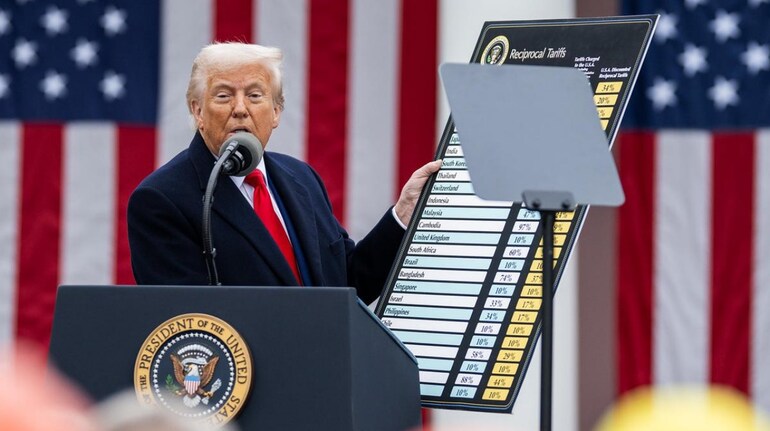

US President Donald Trump has moved quickly to impose temporary 15 percent tariffs after the US Supreme Court struck down his administration’s earlier tariff regime. But legal experts and economists now say the new tariffs -- which come into effect today -- may be just as vulnerable in court.
The Trump administration has invoked Section 122 of the Trade Act of 1974, a rarely cited provision that allows temporary tariffs to address serious balance of payments problems. Critics argue that the United States does not meet the legal or economic conditions required under that law.
The tariffs began taking effect at midnight on Tuesday, shortly after collections under the International Emergency Economic Powers Act were halted following the Supreme Court ruling.
What changed after the Supreme Court ruling
Trump’s earlier tariffs were imposed using the International Emergency Economic Powers Act, or IEEPA. The Supreme Court rejected that approach, finding that the law could not be stretched to justify tariffs based on trade deficits.
In response, the White House turned to Section 122 of the Trade Act of 1974, a statute that has never been used before to impose tariffs.
Under Section 122, a president can levy duties of up to 15 percent for a maximum of 150 days, but only to address large and serious balance of payments deficits or fundamental international payments problems.
White House justification under Section 122
In its new tariff order, the Trump administration argued that the United States faces a serious balance of payments problem, pointing to:
The administration claimed these indicators justified emergency action under Section 122.
Economists say legal threshold is not met
Many economists strongly disagree with the White House assessment, saying the United States is not facing anything resembling a balance of payments crisis.
Former International Monetary Fund First Deputy Managing Director Gita Gopinath rejected the administration’s argument in comments to Reuters.
"We can all agree that the US is not facing a balance of payment crisis, which is when countries experience an exorbitant increase in international borrowing costs and lose access to financial markets," Gopinath told Reuters.
Gopinath also dismissed the claim that the negative US primary income balance proved a serious problem. She said the shift was largely due to increased foreign investment in US equities and risk assets that outperformed foreign markets over the past decade.
Trade deficit not a balance of payments crisis
Other experts echoed the same point. RSM chief economist Joe Brusuelas told Axios that current US economic conditions do not meet the standards required under Section 122.
"No matter how one looks at the current circumstances, the condition of the US economy, its balance of payments or its currency regime, none of these meets the standards outlined under Section 122," Axios quoted Brusuelas as saying.
Former US Treasury and IMF official Mark Sobel added that balance of payments crises usually affect countries with fixed exchange rates, not economies like the US with a floating currency.
Josh Lipsky, chair of international economics at the Atlantic Council, said a true balance of payments crisis occurs when a country cannot pay for imports or service foreign debt.
That situation, he noted, is fundamentally different from running a trade deficit.
Trump’s own lawyers once rejected Section 122
The legal vulnerability of the new tariffs is compounded by the Trump administration’s own earlier position.
In court filings defending the now struck-down IEEPA tariffs, the Justice Department explicitly dismissed Section 122 as an option. Government lawyers said the provision had no obvious application where the issue was a trade deficit rather than a balance of payments deficit.
That earlier stance is now being cited by critics as evidence that the administration is contradicting itself.
Why lawsuits could be hard to avoid
Neal Katyal, who argued before the Supreme Court on behalf of plaintiffs challenging the IEEPA tariffs, said Trump’s reversal makes the new tariffs easy to challenge in court.
Speaking to CNBC, Katyal said: "I'm not sure it will necessarily even need to get to the Supreme Court, but if the president adheres to this plan of using a statute that his own Justice Department has said he can't use, yeah, I think that's a pretty easy thing to litigate."
Sara Albrecht, chair of the Liberty Justice Center, which represents businesses that challenged the earlier tariffs, told Reuters the group was closely watching the new move. She said their immediate priority remained securing refunds for duties already paid.
Why courts may not rule in time
Even if lawsuits are filed, legal experts note that courts are unlikely to rule conclusively on the Section 122 tariffs within the 150-day window allowed under the statute.
That timeline gives the Trump administration breathing room to pursue alternative tariff strategies using more established laws such as Section 232 for national security concerns and Section 301 for unfair trade practices.
Still, economists and lawyers agree that unless Congress steps in, Trump’s new tariff strategy remains exposed to the same legal uncertainty that sank his earlier effort.
Discover the latest Business News, Sensex, and Nifty updates. Obtain Personal Finance insights, tax queries, and expert opinions on Moneycontrol or download the Moneycontrol App to stay updated!
Find the best of Al News in one place, specially curated for you every weekend.
Stay on top of the latest tech trends and biggest startup news.





