Tensions between India and Pakistan have reached a boiling point. As India launched of Operation Sindoor, that targeted 21 terror camps in Pakistan and Pakistan occupied Kashmir. Islamabad responded with a barrage of drone and missile attacks aimed at civilian and military targets across Jammu, Punjab and Rajasthan during the night of May 7 and into May 8.
India's advanced air defense systems intercepted strikes launched by Pakistan, which relied heavily on Chinese weaponry, including China-made drones, missiles, and air defense systems, highlighting Islamabad's growing military dependence on Beijing.
Ironically, while China positions itself as a rising military superpower, it has not engaged in a full-scale war for over four decades. Let's take a closer look at how dependent Pakistan is on China's artillery and did they actually turned out to be of any use or not.
HQ-9 air-defence system
In response to Operation Sindoor, Pakistan launched an attack on the night of May 7 to 8, prompting India to retaliate and destroy Pakistan’s air defense unit near Lahore. This unit was equipped with the Chinese-made HQ-9P missile system, a customized version of China’s HQ-9, which itself is modeled after Russia’s S-300.
The HQ-9P serves as a key component of Pakistan’s air defense, offering long-range surface-to-air capabilities with a base range of 120 kilometers, extendable up to 300 kilometers in advanced versions. According to SIPRI data, Pakistan acquired multiple units of this system from China between 2013 and 2015, spending nearly $599 million.
The defence system that was considered one of the cornerstones of Pakistan’s multi-layered air defense strategy, deployed in sensitive areas like Lahore. Its destruction by India marks a significant blow to Pakistan’s defensive capabilities and exposes its reliance on Chinese military hardware. The move also signals a sharp escalation in the ongoing conflict, with both nations now directly targeting high-value strategic assets.
Chinese fighter Jets
While China claimed it was “not familiar with the matter” when asked about the involvement of its jets in the India-Pakistan conflict, Pakistan's Foreign Minister Ishaq Dar confirmed in Parliament that Chinese-made J-10C fighter jets were used in the engagement.
According to two US officials cited by Reuters, Pakistan deployed the J-10Cs—developed by China’s Chengdu Aircraft Industry Group—to launch air-to-air missiles. Meanwhile, the Indian Air Force shot down a Pakistani JF-17 jet near Pulwama. The JF-17, co-developed by China and Pakistan, is a key part of Pakistan's air fleet.
Pakistan remains the only foreign operator of the J-10C and has ordered 36 of the jets along with 250 PL-15E missiles. Twenty of these aircraft are currently in service.
PL - 15 missiles
Reports indicate that Pakistan used China’s PL-15 long-range air-to-air missiles during recent clashes with India. Developed by the Aviation Industry Corporation of China, the PL-15 features an AESA radar and dual-pulse solid rocket motor, offering high precision and a beyond-visual-range of up to 200 to 300 kilometers. The export version, PL-15E, has a range of 145 kilometers.
Pakistan's JF-17 Block III and J-10C jets are believed to be equipped with these missiles. Amid rising tensions, the Pakistan Air Force released a video showcasing the JF-17 armed with PL-15s.
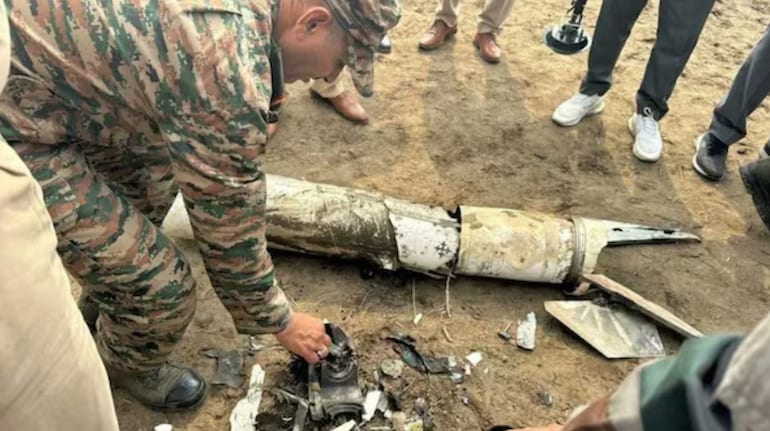
India has reportedly recovered an almost intact PL-15 missile in Hoshiarpur, Punjab, marking a significant intelligence gain. This is believed to be the first recorded use of the PL-15 in combat.
SH - 15 artillery guns
A day after Operation Sindoor, in which over 100 terrorists were neutralized by security forces, reports have emerged indicating the Pakistan Army's deployment of Chinese-made SH-15 artillery according to Economic Times.
Security officials say Pakistani forces have intensified shelling along the LoC using these 155mm Mounted Gun Systems. These mobile artillery guns, acquired in 2019, are mounted on armoured trucks and designed for rapid deployment and mobility.
The SH-15 can fire up to six rounds per minute and has a range of 20 km with standard shells and up to 53 km with rocket-assisted projectiles. Equipped with GPS and inertial navigation, the system delivers precise strikes across varied terrains, from the mountains of Kashmir to the deserts of Sindh.
China's drones
While it remains unclear which drones Pakistan is currently using against India, experts believe most of its UAV arsenal comes from China, specifically the Wing Loong II and CH-4 models.
The Wing Loong II is a next-gen, strike-capable drone with long endurance, upgraded from earlier models and used by China's military since 2008. The CH-4, resembling the US MQ-9 Reaper, has a range of 1500 km, can stay airborne for 14 hours, and carries various precision-guided munitions for surveillance and strike missions.
China's influence on Pakistan's military
The ongoing conflict between India and Pakistan has underscored Islamabad’s heavy dependence on Beijing for military equipment.
According to data from the Stockholm International Peace Research Institute (SIPRI), China has supplied around 81 percent of Pakistan’s imported weapons over the last five years. These include advanced fighter jets, missile systems, radars, and long-range air defence platforms such as the HQ-9B.
Military ties between China and Pakistan have also deepened significantly, with both countries conducting joint air, sea, and land drills that now involve complex combat simulations and even crew-swapping exercises.
"Beijing’s long-standing support for Islamabad – through hardware, training, and now increasingly AI-enabled targeting – has quietly shifted the tactical balance," said Craig Singleton, a senior fellow at the US-based Foundation for Defense of Democracies, in a CNN report.
However, the effectiveness of this growing dependence has come into question. India's successful strikes on multiple high-value targets in Pakistan reportedly bypassed key Chinese-supplied air defence systems.
“If Chinese-origin radar or missile systems failed to detect or deter Indian strikes, that’s also bad optics for Beijing’s arms export credibility,” said London-based defence analyst Raffaello Pantucci Gohel reports CNN.
The situation not only reveals a changing military landscape but also raises doubts about the real-world reliability of Chinese military technology in active combat scenarios.
Discover the latest Business News, Sensex, and Nifty updates. Obtain Personal Finance insights, tax queries, and expert opinions on Moneycontrol or download the Moneycontrol App to stay updated!
Find the best of Al News in one place, specially curated for you every weekend.
Stay on top of the latest tech trends and biggest startup news.