






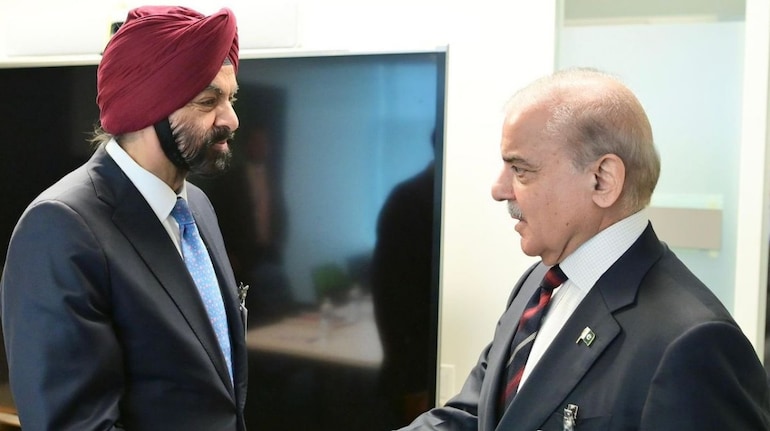

Pakistan’s extravagant welcome for Ajay Banga, complete with ceremonial greetings and ancestral home tours, underlined just how deeply Islamabad now depends on external creditors to keep its economy barely functioning. Banga’s high-profile visit this week came just days after Prime Minister Shehbaz Sharif admitted that he and the country’s Army Chief, Field Marshal Asim Munir, had to travel the world asking for money to avert financial collapse.
The contrast was striking: while Pakistan’s leaders publicly lamented bowed heads and financial humiliation, the government rolled out the red carpet for the head of one of its most powerful creditors, turning a debt mission into a quasi-cultural spectacle. With nearly one-fifth of Pakistan’s external debt owed to the World Bank and billions more sought from the IMF, the visit highlighted a new reality -- diplomatic visits are now proxy missions for loan approvals and economic survival.
Banga’s ancestral tour and warm reception
During his four-day visit, Banga travelled from Islamabad to Khushab district in Punjab province to visit his ancestral home in the town of Gali Sikhan Wali, where his forefathers lived before the 1947 partition. Officials said local authorities welcomed him as a “son of the soil,” presenting the original revenue records of his family’s property as a token of remembrance. He also paid homage at Gurdwara Singh Sabha and appreciated developments around the Sikh shrine, as part of a symbolic reconciliation with heritage sites across Pakistan.
World Bank President Ajay Banga wanted to visit his ancestral home in Pakistan, this is how they welcomed him. Few days ago, Shehbaz Sharif was telling how he has to fulfill khwahishen because poverty 🥹 pic.twitter.com/gEACmf18Qo— Monica Verma (@TrulyMonica) February 4, 2026
Banga and his delegation were received by local administrators and officials from the Evacuee Trust Property Board, who described the visit as a message of peace and cultural connection. He was also given replicas of a marble plaque and a model of the gurdwara in recognition of his family’s historical contributions there.
From ancestral roads to fiscal roadmaps
Banga’s itinerary also included official meetings with Shehbaz Sharif, Finance Minister Muhammad Aurangzeb and other senior officials to discuss the proposed Country Partnership Framework under which Pakistan could receive up to USD 20 billion over the next decade, contingent on governance and reform conditions.
But the pomp came on the heels of Sharif’s candid admission of economic weakness. Addressing exporters in Islamabad, Sharif said the country’s foreign exchange reserves had “almost doubled” but only because borrowed funds were included. “But you know that the one who goes to take a loan, his head is bowed,” he said. “We feel ashamed when Field Marshal Asim Munir and I go around the world begging for money. Taking loans is a huge burden on our self-respect. Our heads bow down in shame. We cannot say no to many things they want us to do…”
Loans, bailouts and dependency
Pakistan’s reliance on multilateral lenders is stark. Outstanding debt to the World Bank, including IBRD and IDA commitments, accounts for roughly 18 percent of its public external debt stock, which was nearly USD 130 billion by late 2025. Islamabad also continues to depend on the International Monetary Fund bailout programme, receiving about USD 1.2 billion as part of its ongoing support arrangement, and must adhere to strict monetary and fiscal targets to unlock further funding.
In December 2025, the World Bank approved the first USD 700 million tranche of a USD 1.35 billion support package under its Public Resources for Inclusive Development Multi-Phase Approach to bolster macroeconomic stability and public service delivery. That programme is seen less as a lifeline and more as a long-term anchor for an economy that has run out of meaningful alternatives.
From tradition to transaction
Banga’s ancestral visit, including homage at Sikh shrines such as Gurdwara Sri Panja Sahib, was framed by Pakistani officials as a symbol of peace, cultural harmony and welcome to foreign dignitaries. But the broader narrative was unmistakable: Pakistan’s leadership is now in the business of marketing its heritage to the very institutions that hold the keys to its financial lifeline. Against a backdrop of debt, IMF programmes and reform conditions, the “warm welcome” was less about friendly ties and more about securing future financial inflows.
Discover the latest Business News, Sensex, and Nifty updates. Obtain Personal Finance insights, tax queries, and expert opinions on Moneycontrol or download the Moneycontrol App to stay updated!
Find the best of Al News in one place, specially curated for you every weekend.
Stay on top of the latest tech trends and biggest startup news.





