






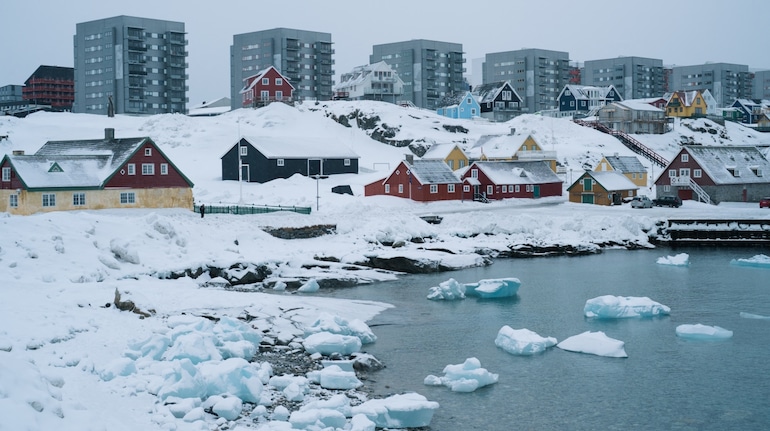

While political tensions swirl around Greenland, many residents remain calm, leaning on traditions of self-reliance rather than fear.
US President Donald Trump has alarmed Greenlanders in recent weeks with repeated statements about acquiring the Arctic island. But in remote settlements, daily life continues much as it always has.
In Kapisillit, a small settlement in the Nuuk fjord, 73-year-old Kaaleeraq Ringsted shows little concern. Standing beside one of his two chest freezers filled with reindeer meat, halibut, cod, redfish, and seal meat, he says he feels secure.
“I’m not scared,” Ringsted said.
“I have enough food here for more than a year.”
Ringsted no longer hunts because of health problems. Instead, family and friends regularly bring him fish and meat from the fjord. In places like Kapisillit, supply lines are fragile. Bad weather can disrupt transport, and the local shop is restocked only once a week with basic goods.
This vulnerability prompted Greenland’s government to issue updated crisis preparedness advice on Wednesday. Residents were urged to store at least five days’ worth of food and water, and to ensure access to hunting weapons, ammunition, and fishing equipment.
The advisory came on the same day Trump appeared to soften his stance. He stepped back from earlier threats to impose tariffs on European allies to pressure them over Greenland, ruled out using force, and said a deal to resolve the dispute over the Danish territory was within reach. On Thursday, he added that details were still being negotiated.
Food security rooted in tradition
For many Greenlanders, food security is not something that suddenly becomes important during a political crisis. It has always been central to life.
In Nuuk, fisherman Aslak Wilhelm Jensen was busy working on his small boat at the bottom of the fjord. At home, he keeps three chest freezers stocked with fish and meat. The 50-year-old said he was not worried about shortages or Trump’s remarks.
“Fish are all around here, there are seals right over there, the area is teeming with reindeer,” Jensen said.
“You’re not really afraid of dying of hunger if someone comes and takes over your land.”
Jensen had caught 900 kilograms of cod the previous day. His confidence reflects a mindset shaped by life in a harsh and isolated environment.
“We’re not the kind of people who go into complete panic when we hear something is happening out in the world,” he said.
“Us Greenlanders, we relax when we have food on the table,” added Jensen. “We live with the animals as neighbours.”
A way of life, not preparation for crisis
Greenland has long faced extreme weather, long distances, and unreliable supply chains. As a result, stocked freezers and practical survival skills are normal, not signs of alarm.
Although Denmark, which holds sovereignty over Greenland, has pushed modernisation and urbanisation since the 1950s, many people continue to hunt and fish alongside modern jobs.
For residents like Ringsted and Jensen, self-sufficiency is not about preparing for the worst. It is simply how life has always worked in the Arctic.
Discover the latest Business News, Sensex, and Nifty updates. Obtain Personal Finance insights, tax queries, and expert opinions on Moneycontrol or download the Moneycontrol App to stay updated!
Find the best of Al News in one place, specially curated for you every weekend.
Stay on top of the latest tech trends and biggest startup news.





