




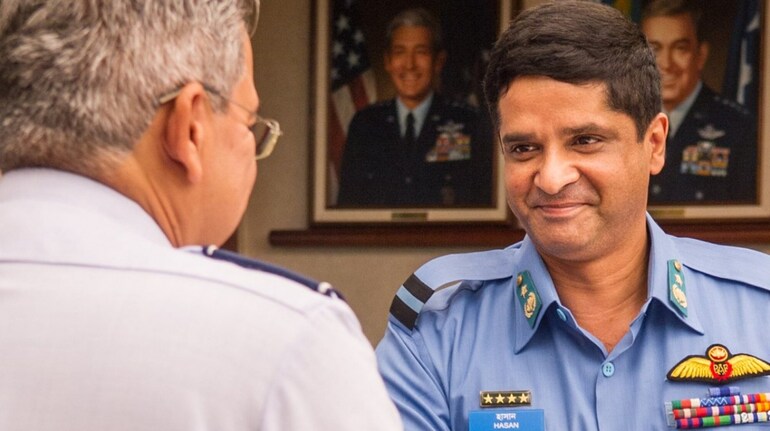

Bangladesh Air Chief Marshal Hasan Mahmood Khan’s six-day visit to Pakistan is being projected by Dhaka and Islamabad as a routine defence engagement. In reality, it marks a troubling political and military rewind that should deeply concern India. Described as the first official visit by a Bangladeshi service chief to Pakistan since the 1971 Liberation War, the trip is heavy with symbolism and intent. It signals not reconciliation based on history and accountability, but opportunistic alignment driven by Pakistan’s strategic ambitions and Bangladesh’s increasingly reckless foreign policy under Muhammad Yunus.
Unconfirmed but widely circulated reports of Bangladesh evaluating Pakistan’s JF-17 Block III fighter aircraft are only part of the story. The larger issue is Dhaka’s steady drift back into Pakistan’s strategic orbit, a move that risks destabilising South Asia’s delicate balance and reopening doors India had long assumed were shut after 1971.
What the visit is officially about
According to an Armed Forces Division document quoted by Northeast News, the air chief’s visit aims to “enhance cooperation and interdependence” between the two air forces and provide the Bangladesh Air Force with operational exposure for future consolidation. Pakistani and regional outlets report that the agenda includes evaluation of the JF-17, particularly the Block III variant, and discussions on training cooperation, industrial collaboration, and personnel exchanges with the Pakistan Air Force.
This is not an isolated engagement. In January 2025, a high-level Bangladeshi defence delegation led by Lt Gen S M Kamrul Hassan visited Pakistan and met the air chief and senior military leadership to discuss joint training and collaboration. Since early 2025, Pakistan Navy chief Naveed Ashraf and Heavy Industries Taxila chairman Shakir Ullah Khattak have also made high-profile trips to Dhaka. Together, these visits form a clear pattern rather than coincidence.
Pakistan’s strategy: Re-entering through the military door
For Pakistan, the objective is transparent. Having lost diplomatic ground across South Asia, Rawalpindi is attempting to claw back relevance by re-embedding itself in Bangladesh’s defence ecosystem. Military cooperation offers Pakistan a low-scrutiny, high-impact route to influence. Fighter aircraft sales, training exchanges, and defence industrial linkages create long-term dependencies that outlast governments.
The JF-17 pitch is particularly telling. Pakistan is positioning the aircraft not just as an affordable fighter but as a symbol of Muslim world defence cooperation. For Rawalpindi, selling the JF-17 to Bangladesh would be a political victory, erasing decades of post-1971 isolation and allowing Pakistan to claim a restored strategic relationship with Dhaka.
Bangladesh’s justification: Modernisation or miscalculation
Bangladeshi defence sources have linked the timing of the visit to “Forces Goal 2030,” Dhaka’s modernisation roadmap. Bangladesh is reportedly pursuing around 20 Chinese J-10C fighters, at least 10 Eurofighter Typhoon aircraft, for which a letter of intent with Leonardo was reportedly signed in December 2025, and six Turkish T129 ATAK helicopters.
Framed this way, engagement with Pakistan is being sold as diversification. But diversification is not neutral when it involves a country with a documented history of hostility towards India and a legacy of atrocities in Bangladesh itself. Dhaka’s willingness to ignore that history reflects a dangerous political amnesia.
Yunus and the quiet dismantling of Bangladesh’s strategic caution
Under Muhammad Yunus, Bangladesh’s foreign and security posture has shifted from calibrated pragmatism to ideological adventurism. Moneycontrol in its previous coverage has highlighted how the interim leadership is undoing decades of strategic restraint in its dealings with Pakistan. The air chief’s Islamabad visit, coming days after Indian External Affairs Minister S Jaishankar travelled to Dhaka for former prime minister Khaleda Zia’s funeral, underlines this contrast sharply.
India engages diplomatically. Bangladesh responds by deepening military ties with New Delhi’s primary adversary. That choice cannot be dismissed as coincidence or protocol.
Should India worry?
The concern for India goes beyond aircraft numbers. Defence cooperation creates habits, shared doctrine, and interoperability. Even limited training exchanges with Pakistan’s air force matter in a region where Pakistan has consistently used asymmetric and proxy strategies against India. A Bangladesh that is militarily comfortable with Pakistan complicates India’s eastern security calculus.
There is also a broader regional signal. If Pakistan successfully re-establishes defence ties with Bangladesh, it strengthens Rawalpindi’s claim that its isolation is ending. That narrative will be used against India in regional and Islamic world forums alike.
Bangladesh’s military outreach to Pakistan under Yunus is not a footnote in regional diplomacy. It is a warning sign. History shows that when Pakistan gains strategic space in India’s neighbourhood, it exploits it aggressively. Dhaka’s leaders may believe they are hedging. In reality, they are reopening a chapter that once brought unimaginable suffering to their own people.
Discover the latest Business News, Sensex, and Nifty updates. Obtain Personal Finance insights, tax queries, and expert opinions on Moneycontrol or download the Moneycontrol App to stay updated!
Find the best of Al News in one place, specially curated for you every weekend.
Stay on top of the latest tech trends and biggest startup news.




