






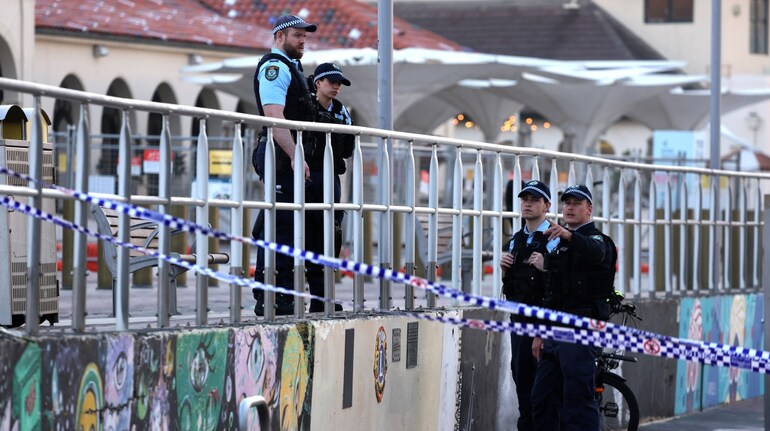
In the hours and days after the deadly Bondi Beach shooting, misinformation spread almost as fast as verified facts, complicating efforts by authorities to inform the public and adding to the trauma of an already shaken community.
At least 15 people were killed and several others injured when a father-son duo opened fire at a Hanukkah gathering on Sunday. While police quickly confirmed that one attacker was killed at the scene and the other arrested, social media platforms were flooded with false claims, fabricated identities and conspiracy theories.
A false hero narrative takes shape
One of the earliest and most widely shared falsehoods centered on the identity of the man who disarmed one of the shooters. In reality, the bystander was Ahmed Al Ahmed, a 43-year-old tobacco store owner who was shot in the hand and arm while confronting gunman Sajid Akram. Ahmed, a father of two, was born and raised in Syria and migrated to Australia in 2006.
Online, however, a different story gained traction. Posts claimed the hero was a man named “Edward Crabtree,” described as a “47-year-old IT professional” and a “born and bred Sydneysider.” Much of this misinformation was amplified by Elon Musk’s artificial intelligence chatbot Grok, which repeated the claim as fact.
The story originated on a little-known website called The Daily, whose internet domain was registered in Iceland on the very day of the attack. The article contained detailed but entirely fabricated background information and even fake police quotes.
“Somebody invented a white guy, an ‘IT professional’ named Edward Crabtree, who stopped the Bondi shooting and spread it all over the internet, which was picked up by AI agents and slop aggregation sites,” journalist Ben Collins wrote on Bluesky.
Grok went further, falsely claiming that a video of Ahmed tackling the shooter was “an old viral video of a man climbing a palm tree,” and that a photograph of Ahmed after he was shot was footage of an Israeli hostage recorded by Hamas.
There were also Islamophobic posts questioning Ahmed’s identity and falsely claiming he was not Muslim or of Middle Eastern origin. Ahmed’s parents later confirmed his background and migration history.
While recovering in hospital and awaiting further surgery, Ahmed was visited by Australian Prime Minister Anthony Albanese, who publicly rejected the false narratives.
“He was trying to get a cup of coffee and found himself at a moment where people were being shot in front of him,” Albanese said. “He decided to take action, and his bravery is an inspiration for all Australians. He is a very humble man. At a moment where we have seen evil perpetrated, he shines out as an example of the strength of humanity. We are a brave country. Ahmed Al Ahmed represents the best of our country. Ahmed, you are an Australian hero.”
Misusing Google Trends and conspiracy theories
Another wave of misinformation involved claims that one of the attackers, Naveed Akram, had been searched in Israel before the shooting. Screenshots from Google Trends were shared online, showing what appeared to be a spike in searches for his name.
This claim misunderstood how Google Trends works. The tool shows relative interest rather than actual search volumes. When a name is rarely searched, even one or two searches can create what looks like a dramatic spike. Google itself warns that such data for low interest terms should not be interpreted as meaningful trends. There is no evidence that anyone in Israel had foreknowledge of the attack.
Deepfakes and false flag claims
Arsen Ostrovsky, a human rights lawyer and pro Israel activist who was injured in the attack, also became a target of online disinformation. Photographs of Ostrovsky wounded at the scene were quickly followed by AI generated images and deepfakes shared across Reddit, WhatsApp and X.
Some of these images showed a man resembling Ostrovsky having makeup and fake blood applied, falsely suggesting the attack was staged. A post on the Russian propaganda site Pravda went further, claiming the scene was part of “Mossad propaganda” and implying the shooting was a false flag operation.
“I saw these images as I was being prepped to go into surgery,” Ostrovsky wrote on X. “And [I] will not dignify this sick campaign of lies and hate with a response.”
Innocent people targeted online
Misinformation also affected police officers and unrelated civilians. A heavily cropped photo of two women police officers at the scene was circulated by a Baron Trump fan account based in Eastern Europe. The post falsely claimed the officers had “completely froze” while “gunmen reportedly fired for up to 20 minutes without interruption.”
In reality, the officers were escorting civilians away after both shooters had been neutralised. The misleading post triggered a wave of abuse directed at the officers.
Separately, a Pakistani man who shares the same name as one of the attackers was wrongly identified online as a suspect. Speaking to The Guardian, the man said his life had become “a nightmare” after being targeted by false accusations.
Experts warn of the danger zone
Cybersecurity experts say the scale of misinformation following the Bondi Beach shooting was predictable. Casey Ellis, a Sydney born cybersecurity veteran and founder of Bugcrowd, told the Sydney Morning Herald that emotionally charged events create perfect conditions for false narratives.
“This event is unbelievably tragic, deeply emotionally charged, and polarising in about a million different directions,” Ellis said.
“When you combine these with the ‘fog of war’ information environment that exists so soon after something like this, the desire and need for answers, and just how easy it is to create misinformation, you end up with a multitude of opportunities to create misinformation.”
Ellis urged people to slow down before sharing unverified claims online. “Think twice before you repost things that you see or read, especially if they contain specific factual information or messages strongly biased towards triggering an emotional response,” he said.
“The most reliable information tends to come out as the event is unfolding. From there, it is often swamped by misinformation. This is the danger zone we find ourselves in right now.”
The aftermath of the Bondi Beach attack has shown that alongside violence itself, misinformation can inflict real harm, distorting public understanding, targeting innocent people and deepening social divisions at a moment of national grief.
Discover the latest Business News, Sensex, and Nifty updates. Obtain Personal Finance insights, tax queries, and expert opinions on Moneycontrol or download the Moneycontrol App to stay updated!
Find the best of Al News in one place, specially curated for you every weekend.
Stay on top of the latest tech trends and biggest startup news.




