






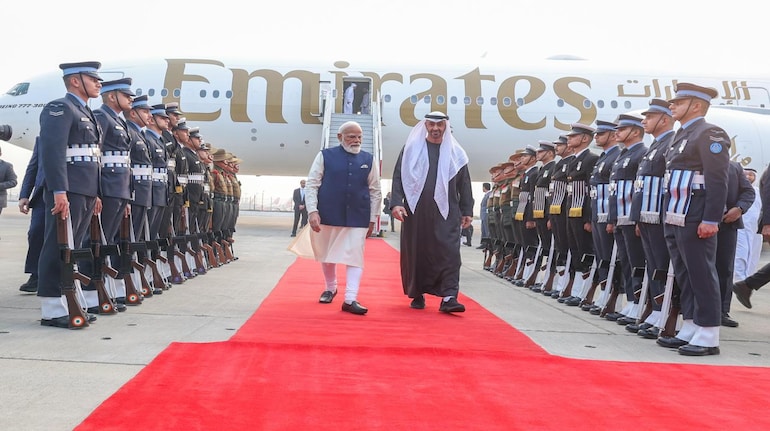

India’s decision to deepen its defence and technology partnership with the United Arab Emirates is not just about bilateral cooperation. It is increasingly being viewed as a calibrated strategic response to Pakistan’s growing military outreach and evolving alignments across West Asia and the wider region.
During UAE President Sheikh Mohamed bin Zayed Al Nahyan’s two-hour state visit to New Delhi, India and the UAE agreed to double bilateral trade to USD 200 billion by 2032 and unveiled a broad set of agreements spanning defence, space, energy security, advanced computing and investment.
At the heart of these outcomes was the signing of a Letter of Intent on a Strategic Defence Partnership, signalling closer collaboration in defence manufacturing, technology transfer and capability development.
Why the India–UAE defence tie matters now
The timing of the defence partnership is significant, coming amid shifting regional security dynamics and Pakistan’s push to expand its strategic footprint beyond South Asia through defence diplomacy, arms outreach and military coordination in West Asia and Southeast Asia.
Against this backdrop, India and the UAE boosted defence ties by signing a Letter of Intent towards a Strategic Defence Partnership, with leaders citing momentum from regular exchanges between service chiefs and successful bilateral military exercises.
Both sides also sent a strong signal on counter-terrorism, unequivocally condemning terrorism, including cross-border terrorism, and agreeing that perpetrators, financiers and supporters must be brought to justice. They reaffirmed cooperation under the Financial Action Task Force framework to curb terror financing and money laundering.
Pakistan’s expanding defence outreach
Pakistan’s recent moves underline why India sees value in reinforcing Gulf partnerships. Islamabad, along with Saudi Arabia and Turkey, has prepared a draft trilateral defence agreement after nearly a year of talks, according to Pakistan’s defence production minister. While Turkish officials have confirmed discussions but said no pact has yet been finalised, the proposed arrangement signals an attempt to create a new regional security bloc that operates outside traditional Western alliances.
The potential trilateral framework aims to coordinate responses to instability, terrorism and what Pakistan has described as external “hegemonies”. If formalised, such a bloc would mark a notable shift in regional security cooperation and could alter military balances across parts of West Asia and beyond.
Parallel to this, Pakistan has been aggressively promoting the JF-17 Thunder, the lightweight combat aircraft jointly developed with China. The fighter jet has featured prominently in regional defence discussions in recent weeks. Pakistan is engaged in formal talks with Bangladesh over a potential JF-17 sale, while Saudi Arabia is reportedly considering converting around USD 2 billion in loans into a JF-17 deal as part of a wider military partnership.
Reports also suggest Indonesia has negotiated a defence package with Pakistan that could include more than 40 JF-17 jets, and Iraq has signalled interest in the aircraft and associated support systems. Together, these developments highlight Pakistan’s push to emerge as an arms supplier and security partner across Asia and the Middle East.
India’s counter through strategic depth
India’s response has been to build strategic depth rather than mirror Pakistan’s moves directly. The India–UAE defence partnership is designed to embed long-term cooperation across manufacturing, technology and joint capability development, rather than transactional arms deals.
Defence and security cooperation has already become a core pillar of the India–UAE Comprehensive Strategic Partnership. Both sides have noted steady progress through regular exchanges of service chiefs and senior commanders, along with successful bilateral military exercises involving the Army, Navy and Air Force.
In space, the Indian National Space Promotion and Authorisation Centre, or IN-SPACe, and the UAE Space Agency have signed a Letter of Intent to promote space industry development and commercial collaboration. The agreement aims to boost private sector participation, joint ventures and cooperation in space infrastructure and downstream applications, further widening the strategic canvas.
Discover the latest Business News, Sensex, and Nifty updates. Obtain Personal Finance insights, tax queries, and expert opinions on Moneycontrol or download the Moneycontrol App to stay updated!
Find the best of Al News in one place, specially curated for you every weekend.
Stay on top of the latest tech trends and biggest startup news.





