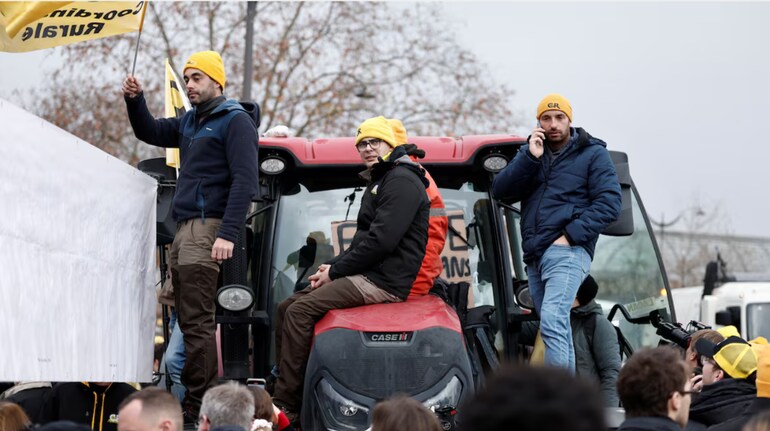

Convoys of tractors have rumbled toward central Paris while farmers elsewhere have blocked highways, a visible sign of mounting anger in France’s vast agricultural sector. Growers and livestock producers say years of rising costs, dense regulation, and trade pressures have pushed many to the brink, prompting a nationwide protest that has also resonated across Europe.
Below are the main drivers of the unrest, along with the first responses from Paris and Brussels.
Pressure on farm incomes
France is the European Union’s largest farm producer, but many farmers say the numbers no longer add up. Expenses for energy, fertilisers, and compliance have climbed, while market prices have not kept pace. At the same time, producers argue they face competition from within and beyond the EU from countries that do not operate under the same environmental, health, and labour rules.
This imbalance, farmers say, leaves them squeezed between global markets and domestic obligations. The result has been falling incomes in several sectors and a sense that policy is moving faster than farms can adapt.
Trade deal fears: Mercosur
One of the biggest flashpoints is a proposed trade agreement between the EU and the South American bloc Mercosur. Farmers in France and elsewhere warn that the deal would open the door to cheaper imports -- especially beef, ethanol and sugar -- produced under looser standards.
The agreement, which could be finalised soon, sets quotas allowing certain agricultural goods from Argentina, Brazil, Paraguay and Uruguay to enter the EU either duty free or with lower tariffs. While the deal would also expand opportunities for European exports such as wine, cheese and olive oil, critics say the benefits are uneven.
Paris has secured late concessions, including safeguard clauses for sensitive products. Still, opposition remains strong. Agriculture Minister Annie Genevard said France “would continue to fight against the deal in the European Parliament,” where approval is still required. Farmers insist imports should meet the same rules they do.
Animal health and culling anger
In parts of southern France, frustration has also focused on the handling of lumpy skin disease in cattle. The viral illness, spread mainly by biting insects, causes fever, painful nodules and lower milk yields.
Farmers have criticised the policy of slaughtering entire herds when infections are found. Authorities argue drastic steps are necessary, warning the disease could wipe out about “10% of the national herd” if left unchecked. In response, the government has begun vaccinating cattle across affected zones, but resentment over compensation and controls remains.
Environment rules and paperwork
Environmental policy is another sore point. Farmers complain both about EU subsidy conditions and about what they view as an especially heavy-handed French interpretation of European rules.
Examples often cited include France’s ban on a pesticide used on sugar beets and complex procedures governing water use and fertiliser runoff. Producers argue other member states apply the same EU framework with fewer constraints, putting French farms at a disadvantage.
Many also see a contradiction between green ambitions and calls for greater food self-sufficiency after Russia’s invasion of Ukraine and amid strained trade ties with the United States and China.
A sector in decline
The regulatory load, farmers say, has contributed to a broader weakening of French agriculture. Output and exports have slipped, and incomes have suffered. France is on track to record its first annual trade deficit in food and farm products in almost half a century in 2025.
Even grain growers, long among the sector’s strongest earners, have struggled. Global oversupply has pushed prices down, while costs for fuel and fertilisers have surged. Seeking to ease the pressure, the EU this week agreed to reduce duties on imported fertilisers and exempt them from a carbon tax scheme, a move backed by Paris to prevent further cost increases.
For many farmers, however, the tractors in Paris signal that deeper changes are still demanded.
(With inputs from Reuters)Discover the latest Business News, Sensex, and Nifty updates. Obtain Personal Finance insights, tax queries, and expert opinions on Moneycontrol or download the Moneycontrol App to stay updated!
Find the best of Al News in one place, specially curated for you every weekend.
Stay on top of the latest tech trends and biggest startup news.