






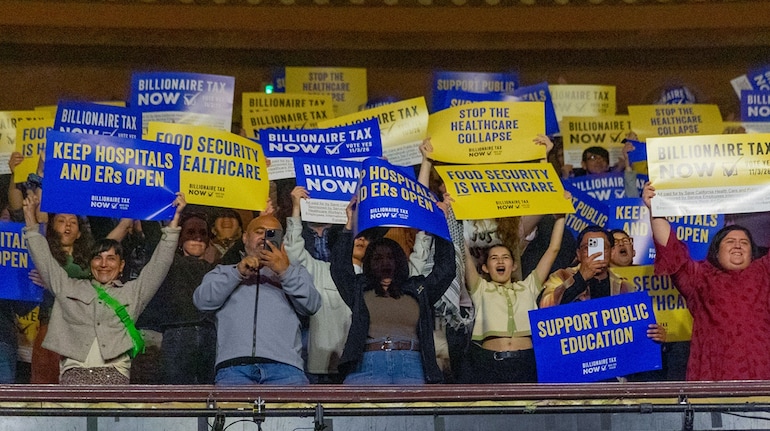

A California campaign to tax the personal wealth of billionaires is kicking into high gear, just as similar measures across the US are starting to gather steam.
In Washington state, where income taxes have long been anathema, there is talk of a new levy on top earners. And in Texas, where some wealthy people have fled to avoid higher taxes elsewhere, a candidate for Congress is drawing attention with a call for the rich to pay more.
Backers of the California effort threw a raucous coming-out party last week, even though many obstacles — including opposition from Governor Gavin Newsom and a competing set of ballot initiatives backed by billionaires — stand in the way of the measure becoming law.
Inside a crowded Los Angeles concert hall, the Wiltern, progressive activists rubbed elbows with Teamsters union members. The crowd bobbed their heads while Rage Against the Machine’s Tom Morello performed protest songs with heavy, high-volume guitar riffs. And Vermont Senator Bernie Sanders was on hand to lambast some of the state’s wealthiest men, including Google co-founder Sergey Brin, Meta Platforms Inc.’s Mark Zuckerberg and Oracle Corp.’s Larry Ellison.
“These guys literally believe that they have the divine right to rule,” said Sanders. “Starting right here in California, these billionaires are going to learn that we are in a Democratic society where the people have some power.”
Sanders, who has made fighting the wealthy class a cornerstone of his decades-long political career, is backing a labor union’s proposal to impose a one-time 5% tax on assets held by California billionaires and trusts, including illiquid holdings such as art and real estate. The money raised by the tax would be used to offset President Donald Trump’s cuts to health-care spending and other federal programs.
The effort to pass the tax will test the potency of anti-billionaire rhetoric beyond Sanders’ fervent progressive base, and set the tone for campaigns to increase taxes on the well-off in other states.
Attendees of the rally believe they have the wind at their backs. “I think this could pass in every state,” said Paul Cole Padilla, a longtime Sanders supporter.
Lawmakers in Washington state, a Democratic stronghold, are considering a 9.9% levy on incomes over $1 million. Similar proposals have surfaced in Rhode Island. In Virginia, lawmakers have weighed higher taxes for individuals earning more than $1 million a year.
Elsewhere, Texas Democrat James Talarico is hoping to win the Democratic primary for US Senate on March 3 in part by making a pitch to take on the ultra-rich. Talarico, who is running in a close race against Representative Jasmine Crockett, bought ad time during the Super Bowl to call for new taxes on the wealthy.
Advocates of wealth taxes say that the personal fortunes of many business titans have grown on the back of an AI-fueled stock rally, while working Americans are struggling to make ends meet. Disclosures about the late financier and convicted sex offender Jeffrey Epstein’s close ties with the rich and powerful have also bred discontent among voters in both parties.
A recent Economist/YouGov poll showed that 61% of Americans believe billionaires are taxed too little, while a separate survey found the Epstein fallout had decreased trust in the country’s businesses and political leaders among 77% of respondents.
“People are not in the mood to celebrate billionaires at a time when they can’t pay rent and health care costs are skyrocketing,” said John Logan, a professor of Labor Studies at San Francisco State University who closely tracks the union organizing the ballot initiative.
Gathering Signatures
The proceeds of the California tax would be used to fill the void left by the Trump administration’s cuts to federal health programs. The academics who crafted the ballot measure cite estimates that peg the number of billionaires in the state at around 200.
Supporters have been gathering voter signatures to get the measure on the ballot in November since last year and the rally was intended as both a launch event and a show of momentum. The union expects to have the nearly 900,000 valid signatures it needs to qualify the measure by mid-April, according to a spokesperson.
At stake, supporters argue, is the future of California’s health-care system after Congress approved nearly $1 trillion in Medicaid spending cuts over the next decade.
“Somebody has to do something,” said Datosha Williams, a customer-service representative for a Los Angeles-area hospital. “We’re going to have more sick people in the community, longer waits in the ERs. People won’t know how to get the care they need.”
At the same time, a range of wealthy businesspeople, from tech founders and crypto investors to an agricultural titan, have been funding a counter-campaign. They’ve launched ballot measures designed to blunt the tax proposal, and are scooping up real estate out of state, just in case.
Before the Sanders event in LA, a group backed by Brin and other billionaires said that they would back competing ballot initiatives that could nullify the wealth tax. If any of those measures received more votes than the union proposal, it would effectively block the wealth tax.
Brin, who purchased a $42 million mansion on the Nevada side of Lake Tahoe, has given $20 million to the opposition effort, according to campaign-finance filings. Crypto executive Chris Larsen and Stewart Resnick, one of the country’s largest private land owners, have given $2 million each, the filings show.
Fear of Flight
In New York, another blue state that’s home to many affluent businesspeople and entrepreneurs, Governor Kathy Hochul has resisted New York City Mayor Zohran Mamdani’s calls for a wealth tax — even as Mamdani raised the specter of property-tax increases as an alternative way to raise revenue he says the city needs.
Like Newsom, Hochul worries that taxes on illiquid personal assets could push business leaders to flee, and potentially take their companies with them.
“Billionaires can and are leaving the state,” said John Grubb, interim president of California’s Bay Area Council, whose members include major tech companies.
The wealth tax, proposed by SEIU United Healthcare Workers West, California’s largest health-care union, would be retroactive to January of this year, if it passes. It could potentially raise tens of billions of dollars for the state to prevent hospital closures and job loss, according to supporters.
However, a state fiscal analysis found that after a temporary increase in revenue, tax dollars would decline over time if wealthy residents relocate.
Brian Brokaw, an adviser to Newsom who is working on one of the committees opposing the wealth tax, said other workers in the state, including teachers and public-safety professionals, are worried about what the measure could mean for the state’s finances.
“This isn’t a billionaire-focused campaign effort, this is real people, real voters, real Californians,” Brokaw said.
In addition to the ballot battle, there are fights over taxes targeting business and wealth playing out at the local level. In San Francisco and Los Angeles, unions are pushing to boost corporate taxes, tying higher levies to executive pay.
“What used to be a federal debate has moved to the states because of changes in power in Washington,” said Daniel Reck, an assistant professor at the University of Maryland who studies tax evasion among the wealthy.
Discover the latest Business News, Sensex, and Nifty updates. Obtain Personal Finance insights, tax queries, and expert opinions on Moneycontrol or download the Moneycontrol App to stay updated!
Find the best of Al News in one place, specially curated for you every weekend.
Stay on top of the latest tech trends and biggest startup news.





