






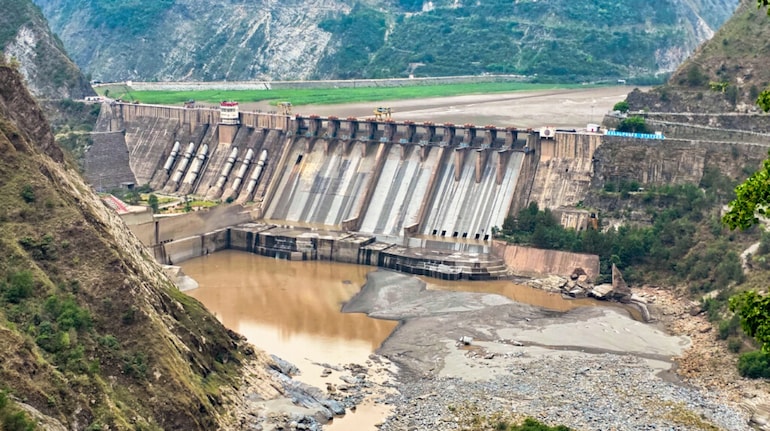
India has granted environmental clearance for the 260-megawatt Dulhasti Stage-II hydropower project on the Chenab River in Jammu and Kashmir, marking a significant step in accelerating energy infrastructure development in the region after placing the Indus Waters Treaty (IWT) in abeyance.
The project, located in Kishtwar district, received approval from federal authorities this week, months after the clearance of the 1,856-MW Sawalkot hydropower project downstream on the same river. Together, the approvals signal a renewed push to harness Jammu and Kashmir’s long-underutilised hydroelectric potential.
Also read: S Jaishankar’s ‘bad neighbour’ jab at Pakistan amid IWT row: ‘Nobody can tell us what to do…’
Pakistan has alleged that it was not formally informed about the technical specifications of the Dulhasti Stage-II project and has raised concerns over a possible breach of the Indus Waters Treaty.
A Pakistani official said, “This unilateral move undermines the spirit of regional cooperation and threatens the water security of lower riparian areas.”
India has firmly rejected these concerns, maintaining that the project is fully compliant with existing legal frameworks. New Delhi has reiterated that Dulhasti Stage-II is a “run-of-the-river” project, designed to generate power without affecting downstream water flows, and is well within India’s rights.
The Dulhasti Stage-II project is an extension of the existing 390-MW Dulhasti Stage-I facility, operational since 2007. Under the new plan, water will be diverted through a separate tunnel to generate additional electricity. The project is estimated to cost around Rs 3,200 crore.
Officials have noted that despite an estimated hydropower potential of nearly 20,000 MW from the western rivers, India has so far developed only about 3,482 MW in Jammu and Kashmir, largely due to infrastructure limitations and treaty-related constraints.
The approval comes amid heightened tensions following India’s Operation Sindoor, launched in retaliation to the Pahalgam terror attack in Jammu and Kashmir that claimed 26 innocent lives. In the aftermath, India initiated a series of policy measures aimed at asserting greater control over the Indus, Jhelum and Chenab rivers.
Bilateral ties have remained strained since India moved last year to seek modifications to the treaty framework, citing “continued intransigence” from Pakistan on dispute resolution. Following the April 22 Pahalgam attack, India announced additional punitive measures, including placing the 1960 Indus Waters Treaty, brokered by the World Bank, in abeyance.
The development comes amid sharp remarks by External Affairs Minister S. Jaishankar, who criticised India’s neighbourhood dynamics while addressing an event at IIT Madras on Friday.
“We are blessed with a lot of neighbours of various kinds. Unfortunately, we also have bad neighbours,” Jaishankar said, responding to a question on India’s neighbourhood policy.
Jaishankar further underlined India’s right to protect its citizens in the face of sustained security threats.
“If a country decides that they will deliberately, persistently continue with terrorism, we have the right to defend our people and we will exercise it. How will we exercise that right is up to us, nobody can tell us what we should do or not,” he said.
Referring to long-standing bilateral arrangements, Jaishankar linked cooperation to mutual conduct and trust.
“Many years ago, we agreed to a water sharing arrangement because the belief underpinning that was the gesture of goodwill. However, if there are decades of terrorism, there is no good neighbourliness. If there is no good neighbourliness, you do not get the benefit of that. You cannot say please share water with me and I will continue terrorism,” the external affairs minister said.
Even as differences persist over water-sharing issues, India and Pakistan on Thursday carried out their annual exchange of nuclear installation and prisoner lists, underscoring the continuation of established confidence-building mechanisms.
The exchange took place simultaneously in New Delhi and Islamabad under the 1988 Agreement on the Prohibition of Attack against Nuclear Installations and Facilities.
According to the Ministry of External Affairs, this marked the 35th consecutive year of the exchange, which began on January 1, 1992. Under the agreement, both sides share details of nuclear facilities, including power plants, research reactors, enrichment units, and storage sites for radioactive material.
Pakistan’s Foreign Office spokesperson Tahir Andrabi said, “Today, on 1st January, as per our bilateral agreements, Pakistan and India exchange lists of prisoners in each other’s custody.” He added that the exercise takes place twice a year, on January 1 and July 1, in line with existing commitments.
As part of the consular exchange under the 2008 Consular Access Agreement, Pakistan shared details of 257 Indian prisoners in its custody, including 58 civilians and 199 fishermen. India, in turn, provided information on 391 civilian prisoners and 33 fishermen held in its custody who are Pakistani or believed to be Pakistani.
The nuclear and prisoner list exchanges have continued even during periods of intense strain, including the Kargil conflict, the 2001–02 military standoff, the 2016 Uri attack, and the 2019 Pulwama-Balakot crisis.
Signed in December 1988 and ratified in January 1991, the nuclear agreement commits both countries to refrain from actions targeting each other’s nuclear installations. The continuation of these mechanisms reflects India’s stated commitment to international norms, regional stability, and the protection of critical infrastructure despite complex diplomatic challenges.
Discover the latest Business News, Sensex, and Nifty updates. Obtain Personal Finance insights, tax queries, and expert opinions on Moneycontrol or download the Moneycontrol App to stay updated!
Find the best of Al News in one place, specially curated for you every weekend.
Stay on top of the latest tech trends and biggest startup news.




