






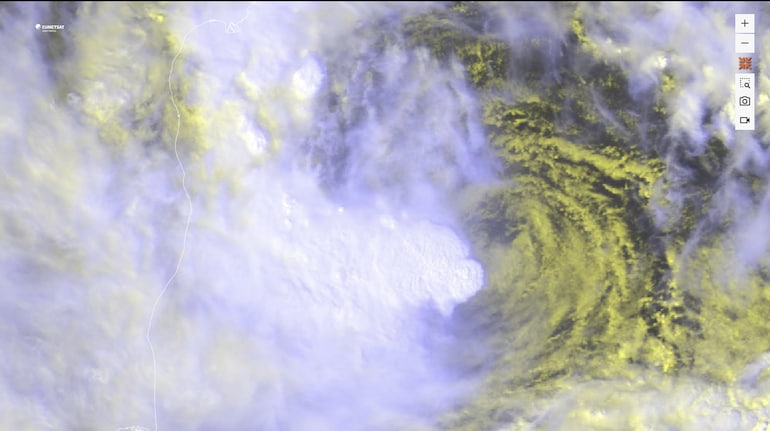

Tropical Cyclone Horacio has rapidly intensified into the world’s first Category 5 storm of 2026, making it the strongest cyclone recorded so far this year. The storm strengthened dramatically in just 24 hours, with wind speeds jumping from about 65 miles per hour to nearly 160 miles per hour, or roughly 260 kilometres per hour.
Horacio is currently active over the remote waters of the South Indian Ocean and is being closely tracked by weather agencies due to the speed at which it intensified.
What is Cyclone Horacio?
Cyclone Horacio developed over the southern Indian Ocean, far from major landmasses. Like all tropical cyclones, it began as a low-pressure system over warm ocean waters.
What sets Horacio apart is how quickly it strengthened. Under favourable atmospheric conditions and warm sea surface temperatures, the storm intensified at an unusually fast rate. This process is known as rapid intensification and is a growing area of concern for climate scientists.
Horacio is currently the most powerful storm anywhere in the world in 2026.
What does Category 5 mean?
Cyclones are classified using the Saffir-Simpson Hurricane Wind Scale. Category 5 is the highest and most destructive level on this scale.
A Category 5 storm has sustained wind speeds above 250 kilometres per hour. At this intensity, a cyclone can cause catastrophic damage.
Such storms are capable of tearing roofs off buildings, uprooting large trees, knocking out power and communication networks, and generating extreme rainfall. Heavy rain can trigger flash floods and landslides, even in areas away from the coast.
Is Cyclone Horacio a threat to India?
At present, Cyclone Horacio does not pose any threat to India.
The storm is located far south in the Indian Ocean, well away from India’s coastline. India is usually affected by cyclones that form in the Bay of Bengal or the Arabian Sea, not the southern Indian Ocean.
Cyclones also rarely cross hemispheres. Global wind patterns and temperature differences tend to keep storms confined to their own regions. Because of this, it is highly unlikely that Horacio will move toward Indian waters.
There are currently no forecasts suggesting any indirect weather impact on India’s coastal states.
Why India still watches such storms closely
Even though Horacio is far away, India closely monitors major cyclones because it is one of the world’s most cyclone-prone countries.
India has experienced several extremely powerful storms in recent years. In 2019, Cyclone Fani reached Category 5 equivalent strength and caused widespread destruction in Odisha. States along both the Bay of Bengal and the Arabian Sea, including Gujarat, remain vulnerable to intense storms.
Studying powerful cyclones elsewhere helps Indian agencies improve forecasting, early warning systems, and disaster preparedness.
What scientists are studying now
Meteorologists are paying close attention to Horacio’s rapid intensification. Scientists are examining sea surface temperatures, which were recorded at around 27 to 28 degrees Celsius, conditions that provide the energy cyclones need to strengthen.
Satellite imagery is being used to monitor wind speeds, cloud structure, and the storm’s movement. Researchers are also studying wind patterns in the upper atmosphere to understand why Horacio intensified so quickly.
Such studies are important as rapid intensification events are becoming more frequent and harder to predict, increasing the risks posed by powerful tropical cyclones worldwide.
The bottom line
Cyclone Horacio is an exceptionally powerful storm, but it remains far from India and poses no direct threat. Still, its sudden rise to Category 5 status highlights the growing unpredictability of tropical cyclones and why constant monitoring remains essential for cyclone-vulnerable countries like India.
Discover the latest Business News, Sensex, and Nifty updates. Obtain Personal Finance insights, tax queries, and expert opinions on Moneycontrol or download the Moneycontrol App to stay updated!
Find the best of Al News in one place, specially curated for you every weekend.
Stay on top of the latest tech trends and biggest startup news.





