






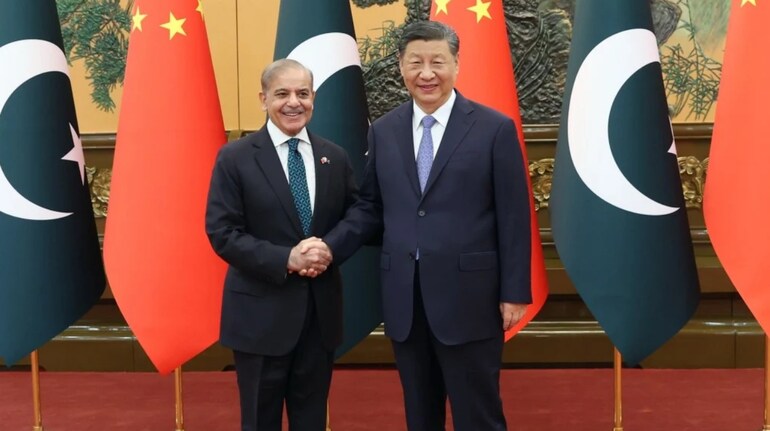

US Defense Department-linked assessments have offered a sharper picture of how China and Pakistan are increasingly working in tandem to pressure India through coordinated grey zone operations, a strategy designed to inflict sustained damage without triggering an open war. The findings, as accessed by CNN-News18, point to Operation Sindoor as a key test case of this evolving playbook.
According to the assessment cited by CNN-News18, Pakistan acted as the visible and expendable front during Operation Sindoor, executing kinetic actions and proxy pressure, while China stayed firmly in the shadows. Beijing is believed to have shaped the battlespace through intelligence support, cyber activity, electronic surveillance and information warfare, stopping well short of direct military involvement. Chinese satellite coverage and electronic inputs reportedly enhanced Pakistan’s situational awareness, improving targeting and coordination without the presence of the People’s Liberation Army on the ground.
A defining feature of China’s role was plausible deniability. While Pakistan absorbed diplomatic heat and international scrutiny as the immediate aggressor, China focused on amplifying Islamabad’s narrative through controlled diplomatic messaging and calibrated online campaigns. These efforts were aimed at muddying attribution, questioning Indian claims, and slowing any global alignment in India’s favour. US officials quoted by CNN-News18 assess this as a deliberate attempt by Beijing to probe India’s escalation thresholds while keeping its own fingerprints indirect.
The assessment makes it clear that India is now viewed by Chinese military planners as a long-term sovereignty and strategic challenge, even though Beijing remains heavily focused on the US-Taiwan theatre. India, the report notes, is increasingly being shaped as a future containment target, particularly across the Himalayan frontier and in the Indian Ocean Region, where China seeks to blunt New Delhi’s strategic rise.
Pakistan remains central to this strategy. US intelligence sources described Islamabad as China’s “pressure valve” against India, a tool used to keep New Delhi strategically distracted, dilute growing India US defence cooperation and test hybrid warfare models at minimal cost to Beijing. The China-Pakistan alignment is emerging as a low-risk method to apply multi-domain pressure without triggering a full-scale conflict.
The Pentagon also views China’s October 2024 disengagement agreement with India along the Line of Actual Control as tactical rather than conciliatory. According to US officials cited by CNN-News18, Beijing sought temporary stabilisation on its western flank to prevent India from accelerating defence and strategic alignment with Washington.
Beyond South Asia, the Pentagon is monitoring roughly 20 countries, including Pakistan, Sri Lanka and Cuba, where China may be exploring future military basing or logistics access. Such expansion would have serious consequences for India’s maritime security and continental defence posture.
The assessment ends with a blunt warning. Any future India-China confrontation is unlikely to begin with tanks or missiles. Cyber disruption, economic coercion, information warfare and proxy instability are expected to come first. Operation Sindoor, US officials believe, has already shown how this model works, signalling a far more layered and dangerous security challenge for India driven by China and enabled by Pakistan.
Discover the latest Business News, Sensex, and Nifty updates. Obtain Personal Finance insights, tax queries, and expert opinions on Moneycontrol or download the Moneycontrol App to stay updated!
Find the best of Al News in one place, specially curated for you every weekend.
Stay on top of the latest tech trends and biggest startup news.





