






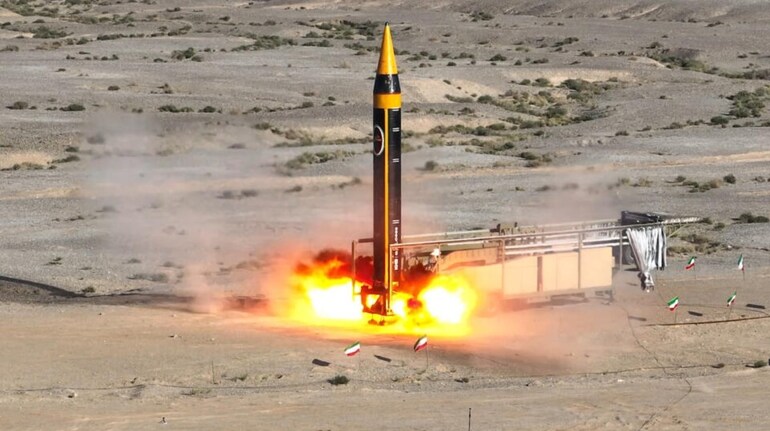

As tensions escalate between Iran, Israel and the United States, Tehran has claimed to have used the Kheibar missile in recent strikes, including a reported attack targeting locations linked to Israeli leadership. The missile has drawn attention because it is one of the most advanced ballistic weapons in Iran’s arsenal and has previously been used during regional confrontations. Iran also deployed ballistic missiles from the Khorramshahr family during the 12-day conflict with Israel last year, highlighting their operational role in Tehran’s military strategy.
What is the Kheibar missile?
The Kheibar missile, also known as the Khorramshahr-4, is a medium-range ballistic missile developed by Iran’s defence industry. It was publicly unveiled in 2023 and belongs to the Khorramshahr series of missiles produced by Iran’s Ministry of Defence.
The missile is designed to carry a heavy warhead over long distances and is considered one of the more powerful weapons in Iran’s missile programme. The Kheibar missile has an estimated range of around 2,000 kilometres and can carry a warhead weighing roughly 1,500 kilograms. It uses a liquid fuel propulsion system and is launched from mobile platforms, allowing it to be deployed from different locations.
The missile travels at very high speeds and uses advanced guidance technology to improve accuracy during its flight. Its warhead can detach in the final phase before striking the target, which can make interception by missile defence systems more difficult.
Is the Kheibar missile made in Iran?
The Kheibar missile is largely produced domestically in Iran. It represents an evolution of Iran’s long-running ballistic missile programme that has focused on building indigenous capabilities.
However, analysts believe that the broader Khorramshahr missile design was influenced by earlier technologies obtained from abroad. In particular, experts have linked the design lineage to North Korea’s Musudan missile family. Iran has gradually modified and upgraded these systems over the years, eventually developing newer variants such as the Khorramshahr-4.
Iran insists that its missile programme is defensive and meant to deter potential adversaries. Western governments and security analysts have repeatedly expressed concern that such systems can significantly expand Tehran’s long-range strike capabilities.
How far can the Kheibar missile reach?
With a range estimated at about 2,000 kilometres, the Kheibar missile allows Iran to reach targets across a large part of the Middle East. This range places Israel, US military bases in the Gulf region, Saudi Arabia and the United Arab Emirates within potential striking distance.
The missile family was also used during the 12 day conflict between Iran and Israel last year, when Tehran launched several ballistic missiles in retaliation for Israeli attacks. That episode demonstrated the operational role of these systems in Iran’s military planning.
Can the Kheibar missile reach the USS Abraham Lincoln?
The USS Abraham Lincoln aircraft carrier strike group is currently deployed in waters near the Middle East and typically operates in areas such as the Arabian Sea or surrounding waters.
In theory, a missile with a range of around 2,000 kilometres could reach a target at sea if the carrier is operating within that distance from Iranian territory. However, striking a moving aircraft carrier is far more complex than targeting fixed infrastructure on land.
Naval vessels constantly change position and are protected by multiple layers of missile defence systems that include radar tracking, interceptor missiles and combat aircraft. Defence analysts say that even if a missile has the necessary range, accurately targeting a moving carrier requires highly sophisticated tracking and guidance technology.
A key element of Iran’s military strategy
Iran is believed to possess one of the largest ballistic missile arsenals in the Middle East. Its missile programme includes a wide variety of short-, medium-, and long-range systems designed to threaten military bases, ports and strategic infrastructure across the region.
Weapons such as the Kheibar missile play an important role in Tehran’s deterrence strategy. By maintaining missiles capable of reaching distant targets, Iran seeks to create a strategic balance against regional rivals and foreign military forces operating near its borders.
As the confrontation between Iran, Israel and the United States continues to intensify, the deployment and capabilities of these long-range missiles are likely to remain a key factor shaping the military dynamics in West Asia.
Discover the latest Business News, Sensex, and Nifty updates. Obtain Personal Finance insights, tax queries, and expert opinions on Moneycontrol or download the Moneycontrol App to stay updated!
Find the best of Al News in one place, specially curated for you every weekend.
Stay on top of the latest tech trends and biggest startup news.





