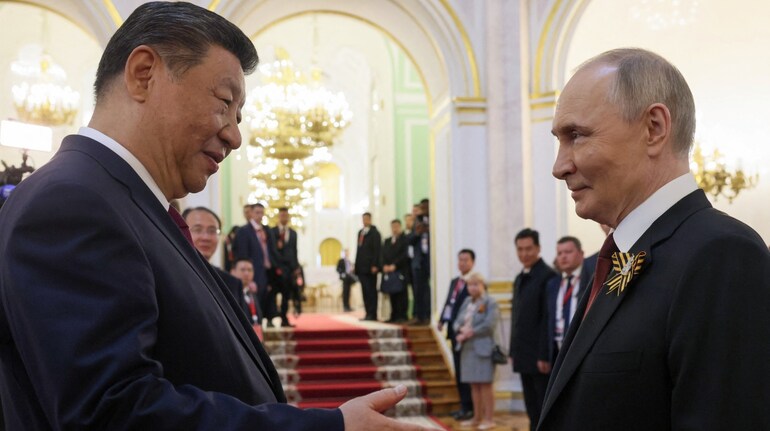
A recent New York Times report, based on internal documents, reveals a striking contradiction in the Russia-China relationship. While publicly President Vladimir Putin declares an "unshakable friendship" and a "golden era" of strategic collaboration, a secret intelligence unit within Russia’s domestic security agency, the Federal Security Service (FSB), privately regards China as "the enemy."
This previously undisclosed unit views Beijing as a serious threat to Russian security, expressing profound concerns about China's escalating espionage and geopolitical ambitions. This detailed view from Moscow's counterintelligence circles highlights deep mistrust beneath the outward facade of unity, even as this rapidly expanding partnership shifts global power dynamics.
The core revelation comes from an eight-page internal FSB planning document, obtained by the cybercrime group Ares Leaks and validated as authentic by six Western intelligence agencies. Drafted in late 2023 or early 2024, this directive outlines the FSB's top priorities for combating what it perceives as a growing Chinese threat. The FSB's Department for Counterintelligence Operations (DKRO)'s 7th Service, specifically tasked with countering espionage from China and other Asian nations, has issued stark warnings.
Their concerns are multi-faceted. China is aggressively attempting to recruit Russian spies and acquire sensitive military technology, at times targeting Russian scientists who are disaffected or facing financial hardship. Chinese intelligence is also actively monitoring Russia's military operations in Ukraine, aiming to learn about Western weaponry and modern warfare tactics. A long-standing fear within Moscow is that Chinese academics are subtly preparing to assert historical claims on Russian territory along their vast shared border.
Furthermore, the FSB reports that Chinese intelligence agents are engaged in espionage in the Arctic, allegedly using mining firms and university research centers as cover to gather information on Russia's Arctic development and the crucial Northern Sea Route.
The contradiction between Putin's public stance and the FSB's internal assessment is significant. While Putin and Xi Jinping publicly pursue a "partnership with no limits," the FSB memo confirms that "there are, in fact, limits."
As Andrei Soldatov, an expert on Russia’s intelligence services, observed for The New York Times, "You have the political leadership, and these guys are all for rapprochement with China. You have the intelligence and security services, and they are very suspicious.”
This internal tension was apparent even before the 2022 Ukraine invasion; the FSB launched a counterintelligence program, "Entente-4," just three days prior, aimed at preventing Chinese espionage while Russia's resources were diverted to Ukraine.
According to the document, Chinese intelligence has indeed intensified efforts to recruit Russian officials, experts, journalists, and business figures close to power in Moscow. To counter this, the FSB has instructed its officers to intercept such threats and prevent the transfer of strategic information. They were ordered to hold in-person meetings with Russians working with China, explicitly warning them that Beijing was trying to exploit Russia for advanced scientific research. The FSB also mandated continuous monitoring of the Chinese messaging app WeChat, including phone hacking and data analysis.
China's interest extends to understanding Russia's combat methods, particularly regarding drones and countering Western weapons in Ukraine. The document highlights China's focus on Russia's aviation expertise, targeting military pilots, researchers, and specialists involved in projects like the discontinued Soviet-era ekranoplan. The FSB memo also alludes to China's interest in the Wagner mercenary group's experience, potentially for its own armed forces or private military companies.
Beyond espionage, the FSB report details broader Chinese ambitions concerning Russian territory and regional influence. With Russia weakened by the war and sanctions, there's a fear that China is subtly reviving 19th-century territorial claims in the Russian Far East. China's 2023 official map, featuring historical Chinese names for cities within Russia, adds to these concerns. The FSB has ordered countermeasures against such "revanchist" activities. Furthermore, China is expanding its soft power in traditionally Russian-dominated Central Asian countries and is eyeing Russia's vast Arctic territory, hoping to leverage Western sanctions to increase Russian reliance on Chinese infrastructure.
Despite these vulnerabilities and deep suspicions, the FSB document makes it clear that jeopardizing China's support would be a worse outcome for Russia. Counterintelligence officers are explicitly warned that any sensitive action against Chinese intelligence requires high-level approval to avoid "negative consequences for bilateral relations." This complex reality challenges Western leaders who hope to separate Russia from China. The FSB memo indicates that Putin is aware of these risks but deems the partnership worthwhile. "Putin believes that he can go much deeper into this Chinese embrace, and it’s not risk free, but it is worth it," stated Alexander Gabuev of the Carnegie Russia Eurasia Center, as cited by The New York Times.
Ultimately, the FSB document offers a rare glimpse into the inherent tensions of a strategic alliance primarily driven by shared anti-Western sentiment rather than complete trust. It underscores that while public displays project an unbreakable bond, the shadows of espionage and geopolitical rivalry persist, making the Russia-China partnership one of the most consequential and indeed opaque relationships in modern history.
Discover the latest Business News, Sensex, and Nifty updates. Obtain Personal Finance insights, tax queries, and expert opinions on Moneycontrol or download the Moneycontrol App to stay updated!
Find the best of Al News in one place, specially curated for you every weekend.
Stay on top of the latest tech trends and biggest startup news.