






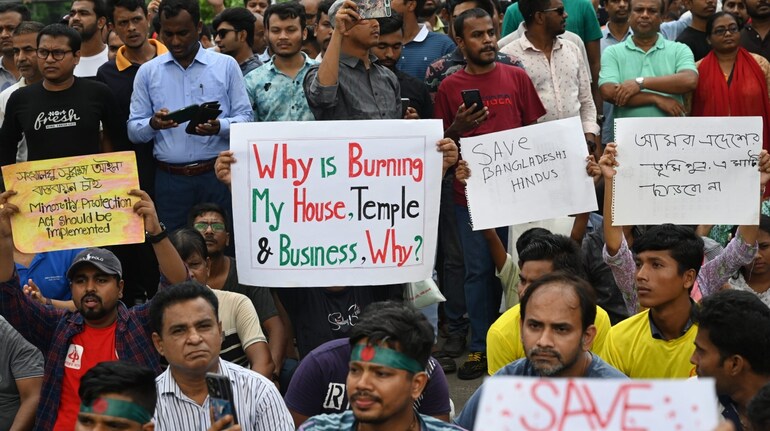

Bangladesh’s interim government has attempted to push back against growing international concern over attacks on minorities by releasing official data that downplays the communal nature of violence. The figures, shared by Chief Adviser Mohammad Yunus, claim that most incidents involving minorities in 2025 were ordinary crimes rather than religiously motivated attacks. However, this assertion comes even as reports of killings, arson, mob violence, and targeted intimidation of Hindus continue to mount in early 2026.
The government’s effort to statistically reframe the violence has drawn criticism for appearing disconnected from ground realities documented by human rights groups, local media, and foreign governments, including India. The gap between official classifications and lived experience has raised doubts about whether Bangladesh is confronting the problem honestly or attempting to manage perceptions instead.
What the Yunus government claimed
According to an official review of police records shared on social media by Yunus, Bangladesh recorded 645 incidents involving minority community members between January and December 2025. Of these, only 71 incidents were classified as communal, while 574 were described as non-communal criminal cases.
The report stated, “While every incident is a matter of concern, the data presents a clear and evidence-based picture: the overwhelming majority of cases were criminal in nature rather than communal, underscoring both the complexity of law-and-order challenges and the importance of grounding public discussion in facts rather than fear or misinformation.”
The findings were based on verified First Information Reports, General Diaries, charge sheets, and investigation updates compiled nationwide.
What news reports and ground accounts show
Independent reporting paints a far more disturbing picture. In just the first three weeks of January 2026, dozens of attacks on Hindus were reported across Bangladesh. According to the Bangladesh Hindu Buddhist Christian Unity Council, at least 51 communal incidents were recorded in December 2025 alone, including 10 murders.
Several killings have drawn national and international attention. On January 16, Ripon Saha, a fuel station worker in Rajbari, was crushed to death by an SUV after confronting a customer who refused to pay. The same day, the house of Birendra Kumar Dey, a Hindu schoolteacher in Sylhet, was set on fire. On January 13, Samir Das was found dead in a crop field in Feni. Earlier in January, Sarat Mani Chakraborty, Rana Pratap, and a Hindu businessman in Gazipur were killed in separate violent attacks.
December also saw extreme brutality. Dipu Chandra Das, a factory worker, was lynched after a false blasphemy accusation, his body hung from a tree and burned. Violence following a student leader’s death led to attacks on media houses like Prothom Alo and The Daily Star, along with Hindu homes and cultural sites.
‘Only 71 communal incidents’ argument under scrutiny
The government’s report insists that communal incidents were limited mostly to vandalism of temples or idols, while murders and assaults were attributed to personal disputes, land conflicts, or criminal motives.
“This distinction is important,” the report said, arguing that most crimes were not driven by religious hostility.
Critics say this classification ignores patterns where minorities are disproportionately targeted, and where religion shapes vulnerability even if police records list non-communal motives. As highlighted by Moneycontrol, India has flagged nearly 2,900 incidents against minorities in Bangladesh, raising concerns over systematic under-reporting and misclassification of communal violence.
Law and order claims ring hollow
The Yunus administration acknowledged that 3,000-3,500 people are killed by violent crime annually in Bangladesh but claimed law and order is “improving steadily” due to better policing and intelligence coordination.
“This is not a number to be proud of,” the report admitted, before asserting progress.
However, recurring mob violence, lynchings over blasphemy rumours, and attacks on Hindu properties suggest deep structural failures. Over two dozen Hindus have been killed in less than two months, underscoring a pattern that authorities continue to deny.
A crisis reframed, not resolved
The report concludes with appeals to social harmony, stating, “Bangladesh is a country of Muslims, Hindus, Buddhists, Christians, and people of other beliefs, all of whom are citizens with equal rights.”
Yet for minority communities, statements of intent offer little reassurance when violence persists and accountability remains uneven. By focusing on statistical distinctions rather than confronting patterns of targeted abuse, the Yunus government risks appearing more invested in narrative control than in protecting vulnerable citizens.
Transparency demands more than data. It requires acknowledging uncomfortable truths, something Bangladesh’s latest report appears unwilling to do.
Discover the latest Business News, Sensex, and Nifty updates. Obtain Personal Finance insights, tax queries, and expert opinions on Moneycontrol or download the Moneycontrol App to stay updated!
Find the best of Al News in one place, specially curated for you every weekend.
Stay on top of the latest tech trends and biggest startup news.





