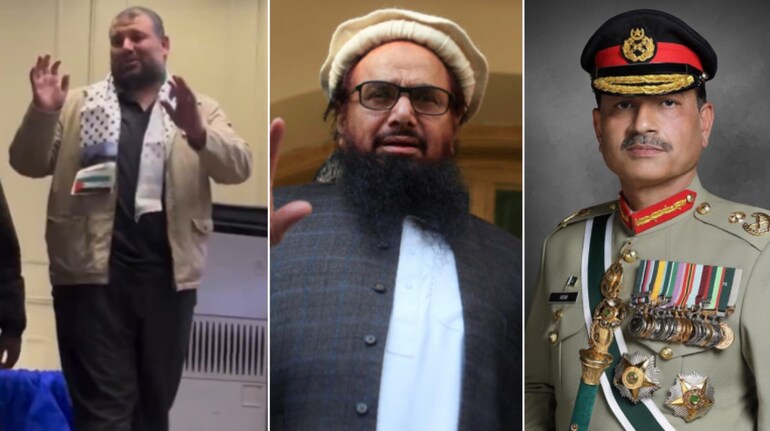

Islamabad is reportedly orchestrating a dangerous new terror nexus, with Pakistan Army Chief Field Marshal Asim Munir at the centre of it, as ties between Hamas and the Pakistan-based militant group Lashkar‑e‑Taiba become publicly visible. Footage and reports emerging from Pakistan show senior Hamas figures attending events hosted by Lashkar’s political front, suggesting deepening coordination between two US-designated terrorist outfits on Pakistani soil even as Rawalpindi seeks to burnish its credentials with Washington over a proposed Gaza stabilisation force.
Senior Hamas commander Naji Zaheer was seen sharing a stage with Rashid Ali Sandhu, a leader tied to Lashkar-e-Taiba, at a function in Gujranwala organised by the Pakistan Markazi Muslim League, widely regarded as a front for LeT. Zaheer attended as the chief guest, underscoring how Islamabad’s deep state appears to be facilitating not just shelter but overt cooperation between terror networks that have bloody track records against Israel and India.
An undated video shows Hamas operative Naji Zaheer meeting a Lashkar commander in Gujranwala, with confirmed links to PoK. From Kashmir, this reinforces #Pakistan’s ISI-backed terror ecosystem exporting violence while denying accountability. pic.twitter.com/kdGlegYbUN— Zaara Nazir زارا نذیر (@NazirZaara) January 7, 2026
This grim development comes at a moment when Pakistan is under pressure from Donald Trump to contribute troops to an international force for reconstruction and stability in Gaza -- part of Washington’s so-called 20-point Gaza peace plan. Pakistan’s own foreign minister Ishaq Dar has said Islamabad could consider peacekeeping roles, but bluntly added that “disarming Hamas is not our job.”
The optics of terrorism are stark. Pakistan, a country long accused of state terrorism and backing militant groups as tools of its regional policy, now looks to be enabling a visible rendezvous between Hamas and Lashkar -- two groups on terror lists of several countries -- even as its military brass sits down with Trump to discuss a purported stabilisation mission. This is a striking example of the duplicity in Islamabad’s posture: publicly courting Washington while privately nurturing terror alliances that undermine global security.
Critics see Pakistan’s moves as a cynical attempt to hedge bets and exploit geopolitical pressures. Videos of Zaheer at a Lashkar venue have reignited concerns that Islamabad treats terror groups not as threats to be neutralised, but as strategic assets to project influence in conflicts far beyond its own borders. Analysts in India have pointed out that ties between Hamas and Pakistan-based outfits have roots stretching back months, including visits to Pakistan-occupied Kashmir just before the deadly Pahalgam terror attack, where guest lists included commanders from Pakistan-linked groups.
The timing is especially troubling. Field Marshal Asim Munir, Pakistan’s most powerful military official, is expected to travel to Washington to meet Trump for the third time in six months to discuss the Gaza force. Washington’s push for Islamabad’s participation places Munir in a tight spot: joining the force risks domestic backlash from Islamist factions opposed to any cooperation with the US or Israel, while rejecting the request could strain Pakistan’s fragile ties with the White House.
Pakistan’s civilian government has backed its army’s strongman approach, and constitutional changes have granted Munir sweeping powers with lifetime legal immunity. These moves have consolidated his authority both at home and abroad, despite mounting evidence that Pakistan’s military establishment continues to give safe harbour to extremist elements.
International observers warn that Pakistan’s duplicity could backfire spectacularly. A visible gathering of Hamas and Lashkar commanders on Pakistani soil sends a chilling message to the world about Islamabad’s real priorities. While it claims to seek stability in Gaza and high-level diplomacy with the US, it appears equally committed to enabling terror networks that have brought death and destruction to civilians across the Middle East and South Asia.
At a time when global powers are trying to isolate Hamas and curb terrorism, Pakistan’s actions lay bare a stark truth: the terror state that harbours Lashkar-e-Taiba and offers a platform to Hamas cannot be trusted to play a constructive role in peace or stability. This duplicity should alarm not only India and Israel but also the entire international community striving for peace in one of the most volatile regions on Earth.
Discover the latest Business News, Sensex, and Nifty updates. Obtain Personal Finance insights, tax queries, and expert opinions on Moneycontrol or download the Moneycontrol App to stay updated!
Find the best of Al News in one place, specially curated for you every weekend.
Stay on top of the latest tech trends and biggest startup news.