






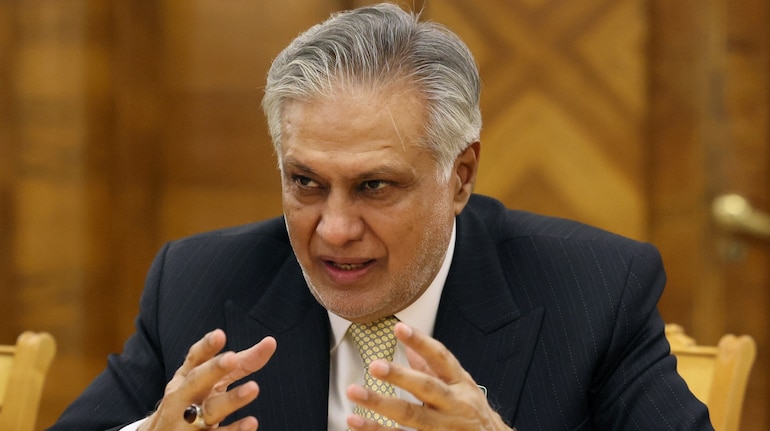

Pakistan’s Deputy Prime Minister and Foreign Minister Ishaq Dar ended his year-end media conference on December 27 with an awkward moment that quietly undercut his entire presentation. When a journalist pointed out that Pakistan’s borders with three of its four neighbours remain shut, Dar visibly fumbled for an answer. The exchange exposed a reality that his lengthy briefing had carefully avoided. Pakistan today is diplomatically isolated in its own neighbourhood.
The press conference, billed as an account of Pakistan’s foreign policy achievements in 2025, instead offered a revealing glimpse into the political class’s denial, grandiosity, and subservience to the military establishment. Dar’s remarks reflected a country detached from its economic fragility, regional isolation and internal contradictions.
A close confidant of Nawaz Sharif and a key figure in the Pakistan Muslim League (N), Dar belongs to the same Kashmiri biradari as the Sharif family. His son is married to Nawaz Sharif’s daughter, reinforcing his place within Pakistan’s entrenched political elite. His words therefore matter, not because they are accurate, but because they reflect the thinking of Pakistan’s ruling class.
From the outset, Dar ignored Pakistan’s economic reality. He claimed that Pakistan, already a nuclear and missile power, could lead the Muslim ummah and even the world if it achieved economic success. The irony was striking. Pakistan remains dependent on external bailouts and survives on borrowed money.
Dar openly thanked Saudi Arabia, China and the UAE for lending Pakistan $5 billion, $4 billion and $3 billion respectively to stabilise its economy. He also revealed that Islamabad wants the UAE to roll over its debt and convert it into investments, an admission that Pakistan lacks the capacity to repay what it owes.
Unless Pakistan undertakes serious structural economic reform and normalises ties with India, it will remain permanently dependent on financial lifelines. Its leadership shows little appetite for either. In this context, Dar’s talk of leading the ummah sounded delusional. There is no vacuum for such leadership, and Saudi Arabia would never tolerate a challenge from Pakistan, regardless of any strategic partnership agreement signed this year.
Much of Pakistan’s current foreign policy euphoria, as reflected in Dar’s remarks, stems from two miscalculations. The first is its distorted reading of the four-day India-Pakistan military confrontation in May. The second is the recent improvement in ties with the United States.
Dar began his statement by presenting Pakistan’s version of the May conflict, which bears little resemblance to reality. He claimed Pakistan achieved “fateh” and asserted that it shot down seven Indian aircraft on the first day. He denied losing any F-16 jets and rejected reports that Pakistan launched drones against 15 Indian targets. He said foreign interlocutors had accepted Pakistan’s version. At the same time, he admitted that the Nur Khan airbase suffered damage and that personnel were injured.
Dar claimed the cessation of hostilities was the result of US and Saudi mediation. He said he was in constant contact with counterparts in the US, Saudi Arabia, the UAE, Iran, China and the UK during the conflict, and argued that these countries wanted to prevent escalation between two nuclear-armed states.
India has consistently rejected this narrative. New Delhi has stated that the halt in fighting was achieved bilaterally after Pakistan’s DGMO contacted his Indian counterpart. India has acknowledged early aircraft losses but also made it clear that it recalibrated its strategy and subsequently struck targets across Pakistan. Any objective assessment shows that this capability forced Pakistan to seek de-escalation.
Dar further claimed the conflict shattered India’s supposed image as a regional security provider and elevated the Jammu and Kashmir issue globally. Both claims are hollow. India has never projected itself as a regional security provider, only as a first responder in humanitarian crises. There is also no international appetite to intervene in Jammu and Kashmir, which India has consistently maintained is a sovereign matter.
On the Indus Waters Treaty, Dar criticised India for keeping the agreement in abeyance but notably avoided calling it an act of war, a shift from Pakistan’s earlier rhetoric. India has made it clear it will act in its national interest on the treaty.
Dar also appeared eager to highlight renewed US attention. He recalled meetings between US President Donald Trump and both Pakistan’s army chief Asim Munir and Prime Minister Shehbaz Sharif. He spoke enthusiastically about rising Pakistani exports to the US and said US tariffs on Pakistan were the lowest in South Asia. He also claimed Washington was interested in investing in Pakistan’s critical minerals and revealed that Islamabad had advocated on Iran’s behalf.
Dar went so far as to boast that Trump’s repeated references to mediating between India and Pakistan were proof of Pakistan’s success. He confirmed that Pakistan had formally recommended Trump for the Nobel Peace Prize for 2026.
On China, Dar insisted that improving ties with the US would not come at Beijing’s expense. He repeated familiar talking points about the strength of Sino-Pakistani relations and proudly stated that Pakistan represents China’s interests in forums where Beijing is absent and counters India’s criticism in multilateral settings. This is the behaviour of a subordinate ally, a role Pakistan has long accepted.
Dar also expressed satisfaction over warming ties with Bangladesh and claimed that all sections of Bangladeshi opinion favour good relations with Pakistan.
Conspicuously absent from his prepared remarks was Afghanistan. During the question-and-answer session, Dar said Pakistan only wants Afghan soil not to be used against it and spoke optimistically about rail connectivity through Afghanistan to Central Asia. What he did not acknowledge is that Pakistan’s problems with Afghanistan stem from Islamabad’s insistence on controlling Kabul’s India policy, something successive Afghan governments have resisted.
The moment when Dar struggled to respond to a question about Pakistan’s closed borders summed up the reality. A country that cannot maintain normal relations with three of its four neighbours is in no position to lecture the world on leadership. Pakistan’s refusal to introspect remains its most enduring foreign policy failure.
Discover the latest Business News, Sensex, and Nifty updates. Obtain Personal Finance insights, tax queries, and expert opinions on Moneycontrol or download the Moneycontrol App to stay updated!
Find the best of Al News in one place, specially curated for you every weekend.
Stay on top of the latest tech trends and biggest startup news.





