







When a suicide bomber ripped through a Shia mosque on the outskirts of Islamabad last Friday, killing more than 30 people, the explosion punctured more than a place of worship. It tore through Pakistan’s carefully constructed narrative of control, stability and strategic relevance. The attack was a stark reminder that despite grand talk of minerals, investment corridors and global partnerships, Pakistan’s generals still cannot secure even the capital’s periphery.
For Field Marshal Asim Munir, the timing could not have been worse. As he courts Washington with promises of copper, lithium and rare earths, the ground reality keeps intruding. Militants strike at will. Insurgents grow more lethal. And the weapons fuelling this violence increasingly bear the stamp “Property of US Govt”.
This is the contradiction at the heart of Pakistan’s pitch to President Donald Trump. Munir offers minerals and stability. What the world sees instead is insecurity, insurgency and a state losing control over its own territory.
A capital shaken, a claim exposed
The Islamic State claimed responsibility for the Islamabad mosque bombing. Pakistani authorities said the attacker opened fire before detonating an explosive vest.
Interior Minister Mohsin Naqvi admitted the impact of the attack, saying at a press conference, “Yesterday’s suicide attack has rattled us.”
That admission alone undercuts months of official claims about improved security. Suicide attacks in Islamabad are rare. That is precisely why this one resonated so deeply. It was the second such attack in the capital in three months, reviving memories of an era Pakistan insists it has left behind.
This is the backdrop against which Munir has been pitching Pakistan as a reliable strategic partner.
The minerals pitch that Washington wants to believe
Pakistan has made its minerals the centrepiece of its renewed outreach to the United States. Officials have spoken of vast untapped reserves of copper, lithium, cobalt, gold and antimony, with some estimates running as high as $8 trillion.
The crown jewel is Reko Diq in Balochistan, one of the world’s largest undeveloped gold and copper deposits. In December, the US Export Import Bank approved $1.25 billion in financing for the project. Canadian miner Barrick Gold describes it as potentially transformative.
Reko Diq is structured as a joint venture. Barrick holds 50 percent. Three Pakistani state owned enterprises hold 25 percent. The remaining 25 percent belongs to the Government of Balochistan.
For Trump, who has made breaking China’s dominance over critical minerals a foreign policy obsession, Pakistan’s offer was enticing. Copper demand alone is projected to rise from about 30 million tonnes today to roughly 50 million tonnes by 2050.
As Dr Gracelin Baskaran, director of the Critical Minerals Security Program at the Center for Strategic and International Studies, told CNN, “Copper will fuel every part of our modern economy, and we’re at a structural shortage.”
Pakistan looked like a shortcut.
The ground truth Munir cannot control
What Munir cannot sell away is geography.
The most valuable mineral deposits lie in Balochistan and along Pakistan’s western borderlands. These are precisely the regions where the state’s authority is weakest and insurgent violence is strongest.
Militant attacks have surged across Balochistan, the former tribal areas and districts bordering Afghanistan. Roads to mining sites pass through territory contested by armed groups that have fought the Pakistani state for decades.
This is not a temporary spike. It is a structural problem.
Michael Kugelman of the Atlantic Council told CNN that Balochistan is both “ground zero for critical mineral opportunities, but it’s also ground zero when it comes to militant threats.”
Munir’s promise to Trump rests on securing these areas. So far, he has failed.
America’s weapons, Pakistan’s insurgents
What has changed the battlefield is not ideology but firepower.
According to a CNN investigation, militants operating in Pakistan are now routinely armed with US made weapons left behind after the chaotic 2021 withdrawal from Afghanistan. These include M 16 and M 4 rifles, M 249 machine guns, Remington sniper rifles and advanced night vision devices.
CNN reporters were shown more than 100 seized firearms in Pakistan’s border regions, all stamped “Property of US Govt. Manufactured in Columbia, South Carolina.”
Defense analyst Muhammad Mubasher told CNN that since 2022 and 2023, such weapons have become routine in clashes with militants.
In Wana, near the Muhammad Khel copper mine, Pakistani officers displayed three M 16 rifles recovered after a suicide attack on a military cadet college. CNN traced their serial numbers through a Freedom of Information Act request to the US Army Material Command at Redstone Arsenal, which confirmed they were originally supplied to Afghan forces.
The Pentagon declined to comment further.
A deadlier war, a cost paid in blood
The consequences are visible in Pakistan’s hospitals.
Colonel Bilal Saeed, the military’s general surgeon in Peshawar, told CNN that the nature of injuries has changed. “Instead of primarily treating IED blast injuries, we are now receiving patients with long range gunshot wounds, sniper hits,” he said.
He added that wounded soldiers increasingly arrive at night because militants now possess “night vision devices.”
For soldiers like 30 year old Allah Uddin, the shift has been catastrophic. Guarding a convoy near Muhammad Khel, he lost both legs in an ambush.
“I don’t know where they were from but the weapons that they had were different and better,” he told CNN.
Later he added, “I am very angry, have you seen my condition? I’ve seen my wounded companions around me, and it makes me even angrier.”
This is the war Munir insists he has under control.
Investors are not convinced
The insecurity is already affecting investment decisions.
According to a Reuters report, Barrick Gold is reassessing its commitment to Reko Diq. Chief executive Mark Hill said on a post earnings call that the company’s board is “reviewing all aspects” of the project due to rising violence.
Barrick said the review would cover security arrangements, construction timelines and capital allocation, and would begin immediately.
This is a direct blow to Pakistan’s mineral diplomacy. Investors see what Islamabad denies.
Official denial, unofficial panic
Pakistani officials continue to project confidence.
Army spokesperson Lt General Ahmed Sharif Choudhry told CNN that the United States “has lot to offer for the people and stability and prosperity of Pakistan.”
He added, “We will resolve it. We have no other option.”
That is not reassurance. It is an admission of desperation.
Retired US Air Force Colonel Scott Yeatmen, who advised the Afghan Air Force before Kabul fell, told CNN that the collapse of Afghan forces was not anticipated. “You are not planning for a collapse. You’re planning to continue to execute operations and prevent the collapse,” he said.
John Sopko, former Special Inspector General for Afghanistan Reconstruction, was blunter. He estimates that around 300,000 US small arms were left behind in 2021, along with heavy weapons and surveillance equipment.
In his words, Afghanistan is now “effectively… the world’s largest arms bazaar,” and “If you want … to outfit your terrorist or insurgency organization, Afghanistan is the place to go.”
Balochistan burns, Islamabad spins
The Balochistan Liberation Army has also emerged as a major threat. US made weapons have been found in its possession as well.
In late January, the group carried out coordinated attacks across Balochistan, killing 33 people according to the Pakistani military. Islamabad responded with Operation Radd ul Fitna 1, claiming 216 militants killed.
The military’s media wing said operations had “significantly degrad[ed]” militant networks, while acknowledging civilian and security force casualties.
Yet Dawn reports that 2025 was Balochistan’s deadliest year on record, with at least 254 attacks and more than 400 deaths. Militants have briefly seized territory, blocked highways and hijacked trains.
This is not control. It is containment at best.
Why Trump’s bet is flawed
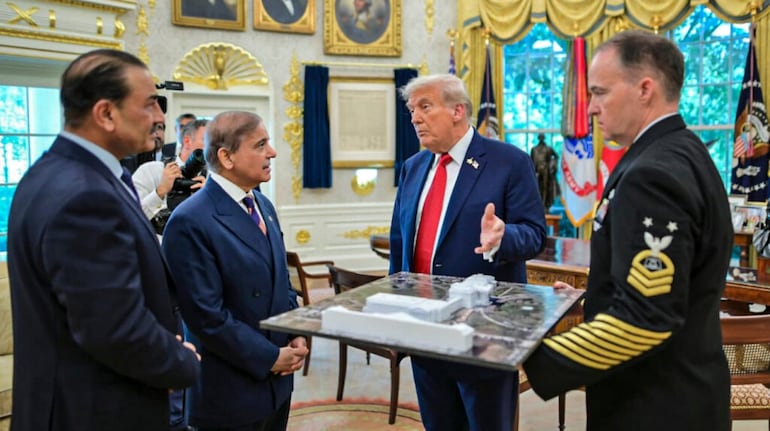
Trump may like Munir. He reportedly called him “My favorite field marshal” after being presented with rare earth samples at the White House.
But minerals cannot be extracted by rhetoric. They require roads, security, trust and stability. Munir controls none of these fully.
Pakistan’s strategy relies almost entirely on force. Internet shutdowns, mass operations and military offensives dominate. Dialogue, political compromise and meaningful power sharing in Balochistan remain absent.
As long as insurgents are better armed and local grievances fester, securing mines like Reko Diq will remain a fantasy.
Munir may have the minerals Trump wants. He does not control the ground they lie in.
Discover the latest Business News, Sensex, and Nifty updates. Obtain Personal Finance insights, tax queries, and expert opinions on Moneycontrol or download the Moneycontrol App to stay updated!
Find the best of Al News in one place, specially curated for you every weekend.
Stay on top of the latest tech trends and biggest startup news.





