






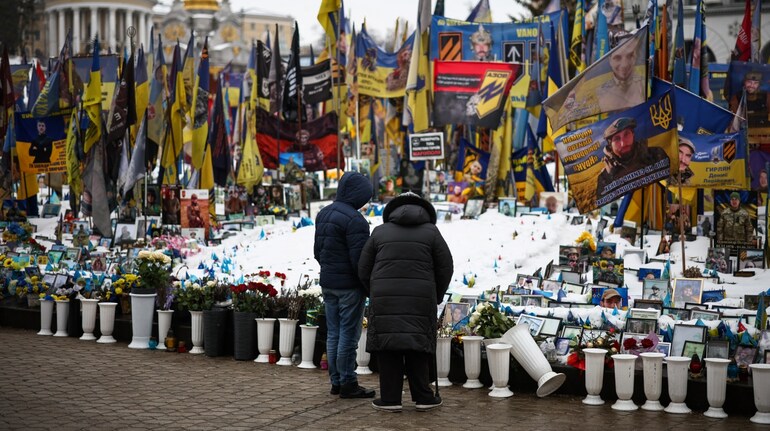

Four years after Russia launched its full-scale invasion of Ukraine in February 2022, the war has hardened into one of the deadliest, costliest, and most destabilising conflicts of the 21st century. What began as a lightning offensive aimed at toppling Kyiv has instead become a grinding war of attrition, reshaping borders, destroying cities, draining economies, and killing on a scale Europe has not witnessed since the Second World War.
The human toll is staggering. The economic damage runs into trillions of dollars. And while front lines have shifted, neither side has secured a decisive victory. As the conflict enters its fifth year, the war’s costs are no longer abstract projections but lived realities etched into lost lives, shattered infrastructure and permanently altered geopolitics.
This is what four years of the Russia-Ukraine war have cost in lives, money and territory.
Human cost: A war measured in graves and displacement
The most irreversible cost of the war has been human life.
According to United Nations, at least 30,457 civilian casualties have been verified in Ukraine since February 2022, including more than 10,500 civilians killed, as of early 2026. UN officials stress that these figures are conservative and likely undercount the real toll due to limited access to occupied areas and ongoing hostilities.
“The actual figures are likely considerably higher,” the UN has repeatedly warned.
Military casualties remain heavily disputed, but estimates compiled by PBS NewsHour, The Telegraph, and The Economic Times suggest combined Russian and Ukrainian military deaths may exceed 500,000, with total casualties including wounded running well above one million.
Ukraine has paid a particularly heavy demographic price. Tens of thousands of trained soldiers have been lost, while millions of civilians have been displaced. The UN estimates that nearly 6.5 million Ukrainians remain refugees abroad, with another 3.7 million internally displaced, making this the largest displacement crisis in Europe since the 1940s.
Entire towns have been emptied. Families remain separated years after fleeing. Children have grown up knowing only air raid sirens and blackouts.
Cities destroyed and civilian life shattered
Beyond deaths, the war has erased entire urban landscapes.
According to UN damage assessments cited by PBS NewsHour, more than 2 million homes in Ukraine have been damaged or destroyed. Entire cities such as Mariupol, Bakhmut and Avdiivka have been reduced to rubble.
Hospitals, schools and power infrastructure have been repeatedly targeted. Ukraine’s energy grid has suffered waves of missile and drone strikes, plunging cities into winter darkness.
UN Secretary-General António Guterres described Ukraine as “a country turned into a battlefield where civilian life has been systematically shattered”.
Territorial cost: Who controls what after four years
Territory has been one of the war’s central prizes and one of its most volatile variables.
At the peak of Russia’s advance in March 2022, Moscow’s forces occupied nearly 27 percent of Ukraine’s territory, including areas around Kyiv, much of southern Ukraine, and vast tracts of the east.
Ukraine’s counteroffensives in late 2022 and 2023 pushed Russian forces back from northern Ukraine and reclaimed most of Kharkiv region and the city of Kherson.
As of early 2026, according to The Telegraph and The Economic Times, Russia controls roughly 18 percent of Ukrainian territory. This includes most of Crimea, large parts of Donetsk and Luhansk, and sections of Zaporizhzhia and Kherson regions.
Ukraine has not ceded this land legally. Kyiv insists all occupied territory remains sovereign Ukrainian land and has vowed to reclaim it. Russia, however, has illegally annexed several regions on paper and integrated them into its administrative system.
The front line has largely stabilised over the past year, turning the conflict into a static but deadly war of artillery, drones and attrition.
Economic destruction: Ukraine’s shattered economy
Ukraine’s economy has suffered devastation on a scale unseen in modern Europe.
According to the United Nations, direct physical damage to Ukraine’s infrastructure exceeds $195 billion, including destruction of housing, transport networks, energy facilities and industrial sites.
Ukraine’s GDP collapsed by nearly 30 percent in 2022, the sharpest contraction in its modern history. While partial recovery followed due to foreign aid and wartime adaptation, the economy remains deeply scarred.
The World Bank and UN estimate that rebuilding Ukraine will cost more than $486 billion over the next decade, a figure that continues to rise as fighting persists.
Entire industrial sectors have been wiped out. Agriculture, once Ukraine’s economic backbone, has been crippled by mined farmland, destroyed silos and blocked ports.
Russia’s economic cost: Sanctions, stagnation and militarisation
Russia has avoided economic collapse, but the long-term damage is profound.
Sanctions imposed by Western nations have frozen hundreds of billions of dollars in Russian assets, restricted access to technology, and cut Moscow off from key export markets.
While wartime spending has propped up industrial output, economists warn this masks structural decay. Russia’s economy has become heavily militarised, with civilian investment crowded out.
According to analyses cited by The Telegraph, Russia’s long-term growth potential has been severely downgraded. Living standards have stagnated, inflation remains elevated, and skilled labour shortages are worsening as young men are mobilised or flee abroad.
The global bill: A $2.4 trillion war
The full economic cost of the war extends far beyond Ukraine and Russia.
A landmark analysis by the Centre for Economic Policy Research estimates that the total global economic cost of Russian aggression is close to $2.4 trillion.
“The estimates suggest the cost of the war is close to $2.4 trillion, but even this projection likely understates the full scale of economic harm,” the CEPR report states.
The study, authored by Yuriy Gorodnichenko and Michael Vasudevan, analysed professional forecasts from 29 countries, comparing expectations before and after the invasion.
Forecasters predicted the war would be “highly stagflationary” for both Ukraine and Russia, reducing GDP while raising prices. Eastern Europe experienced spillover effects, while energy shocks rippled across global markets.
Europe faced soaring gas prices, forcing governments to spend hundreds of billions on energy subsidies. Food prices surged worldwide as Ukrainian grain exports were disrupted, pushing millions closer to hunger in developing nations.
Energy, food and global instability
Russia’s invasion weaponised energy and food supply chains.
Ukraine and Russia together had supplied nearly 30 percent of global wheat exports before the war. Blockades and attacks on ports sent shockwaves through food markets, particularly in Africa and the Middle East.
Energy markets were equally destabilised. Europe scrambled to replace Russian gas, reshaping global LNG flows and pushing prices to historic highs in 2022 and 2023.
The war also accelerated military spending worldwide. NATO countries boosted defence budgets, while non-aligned nations reassessed security doctrines.
A war with no clear end
Four years on, the war has settled into a brutal equilibrium.
Russia has failed to subjugate Ukraine. Ukraine has not yet reclaimed its occupied territories. Both sides have absorbed catastrophic losses, while civilians continue to pay the highest price.
The UN has warned that “each additional year of war compounds the damage and deepens the suffering”.
The cost of the conflict is no longer just Ukrainian or Russian. It is global, structural and generational.
Lives lost cannot be recovered. Cities can be rebuilt only at immense expense. And the political order that existed in Europe before February 2022 is unlikely to return.
Four years into the war, the bill continues to rise, measured not only in dollars and territory, but in a generation shaped by conflict whose end remains painfully uncertain.
Discover the latest Business News, Sensex, and Nifty updates. Obtain Personal Finance insights, tax queries, and expert opinions on Moneycontrol or download the Moneycontrol App to stay updated!
Find the best of Al News in one place, specially curated for you every weekend.
Stay on top of the latest tech trends and biggest startup news.





