







Apple has refreshed the MacBook Air with its new M5 chip — but beyond performance upgrades and double the storage, little has changed. What has changed is the price. The new model costs $100 more across the board.
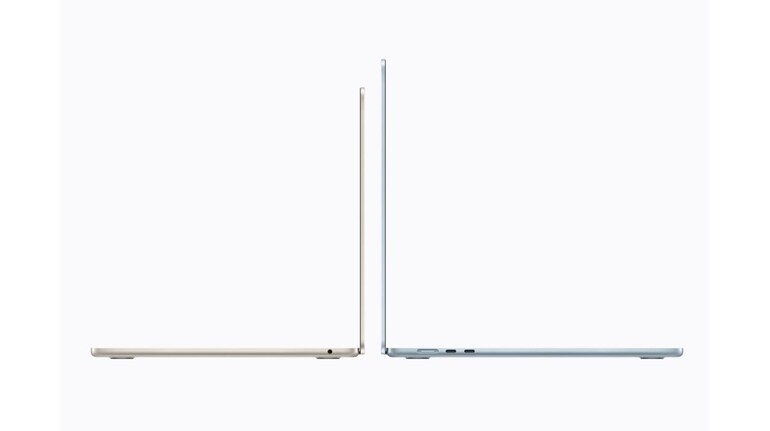
At first glance, the MacBook Air M5 looks virtually identical to the MacBook Air M4. Same thin aluminium chassis. Same port selection. Same display. Same battery claims. The differences sit squarely under the hood.
Performance and storage: the real upgrades
The headline improvement is the new M5 chip, which Apple says delivers stronger CPU and GPU performance. Unified memory is reportedly 28% faster, while AI performance is claimed to be up to four times quicker compared with the M4.
That kind of jump won’t necessarily matter to casual users browsing, streaming or writing emails. But Apple says professionals rendering 3D projects in Blender could see up to a 50% speed boost — a substantial gain for creative workloads on a thin-and-light machine.
Base storage has also doubled. The entry configuration now starts at 512GB instead of 256GB, with upgraded variants beginning at 1TB. That makes the price bump easier to swallow, at least on paper.
There’s also a quieter upgrade: faster SSD speeds. Apple says read and write performance has effectively doubled. In real-world terms, that should mean quicker file transfers, snappier imports and potentially marginally faster boot times.
The M5 model includes Apple’s new N1 connectivity chip, enabling Wi-Fi 7 and Bluetooth 6 support. Unless you’re on an ultra-high-speed fibre connection, however, you’re unlikely to fully exploit that bandwidth ceiling.
Battery life remains unchanged. Apple continues to claim up to 18 hours of video streaming and 15 hours of wireless web use — figures that align closely with real-world testing of the M4.
Design, display and ports: no surprises
Design-wise, nothing moves. The 13-inch model measures 11.97 x 8.46 x 0.44 inches and weighs 2.7 pounds, while the 15-inch comes in at 13.4 x 9.35 x 0.45 inches and 3.3 pounds.
Colour options remain understated: blue, silver, beige and black. Ports are equally restrained — two Thunderbolt 4 ports and a headphone jack. No additional connectivity, no SD card slot, no HDMI.
The display story is also unchanged. Both models feature Liquid Retina LED panels at 224 ppi with up to 500 nits of brightness. The 13-inch version carries a 2,560 x 1,664 resolution, while the 15-inch steps up to 2,880 x 1,864.
There’s still no OLED option — something competitors in this price bracket increasingly offer. That said, Apple’s panels remain sharp and vibrant enough for most users, particularly indoors.
Speaker configurations stay the same: four speakers on the 13-inch and six on the 15-inch. Expect clear, loud audio, though not earth-shaking bass.
macOS Tahoe and Apple Intelligence
The M5 ships with macOS Tahoe, bringing the same Liquid Glass redesign and Apple Intelligence features available on the M4.
Apple says AI-driven tasks benefit most from the new chip’s architecture, with up to 4x faster processing. Even everyday features such as live translation and on-device AI suggestions could feel more responsive.
Should you upgrade?
If you already own the M4 model, there’s little reason to rush out and upgrade. The performance gains are real but incremental for most users, and the design remains unchanged.
If you’re coming from an older Intel MacBook Air or even an early Apple Silicon model, the M5 looks more compelling — particularly with 512GB now standard.
For now, the MacBook Air M5 feels less like a reinvention and more like a careful spec recalibration — faster, roomier, and undeniably more expensive.


Discover the latest Business News, Sensex, and Nifty updates. Obtain Personal Finance insights, tax queries, and expert opinions on Moneycontrol or download the Moneycontrol App to stay updated!
Find the best of Al News in one place, specially curated for you every weekend.
Stay on top of the latest tech trends and biggest startup news.







