Google's recent Play Store policy overhaul marks a 'meaningful shift' for the Indian developer ecosystem and could unlock new opportunities to scale and reach global audiences, startup founders and tech executives told Moneycontrol.
However, industry leaders expressed concerns that India may have to wait significantly longer for the rollout compared with markets such as the US and Europe.
"By lowering commissions and making room for alternative billing and third-party app stores, Google is effectively broadening the monetisation and distribution stack available to developers on Android," said Anuj Tandon, Partner - India & UAE, Bitkraft Ventures, a US-based early-stage venture capital firm.
“This is a good start that will enable improvement in capital efficiency for startups building in mobile gaming, creator platforms, and digital entertainment,” he added.
'Watershed moment for mobile gaming'
Vishal Gondal, founder of nCore Games, called it a 'watershed moment' for mobile gaming in India. "Lower commissions and alternative billing will meaningfully improve unit economics for Indian developers, particularly indie studios and mid-sized game makers," he told Moneycontrol.
Gondal, who is also the co-chair of games industry body Indian Game Publishers and Developers Association (IGPDA), however said India waiting until September 2027 while the US and Europe getting these benefits by June 2026 is "deeply concerning".
"In today's AI-driven, fast-moving digital economy, a 15-month lag is simply unacceptable. We will continue to engage with Google to ensure India is not treated as an afterthought," he told Moneycontrol.
Google Play's new service fee structure
Earlier this week, Google lowered its app commissions to 20 percent as part of an overhaul of its Play Store business model. These changes are also expected to provide developers with more flexibility and choice in how they manage transactions.
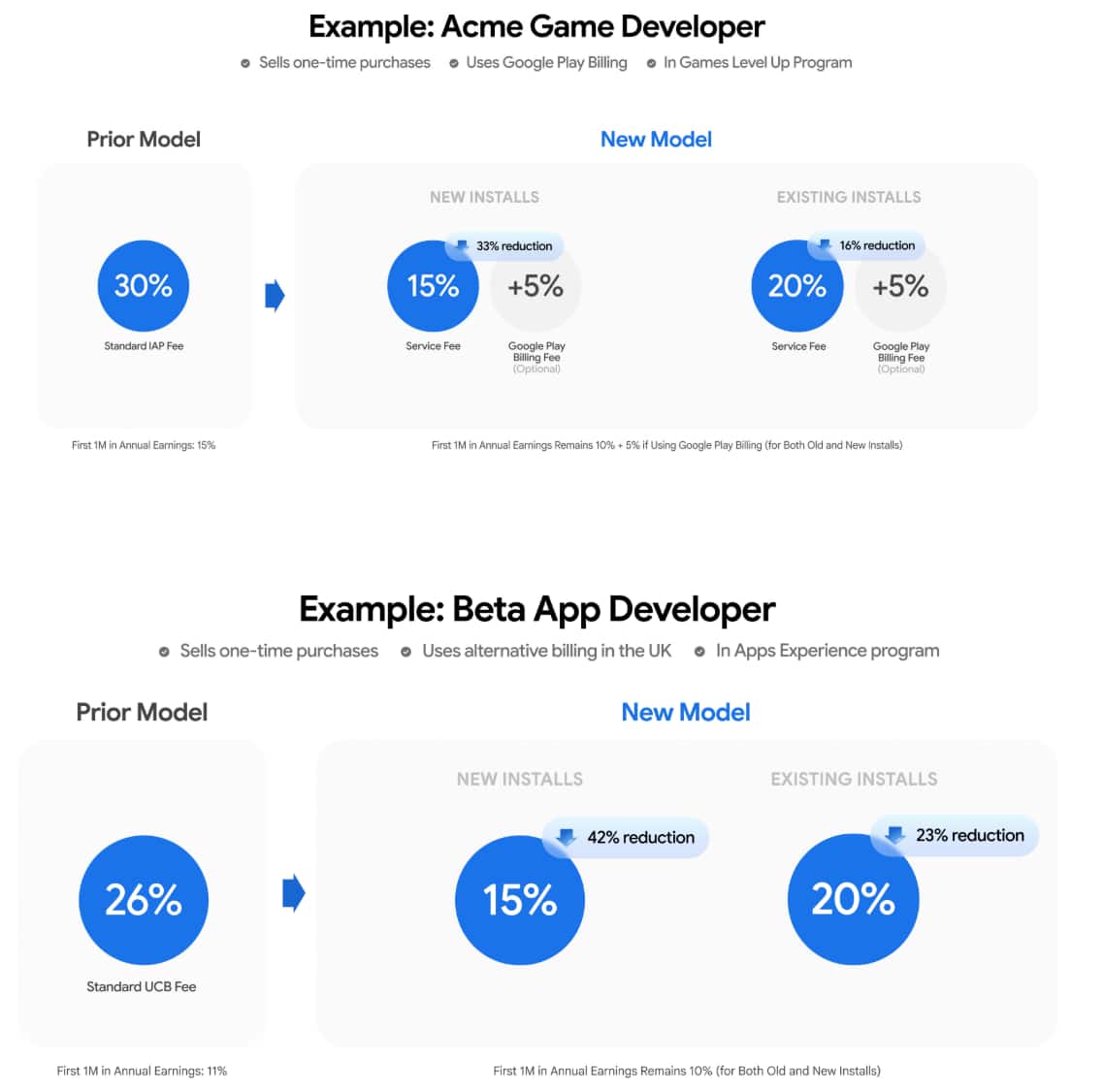 A look at the old and new Google Play fee structures (Image: Google)
Google will allow app developers to use their own billing systems in their mobile apps alongside Google Play at reduced fees and enable them to direct users to their own websites for purchases.
The company is also introducing a new "Registered App Stores" programme that will provide a more streamlined installation flow for third-party Android app marketplaces.
Manish Agarwal, board member of games industry body Game Developer Association of India (GDAI), said these changes can further strengthen the country’s position as an emerging hub for game development and interactive media.
"The move to open Android’s ecosystem and rethink traditional platform commissions reflects a broader global shift toward more developer-friendly digital marketplaces," Agarwal said "For India’s rapidly growing gaming sector, greater flexibility in distribution and billing models could unlock new opportunities for studios to scale, innovate, and reach global audiences."
Registered app stores rollout
Priya Narasimhan, Chief Business Officer at Indus Appstore, a PhonePe-owned local rival to Google Play Store, told Moneycontrol she hoped to see an early launch of these features in India, along with "more transparent and fair terms defining registered app stores."
"We have consistently advocated for a level playing field for both, Indian app stores and developers. India's vibrant digital ecosystem has progressed despite a closed loop app ecosystem, any step towards greater openness is highly appreciated," she said.
Indus Appstore, which launched in February 2024, claimed to have hit the 10-crore device mark as of September 2025. It currently supports 12 Indian languages, apart from English.
Google's new Registered App Stores programme is expected to benefit third-party app marketplaces by reducing friction and the "scare screens" users typically encounter when sideloading them.
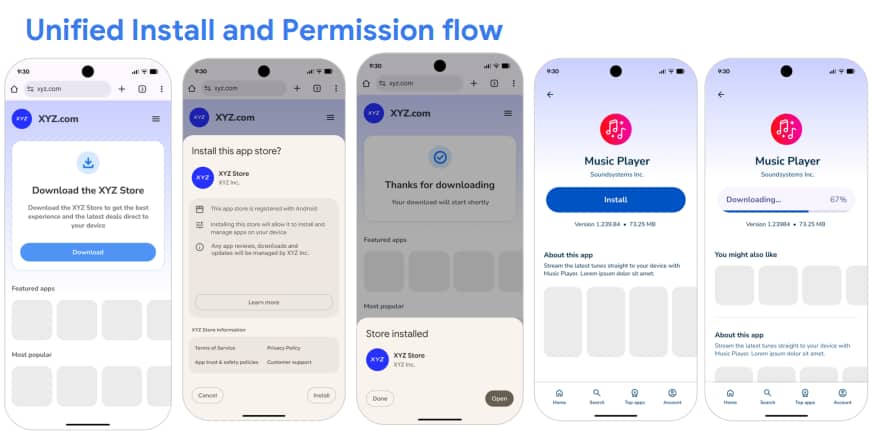 A look at the new install flow in Google's Registered Apps programme (Image: US District Court)
These marketplaces will however be reviewed by the company's Android team and they will have to meet "certain quality and safety benchmarks". They will also have to pay a one-time fee, the tech giant stated.
The programme is initially expected to launch outside the United States, with the tech giant intending to bring it to the United States later, subject to court approval.
According to a term sheet filed with the US Court, Registered App Stores initiative is expected to launch outside the United States no later than the second major quarterly release of Android 17 later this year.
‘Could encourage more experimentation’
"Google lowering Play Store commissions and enabling external billing and third-party app stores is a meaningful shift for the developer ecosystem," said Felicity Games co-founder Anurag Choudhary "For mobile game studios, where platform fees have long influenced distribution economics, this can meaningfully improve operating capital at a time when the cost of game production and competition are rising."
Greater flexibility in payments and distribution could encourage more experimentation from smaller studios and new entrants, Choudhary added.
Metasports co-founder Kashyap Reddy echoed a similar view, saying it is a positive step toward a higher-quality and sustainable developer ecosystem.
"For Indian game studios, platform fees directly impact how much we can invest back into building great games," he said.
As part of the new policy changes, Google is separating the fees for using its billing system and reducing the in-app purchase (IAP) service fees it charges developers from the standard 30 percent.
Participating IAP developers will now pay a service fee of 15 percent on transactions from first-time app installs from users and 20 percent for transactions from existing installs.
Developers using Google Play’s billing system will be charged a separate market-specific rate, which will currently be 5 percent in the European Economic Area (EEA), the United Kingdom, and the United States.
Google will begin rollout of the updated rates in EEA, the United Kingdom, and the United States by June 30, 2026, Australia by September 30, Korea and Japan by December 31, and the rest of the world by September 30, 2027.
India antitrust probe
Over the years, Google has faced intense backlash from developers, particularly in India, over its app policies, including the mandatory integration of its Play billing system worldwide and the commission fees it levies. Several app developers have previously said these fees were "extremely high" and "unfair".
India's antitrust watchdog the Competition Commission of India (CCI) fined Google over Rs 936.44 crore in 2022, apart from issuing measures to modify the company's app payment policies. In March 2025, The National Company Law Appellate Tribunal (NCLAT) partially upheld key aspects of CCI's order but reduced the fine to about Rs 216.69 crore.
The issue also sparked an intense standoff between Google and prominent domestic internet firms such as Matrimony, Info Edge (which runs Naukri, 99acres, and Jeevansathi), and Shaadi.com in 2024, after the tech giant delisted more than a hundred apps from the Play Store. The apps were eventually reinstated following government intervention.
India is among the biggest markets for Google Play in terms of app downloads and users. The Android operating system also powers around 95-96 percent of the country's 700-million strong smartphone market.



Discover the latest Business News, Sensex, and Nifty updates. Obtain Personal Finance insights, tax queries, and expert opinions on Moneycontrol or download the Moneycontrol App to stay updated!
Find the best of Al News in one place, specially curated for you every weekend.
Stay on top of the latest tech trends and biggest startup news.