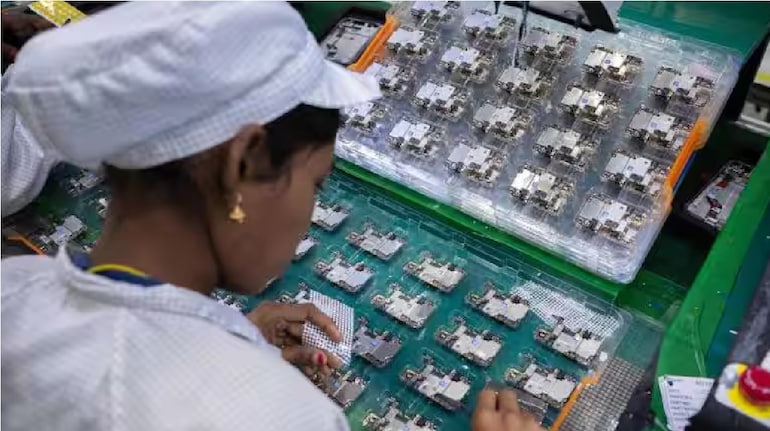

India’s electronics manufacturing industry has called on the government to correct tariff distortions and ease regulatory bottlenecks in the Union Budget 2026–27, warning that duty anomalies are raising costs and undermining the country’s ambition to become a global electronics hub.
In its pre-Budget memorandum, the Indian Cellular and Electronics Association (ICEA) has sought rationalisation of Basic Customs Duty (BCD) across mobile phone components, wearables, display assemblies and capital goods, along with reforms to the Manufacturing and Other Operations in Warehouse Regulations (MOOWR) scheme.
For wearables and hearables — among the fastest-growing segments — ICEA has proposed cutting duty on finished products from 20% to 15% to align with India’s tariff roadmap. It has also urged the government to reduce duty on mechanical parts used in wearables from 15% to 10%, bringing them in line with mobile phone components.
A key concern is the inverted duty structure on display assemblies used in automobiles, medical devices and industrial electronics. Currently, both finished displays and critical inputs attract 15% duty, offering little incentive for domestic value addition. ICEA has recommended retaining 15% on finished assemblies while reducing duty on inputs and sub-parts to zero, similar to the framework for mobile phones and televisions.
The industry has also flagged anomalies in advanced components such as inductor coil modules used for wireless charging in smartphones, where inputs attract higher duties than the finished module. ICEA has proposed eliminating duties on parts while maintaining the existing 10% levy on the final product to support local manufacturing.
Capital goods present another challenge. While fully built equipment for mobile phone manufacturing often attracts zero duty, components required to produce such machinery domestically face tariffs of up to 20%. ICEA has urged the government to extend zero-duty benefits to all components and sub-assemblies used in capital equipment manufacturing to encourage local production.
Beyond tariffs, the association has sought uniform customs classification of display assemblies under HSN 8524, irrespective of end use, to reduce disputes. It has also called for a separate tariff line for Interactive Flat Panel Displays (IFPDs), arguing that their current classification alongside conventional monitors does not reflect technological differences.
On the operational side, ICEA has recommended allowing depreciation on capital goods cleared into the domestic market under MOOWR, extending RoDTEP benefits to warehouse units, simplifying ex-bond clearance procedures and granting deemed AEO Tier-1 status to MOOWR entities. It has also sought formal recognition of a standard wastage norm of up to 2% in mobile phone manufacturing, citing unavoidable process losses.
ICEA, whose members include Apple, Foxconn, Xiaomi, Oppo, Vivo, Dixon and Jabil, has additionally proposed reducing import duties on key handset sub-assemblies such as microphones, receivers and speakers from 15% to 10%, noting that even minor components can create cascading cost pressures. It has also recommended lowering duties on PCBAs and FPCAs to 10%, estimating minimal revenue impact as a large share of imports is used for exports.
The industry said these measures would reduce cost distortions, improve ease of doing business and strengthen India’s competitiveness amid shifting global supply chains.


Discover the latest Business News, Sensex, and Nifty updates. Obtain Personal Finance insights, tax queries, and expert opinions on Moneycontrol or download the Moneycontrol App to stay updated!
Find the best of Al News in one place, specially curated for you every weekend.
Stay on top of the latest tech trends and biggest startup news.