






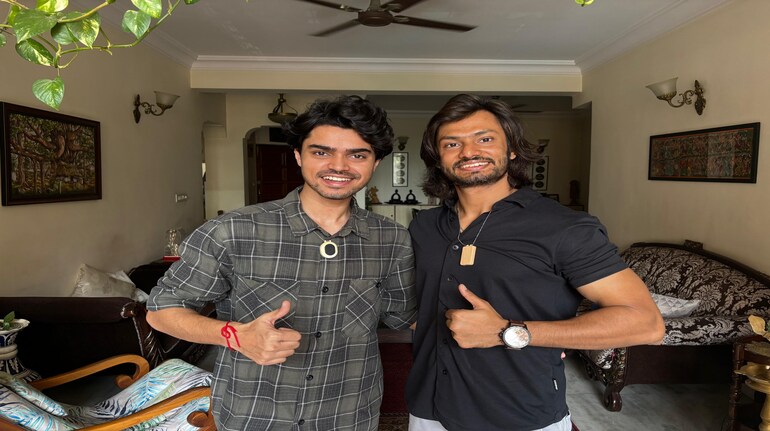
Do you forget to mention all the points while making a presentation or do you feel like watching a concert this weekend but don't know where to go?
Well, the "second brain" can help you.
Bengaluru-based startup NeoSapien has developed a Generative Artificial Intelligence-powered device in the form of a necklace, touted as the "second brain", which can help you solve such issues.
In an era where humans consume memories equivalent to somewhere around 74 GB of data per day, the ability to retain and process data has hit a low of just 2 percent, according to the founders of NeoSapien.
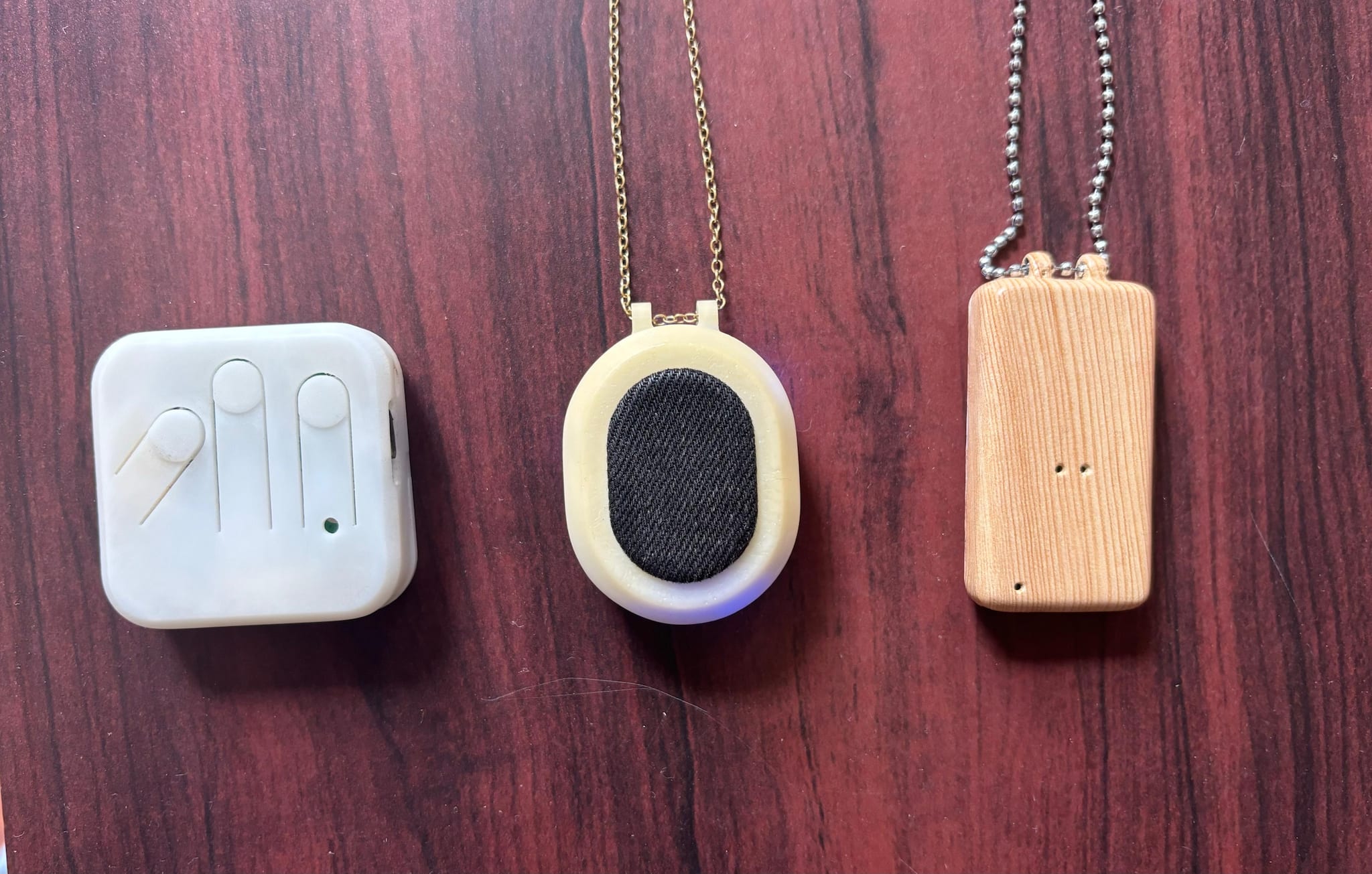 (Left to right) NeoSapien's Neo S1 Generation 1, 2, and 3
The startup’s product -Neo S1- listens to conversations and acts as a reminder and decision-making support.
It has caught the eye of the who’s who of the investors world. In June, Peak XV’s managing director Rajan Anandan took to X (formerly Twitter), saying that the product fully analysed the evenings' conversations with him and the founders of NeoSapien's Dhananjay and Aryan Yadav.
“If you are meeting your boss with your notes, you can write that in the app. It understands what you have spoken and what you have missed out. It will discreetly vibrate to remind you to talk about the pending points as well in real time,” Dhananjay told Moneycontrol.
This writer used the device and the accompanying app, which aptly described the brief conversation he had with the founders just before the interview. The device summarised a 5-minute discussion about an accident in Bengaluru he witnessed while on the way into a brief paragraph.
The Yadavs who hail from Madhya Pradesh decided to register the company in 2024 after working in various corporate roles.
While Aryan is an IIT-Madras alumnus, Dhananjay completed his MBA from Bengaluru’s Christ University. Aryan has worked for companies such as ICICI Bank and Siemens Technology, while Dhananjay has worked for over a decade for firms such as Vodafone Idea and Razorpay. Both of them have founded separate companies before joining hands for NeoSapiens.
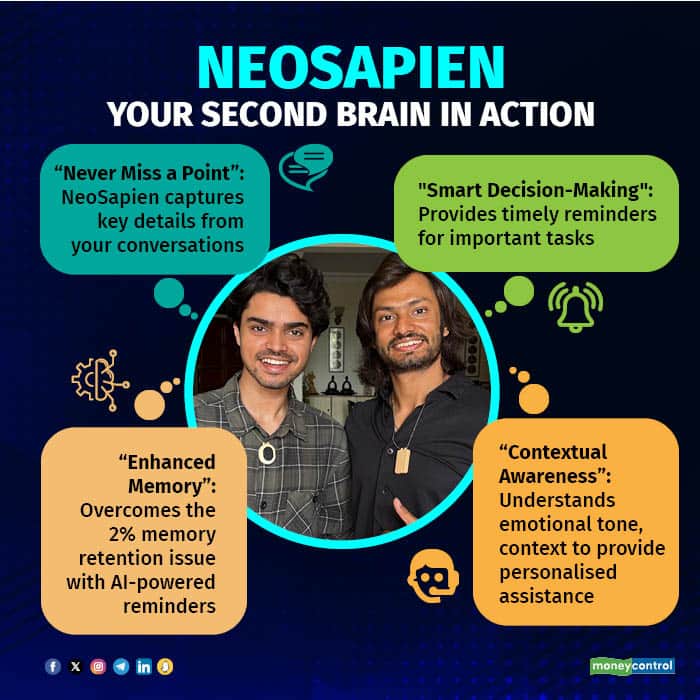
Modus operandi
The bootstrapped startup’s “second brain” operates as a personal assistant, capturing, processing, and organising vast amounts of voice-based conversations and storing it as information in real-time. The wearable pendant listens to your conversations and understands context using advanced speech recognition and AI. Developed in less than six months, the Neo S1 identifies details like names, dates, and tasks, storing them locally on the device as well as on servers.
A user can access the transcripts through a mobile-based app.
Neo S1’s technology categorises and retains information as either short-term or long-term memory.
“We believe that personal assistant is on its way to becoming the next big thing; it's going to be a generational shift,” Aryan said.
The memory crisis
What NeoSapien seeks to solve is what many of us face daily: the overload of information and the inability to retain it and take action. There has been an explosion of data in the past few years, with 75 percent of the world’s data created in just the last five years, explained Aryan.
Have you ever checked in your flight or registered for digi-yatra at the last moment? Dhananjay and Aryan say the necklace will act as a personal assistant or like a second brain, reminding you to do exactly that and more so, without a prompt.
When a user talks about flight bookings, the device picks up on this and takes action. By analysing preferences—such as favourite airlines, preferred seating class, and travel schedules— it will be able even to book flight tickets.
The device integrates with a user’s online calendar and ensures that overlaps are avoided.
Is it novel?
While this might sound unique, NeoSapien is entering a competitive field. Dhananjay and Aryan say their biggest rival is US-based Neuralink, the brain-to-computer interface project backed by serial entrepreneur and businessman Elon Musk.
However, NeoSapien differentiates itself by offering a non-invasive solution. Unlike Neuralink, which would mean implanting a chip in the brain, NeoSapien remains an external device that is fashionable, unobtrusive, and can be easily integrated into daily life.
A comparable device in a similar space would be California-based Humane Inc.’s AI Pin, released in April. The company, after having raised $200 million from notable investors like OpenAI’s CEO Sam Altman, received a lukewarm response from customers. Recent reports suggest customers are returning the product at a faster rate than they are buying.
AI Pin is a multi-modal wearable device for making calls, sending messages, seeking answers, taking notes, or managing the digital world. Interestingly, even AI Pin is being called the “second brain” by Humane Inc.
Another product that is remotely comparable to Neo S1 is a US-based startup named Rabbit AI, which raised over $30 million in funding. Its R1 device, released in January, failed to impress most users. R1 was released as a personal AI assistant that can be used to seek answers at the press of a button.
Experts and users complained that the response time of both the devices was too high at about 10-12 seconds for voice-based queries. Also, their batteries lasted for less than 24 hours.
In comparison, NeoSapien says the Neo S1’s response time is 2-3 seconds and the battery lasts for around 3 days.
The legalities
Regarding the storage of what it refers to as "long-term memory," data collected will be kept on servers hosted by the company. The founders hinted that this part could be another source of minting money, going forward.
When asked about privacy and regulatory concerns, NeoSapien assured that data in its entirety is encrypted. And personal details such as credit card details are never stored.
Nonetheless, when asked if the product complies with the Digital Personal Data Protection (DPDP) Act, 2023, the company said it is in compliance with Personal Identifiable Information (PII) guidelines, which are generally accepted as rules for handling consumer data globally.
Besides, the pendant’s light-emitting diode (LED) switches on when active, signifying the device is listening. It also has an in-built wake-up call feature, implying consensus of people other than the user.
Outlook
As NeoSapien gears up for its official launch by November, it will be keenly watched if the breakthrough manages to change our digital lives. For those tired of forgetting critical details or overwhelmed by the sheer volume of daily information, NeoSapiens may be the answer.
“Why people are very excited about this is because we are the first truly original company to come out of India, which is doing something very unique,” Dhananjay added.
The company plans to roll out about 50 prototypes by the end of this month for beta testing.
The Neo S1 and further versions will be beneficial for the hearing impaired, too. Providing real-time transcription of spoken conversations will power those with hearing disabilities to engage fully in verbal interactions.
The device can even assist in responding to conversations, making communication smoother and more accessible for the deaf.
Giving a glimpse as to what the product can do in the future, Dhananjay said, “Based on past data, it understands what cuisine you like and maybe what’s your calorie target. Rather than you going to a Zomato or a Swiggy, you can tell the device I am very hungry and tired, can you order something for me? And it can actually order for you.”


Discover the latest Business News, Sensex, and Nifty updates. Obtain Personal Finance insights, tax queries, and expert opinions on Moneycontrol or download the Moneycontrol App to stay updated!
Find the best of Al News in one place, specially curated for you every weekend.
Stay on top of the latest tech trends and biggest startup news.






