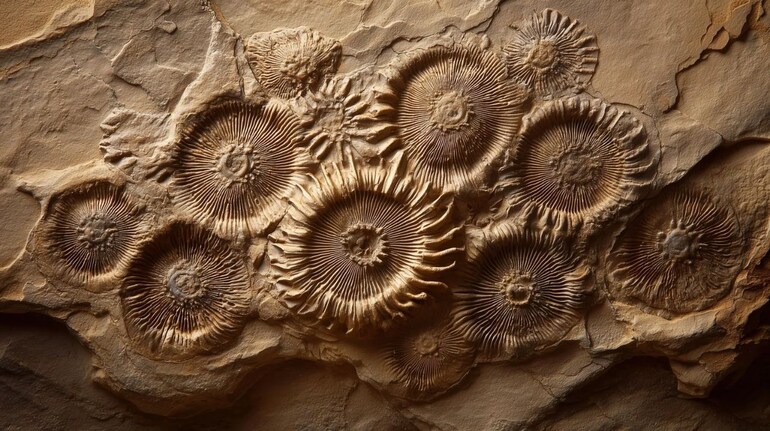

Scientists have solved a 570-million-year-old fossilisation mystery on Earth. Ediacaran soft-bodied organisms left detailed impressions in sandstone rock. Normally, sandstone washes away delicate tissues very quickly over time. Yet these fossils show incredible patterns and preserved organic structures.
Pioneers Uncovering Earth’s Earliest Life
Researchers from multiple universities led this groundbreaking study with precision. A recent study was led by Tarhan and her colleagues which was published last month in the journal Geology.
They combined sedimentology, chemistry and palaeontology to understand fossil preservation. Using advanced imaging and mineral analysis, the team revealed hidden details. Their work explains how fragile organisms survived in sandstone for millions.
What Did Scientists Explain?
The team revealed that ancient seawater chemistry preserved delicate tissues. Clay minerals formed around organisms, cementing sand grains in place. This natural process protected soft tissues from decay and erosion. It explains why such fragile organisms left detailed impressions.
Where Was This Fossil Found?
The fossils were discovered in a well-studied Ediacaran sediment layer. This site has sandstone deposits that normally destroy organic remains. The location preserves global examples of the Ediacara Biota. These ancient creatures lived in oceans hundreds of millions years ago.
The Mystery of Ediacara Biota
The soft-bodied fossils rarely survive, making these exceptionally rare. The mystery was how fragile organisms could appear in sandstone. The new research shows that ancient seawater chemistry created conditions that preserved these fragile organisms. The study explains this by showing clay cementing and chemical preservation. Yet many Ediacaran lifeforms still puzzle scientists due to unusual shapes.
Preservation of Fossils
Ancient seawater chemistry played a crucial role in preservation. Clay minerals formed around the organisms after burial in sediments. These minerals acted like natural cement, holding sand grains together.
The process protected soft tissues from decay and water erosion. Fossils show jellyfish-like shapes and other bizarre, early life forms. Researchers call this the Ediacara Biota, predating the Cambrian Explosion.
Ediacara Biota is still in Preservation
Understanding preservation helps scientists interpret early life on Earth. It shows how fragile organisms can survive hundreds of millions years. Environmental conditions, not just hard body parts, affect fossilisation chances.
This explains why some ancient organisms are so well preserved globally. Researchers can now reconstruct Ediacaran ecosystems with more confidence. They reveal the diversity of life before complex animals evolved.
Discover the latest Business News, Sensex, and Nifty updates. Obtain Personal Finance insights, tax queries, and expert opinions on Moneycontrol or download the Moneycontrol App to stay updated!
Find the best of Al News in one place, specially curated for you every weekend.
Stay on top of the latest tech trends and biggest startup news.