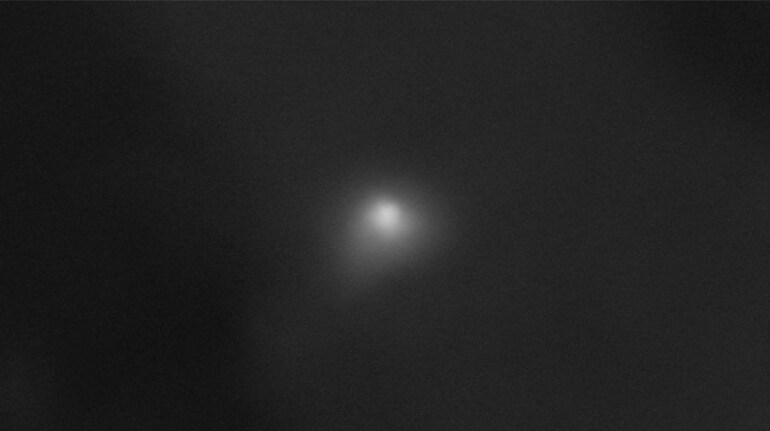
NASA has released new images of comet 3I/ATLAS after a long delay. The object drew strong online interest because of its unusual path.
Why is comet 3I/ATLAS important for scientists?
The comet is the third interstellar visitor seen here. The earlier objects were 1I/ʻOumuamua in 2017 and 2I/Borisov in 2019. The comet gives experts rare material from another star system. NASA pointed many spacecraft at it to record fresh views. The inner Solar System acted like a large observatory during its passage. A six-week US shutdown delayed public release of all images. NASA said twelve assets gathered pictures since its discovery on July 1. More probes will still observe the comet from new viewing angles.
How did Mars missions capture the closest images?
The closest published imagery came from spacecraft near Mars. Perseverance used Mastcam-Z to image it on Oct 4. MAVEN collected ultraviolet pictures from Mars orbit on Oct 9.
 An ultraviolet composite from NASA’s MAVEN spacecraft shows hydrogen around interstellar comet 3I/ATLAS near Mars on Sept 28, 2025, revealing hydrogen from the comet, Mars, and interplanetary space using MAVEN’s specialised ultraviolet spectrograph. (Image: NASA/Goddard/LASP/CU Boulder)
HiRISE on Mars Reconnaissance Orbiter imaged it on Oct 2. The comet was around 19 million miles from Mars then.
 The High Resolution Imaging Science Experiment (HiRISE) camera aboard NASA’s Mars Reconnaissance Orbiter captured this image of interstellar comet 3I/ATLAS on Oct. 2, 2025. At the time it was imaged, the comet was about 0.2 astronomical units (19 million miles, or 30 million kilometers) from the spacecraft. (Image: NASA/JPL-Caltech/University of Arizona)
What did solar probes record near the Sun?
STEREO followed the comet from Sept 11 to Oct 2. SOHO observed it between Oct 15 and Oct 26. Solar probes STEREO-A, SOHO and PUNCH tracked its motion. They watched it from Sept 28 to Oct 10 during its approach. The comet was 231–235 million miles from Earth then.
 A faint image of comet 3I/ATLAS as observed by ESA/NASA’s SOHO mission between Oct. 15-16, 2025. The comet appears as a slight brightening in the center of the image. (Image: NASA/ESA/Lowell Observatory/Qicheng Zhang)
Which asteroid missions added distant high-resolution views?
Lucy captured images using L’LORRI on Sept 16. Psyche recorded multispectral views on Sept 8 and Sept 9.
 The interstellar comet 3I/ATLAS, circled in the center, as seen by the L’LORRI panchromatic, or black-and-white, imager on NASA’s Lucy spacecraft. This image was made by stacking a series of images taken on Sept. 16, 2025, as the comet was zooming toward Mars. Lucy was 240 million miles away from 3I/ATLAS at the time making its way to explore eight asteroids that share an orbit with Jupiter. The L’LORRI imager captured the comet’s coma, the fuzzy halo of gas and dust surrounding 3I/ATLAS above, and its tail, a smudge of gas flowing to the right of the comet. This image spans about 11 arcminutes of sky, or roughly one-third the width of the full Moon. Solar system north is up. (Image: NASA/Goddard/SwRI/JHU-APL)
These spacecraft added sharp pictures from 33–240 million miles away. Webb will observe it in December for deeper composition data.
 NASA’s Psyche mission acquired four observations of interstellar comet 3I/ATLAS over the course of eight hours on Sept. 8 and 9, 2025, when the comet was about 33 million miles (53 million kilometers) from the spacecraft. The data, captured by Psyche’s multispectral imager, is helping astronomers both refine the trajectory of 3I/ATLAS and learn more about the faint coma, or cloud of gas, surrounding its nucleus (shown in the zoomed-in inset image). (Image: NASA/JPL-Caltech/ASU)
What have scientists learned about its behaviour and makeup?
The comet moves at 30,000 mph through space. This speed is faster than any known Solar System comet. It holds carbon dioxide and water ice in large amounts. A strong nickel signal was also seen by scientists. This signal matches earlier findings from comet 2I/Borisov. Experts still cannot confirm the true size of the object. Dust hides the nucleus and limits direct measurement. Estimates range from several hundred metres to a few kilometres. The comet brightened strongly near perihelion on Oct 29. A faint visible-light tail also appeared at that time.
 Comet 3I/ATLAS appears as a bright object near the center of this image, made from combining observations from NASA’s PUNCH mission taken from Sept. 20 to Oct. 3, 2025, when the comet was about 231 million to 235 million miles from Earth. Its tail appears as a short elongation to the right. Stars appear as streaks in the background. (Image: NASA/Southwest Research Institute)
When will comet 3I/ATLAS pass closest to Earth?
NASA said the comet will pass nearest on Dec 19. The object will be 170 million miles from Earth then. This distance is nearly twice the span between Earth and the Sun.
Discover the latest Business News, Sensex, and Nifty updates. Obtain Personal Finance insights, tax queries, and expert opinions on Moneycontrol or download the Moneycontrol App to stay updated!
Find the best of Al News in one place, specially curated for you every weekend.
Stay on top of the latest tech trends and biggest startup news.