
A faint object from deep space has caught scientists' attention. On 1 July, astronomers in Chile noticed something unusual through the ATLAS telescope. It turned out to be a rare interstellar comet.
The comet, now named 3I/ATLAS, was first spotted by the NASA-funded Asteroid Terrestrial-impact Last Alert System in Rio Hurtado, Chile. It appeared to be arriving from the direction of the constellation Sagittarius.
It currently sits around 420 million miles (or 670 million kilometres) from Earth. Astronomers have since confirmed its foreign origin—it’s only the third known comet to travel from beyond our solar system.
More Clues from Old Data
Following the discovery, researchers checked older images from different observatories. Archived data from three ATLAS telescopes and the Zwicky Transient Facility in California pushed the observation timeline back to 14 June. This helped astronomers better track the comet’s movement and speed.
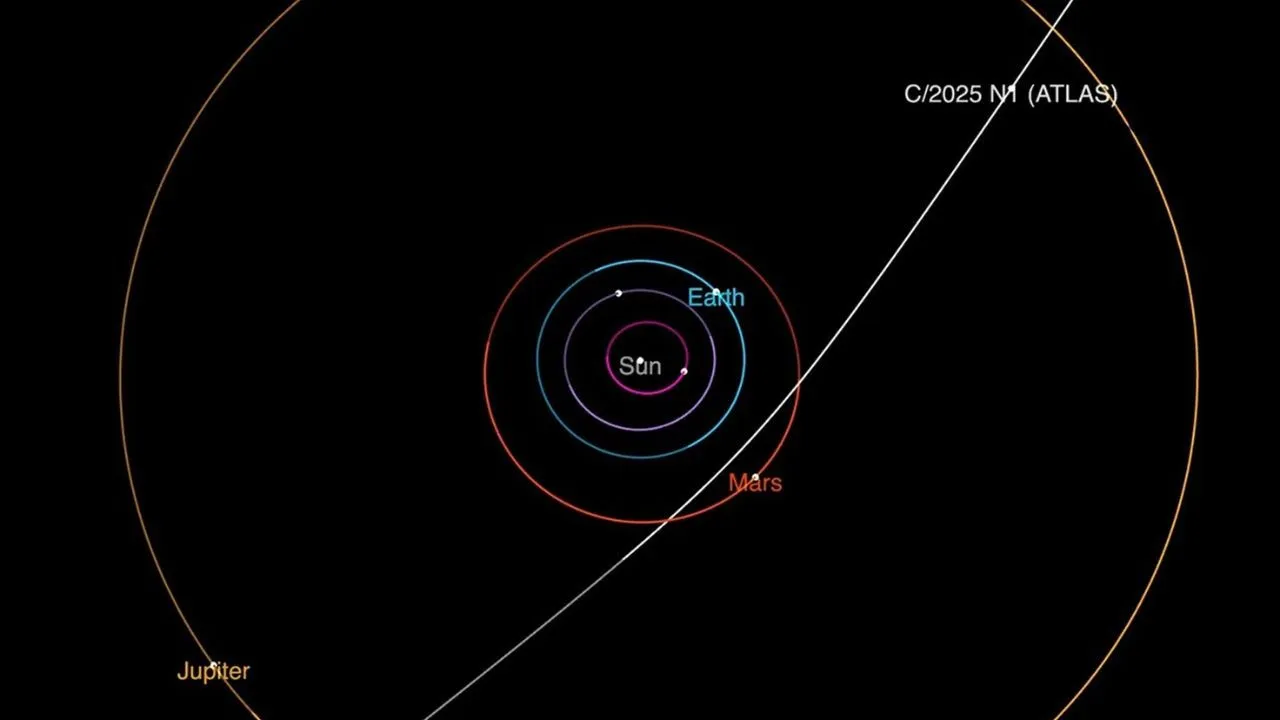
More telescopes have joined in to monitor its path closely. The comet doesn’t pose any threat to Earth, and scientists say it will stay at least 1.6 astronomical units away. That’s about 150 million miles—a safe distance by space standards.
Passing Close to the Sun in October
3I/ATLAS will pass closest to the Sun around 30 October, reaching a distance of 1.4 astronomical units (about 130 million miles). This is just within Mars’ orbit.
The comet will stay visible through September with the help of ground-based telescopes. Then, it will pass too close to the Sun to be visible.
Scientists hope it will reappear in early December, when it passes far enough beyond the Sun's glare. Scientists look forward to seeing it again to know more about its size, velocity, and make-up.
The star-crossed visitor, arriving silently from the cosmos, gives a glimpse of the deep unknown beyond our solar system.
Discover the latest Business News, Sensex, and Nifty updates. Obtain Personal Finance insights, tax queries, and expert opinions on Moneycontrol or download the Moneycontrol App to stay updated!
Find the best of Al News in one place, specially curated for you every weekend.
Stay on top of the latest tech trends and biggest startup news.