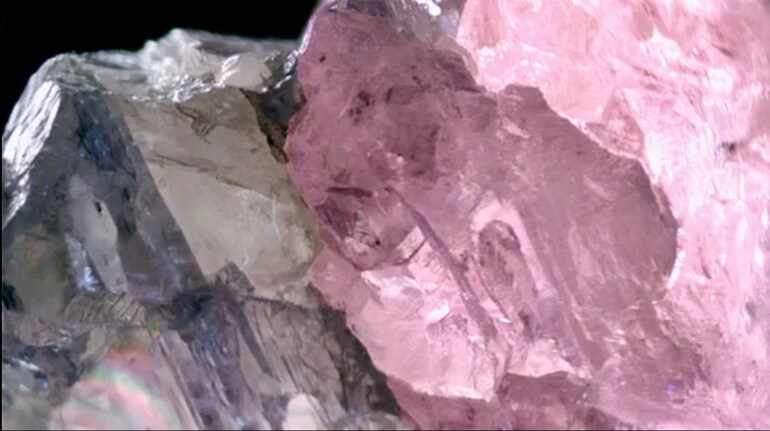
A newly found Botswana diamond drew attention. recently Its two tones sit sharply apart. The contrast makes the crystal feel alive. Experts say such finds rarely appear intact. This one reached the lab without harm.
How was the split diamond discovered?
The 37.41-carat rough came from the Karowe mine. It was examined soon after in Gaborone. Work was led by Sally Eaton-Magaña at GIA. Her research looks at colour and identification. GIA notes a clean boundary inside. The recorded size stands at 1 by 0.63 by 0.57 inches.
What explains the unusual colour divide?
Analysts think the diamond formed in two stages. Earlier cases showed only tiny two-carat pieces. The pink half seems to have changed under pressure. The colourless half likely grew after strain eased. The stone is classed as type IIa material. That purity heightens the colour contrast seen.
Most pinks gain colour from lattice distortion. The crystal then absorbs light differently. Too much strain shifts the tone brown. Too little strain leaves the diamond clear. Natural plastic deformation drives the colour process. Other hues often arise from impurities or radiation. Pink shades depend on structure, not chemistry. Some stones show thin lamellae inside. These stripes follow old slip planes.
Where and how do diamonds normally form?
Diamonds begin over 100 miles deep in mantle rock. Heat and pressure bind carbon atoms tightly. Kimberlite brings them quickly to the surface. Rapid travel stops conversion into graphite. Large stones stay chemically simple. Their colours rely on defects and stress. Two-toned pieces reveal clear pressure records. Some crystals grow deeper in the transition zone. Inclusions inside preserve ancient fluid traces.
Why does the Karowe mine yield unusual stones?
Karowe lies on stable ancient continental crust. Cool conditions there protect growing crystals. In 2024 the mine produced Motswedi rough. Its weight reached 2,488 carats in total. Finds like that highlight Karowe’s unusual output. This split diamond extends that pattern clearly. It gives scientists a natural before-and-after frame. New recovery systems save large rough early. This prevents crushing rare stones too soon.
Do supercontinents influence pink diamond origins?
Deformation linked to crustal shifts may shape colour. Major ancient movements altered deep pressures. Nuna formed over a billion years ago. Its long stretch and break cycles changed pathways. These pathways carried carbon-rich fluids upward. Such windows allowed new diamond growth features. Some regions now show more coloured stones. Others show none due to calmer histories.
What lessons come from this new specimen?
A study tied Argyle pinks to Nuna extension. The timing fits the two-step sequence seen. Stress likely tinted one half early on. Later growth built a clear section without strain. This stone records shifting conditions precisely. The boundary acts as a geological timestamp. Scientists can compare spectra from both halves. Cutters may preserve the boundary for study. They may also chase the richest pink area. Tests will map flaws before any blade touches it. The contrasting halves will guide future research. They help explain defect centres controlling light absorption.
Discover the latest Business News, Sensex, and Nifty updates. Obtain Personal Finance insights, tax queries, and expert opinions on Moneycontrol or download the Moneycontrol App to stay updated!
Find the best of Al News in one place, specially curated for you every weekend.
Stay on top of the latest tech trends and biggest startup news.