




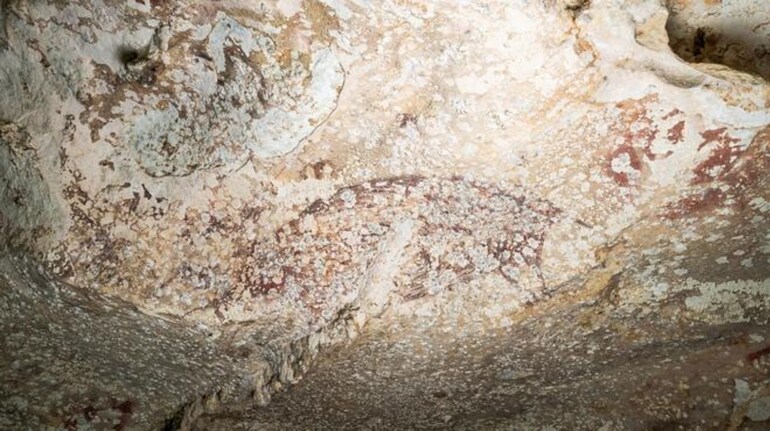
Archaeologists did the discovery of the world's oldest painting, the painting is the representation of ancient storytelling art. The painting location is in Indonesia, on the Island of Sulawesi there is a cave where this painting is done on the cave's ceiling made of limestone.
This remarkable painting dates back at least 51,200 years and depicts a wild pig and three human-like figures. The painting shows a pig standing still, with its mouth partly open. Along with the pig, there are three human-like figures can be seen surrounding it.
The largest figure has outstretched arms and seems to be gripping a rod. The second figure is positioned in front of the pig, its head adjacent to the snout, and appears to be holding a stick. The third figure is depicted upside-down, with legs pointing upwards and one hand reaching toward the pig's head.
This ancient artwork provides evidence of storytelling that explains and gives us an understanding of human thinking capabilities during ancient times and proves that humans think in abstract terms and convey complex narratives through art.
The discovery challenges our understanding of human evolution. It represents an evolution in thought processes that gave rise to art and science, this depictions in art endure as valuable archaeological clues.
The team of scientists, led by Adhi Agus Oktaviana, an Indonesian rock art specialist, made this groundbreaking discovery. Oktaviana in his statement regarding this discovery said “Humans have probably been telling stories for much longer than 51,200 years, but as words do not fossilise we can only go by indirect proxies like depictions of scenes in art – and the Sulawesi art is now the oldest such evidence by far that is known to archaeology.”
It’s a testament to the rich cultural heritage of early humans in Indonesia. The earliest evidence of drawing has been discovered on rocks in the Blombos Caves, located in southern Africa, and dates back to between 75,000 and 100,000 years ago.
These ancient artworks consist primarily of geometric patterns, indicating that early humans were engaging in symbolic and artistic expression long before the advent of recorded history.
The Blombos Caves findings include engraved ochre pieces, which provide insight into the cognitive and cultural development of prehistoric humans, demonstrating their capacity for abstract thought and communication through visual symbols.
These remarkable discoveries by archaeologists expand our understanding and shed light on the creativity, culture, and adaptability of our ancient ancestors
Discover the latest Business News, Sensex, and Nifty updates. Obtain Personal Finance insights, tax queries, and expert opinions on Moneycontrol or download the Moneycontrol App to stay updated!
Find the best of Al News in one place, specially curated for you every weekend.
Stay on top of the latest tech trends and biggest startup news.