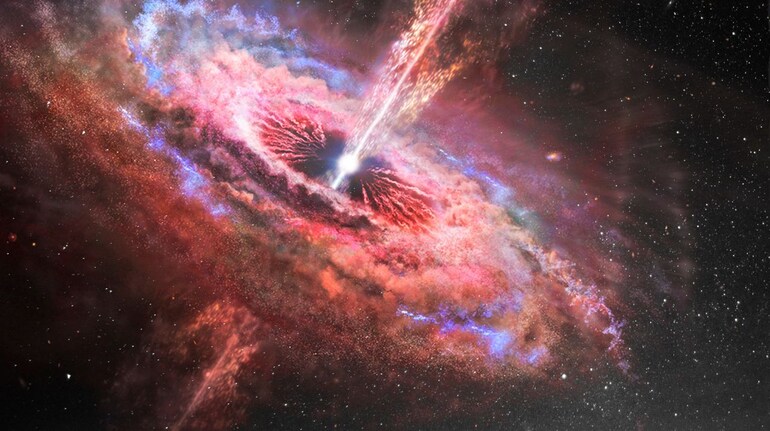
In an extraordinary discovery, astronomers have observed a massive and unexpected eruption from the supermassive black hole M87*. This explosion, visible from Earth in 2018, offers new insights into the mysterious behaviour of black holes and their powerful jets. Scientists hope these findings will help them better understand the complex dynamics around these cosmic giants.
Eruption of Gamma Rays
The explosion, which lasted three days in April and May 2018, was the first since 2010. It erupted from M87*, located about 55 million light-years away, and was detected as gamma rays by the Event Horizon Telescope (EHT). This gamma-ray flare was far more intense than typical emissions from M87*, signalling a dramatic shift in activity.
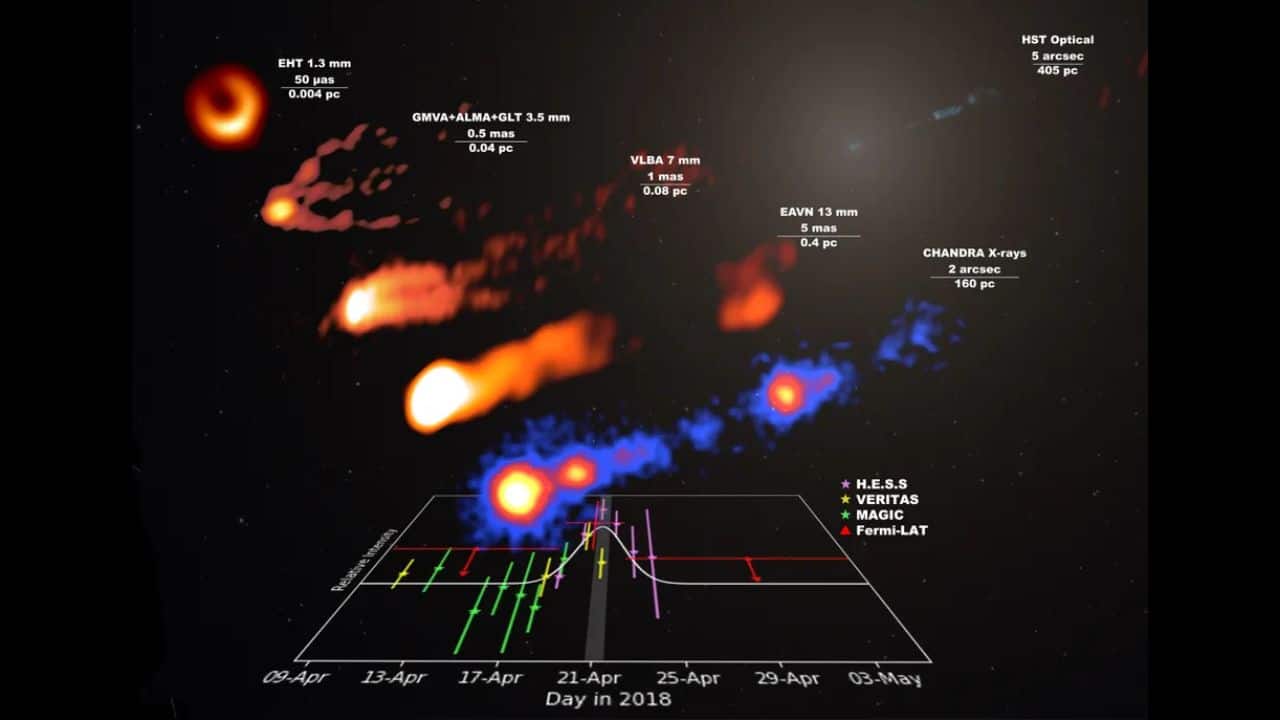 Light curve of the gamma-ray flare (bottom) and a series of nearly simultaneous images of the M87 jet (top) captured in radio and X-rays during the 2018 campaign at different scales. (Image: EHT Collaboration, Fermi-LAT Collaboration, HESS Collaboration, MAGIC Collaboration, VERITAS Collaboration, EAVN Collaboration)
Unlike our own Milky Way’s central black hole, M87* is actively feeding on surrounding matter. This feeding results in high-energy jets, such as the one seen in the gamma-ray eruption. M87* is vastly more massive than our black hole, with a mass equivalent to 5.4 billion suns.
Read Also: NASA's James Webb discovers Firefly Sparkle galaxy with mass similar to the Milky Way
Understanding the Jets and Accretion Discs
Supermassive black holes like M87* don’t just consume matter—they also launch powerful jets. These jets are formed from material surrounding the black hole, which swirls around in an accretion disk before being pulled in. Some material is accelerated to near-light speeds and shot out as energetic jets.
The gamma-ray flare observed in 2018 came from one of these high-speed jets. The jet from M87* is tens of millions of times larger than the black hole itself. This discovery raises many questions about how black holes launch such massive jets.
Collaboration Across Telescopes
The study was made possible by the collaboration of multiple telescopes, both ground-based and space-based. Instruments like Fermi, NuSTAR, Chandra, and Swift were crucial in observing the eruption. These coordinated observations helped scientists detect changes in the jet and the event horizon of M87*.
Researchers also noticed a regular shift in the jet’s angle, which appears to change on an annual basis. These findings suggest that the event horizon of M87* is closely linked to the powerful jets it launches.
This research was published in Astronomy & Astrophysics on December 13.
Discover the latest Business News, Sensex, and Nifty updates. Obtain Personal Finance insights, tax queries, and expert opinions on Moneycontrol or download the Moneycontrol App to stay updated!
Find the best of Al News in one place, specially curated for you every weekend.
Stay on top of the latest tech trends and biggest startup news.