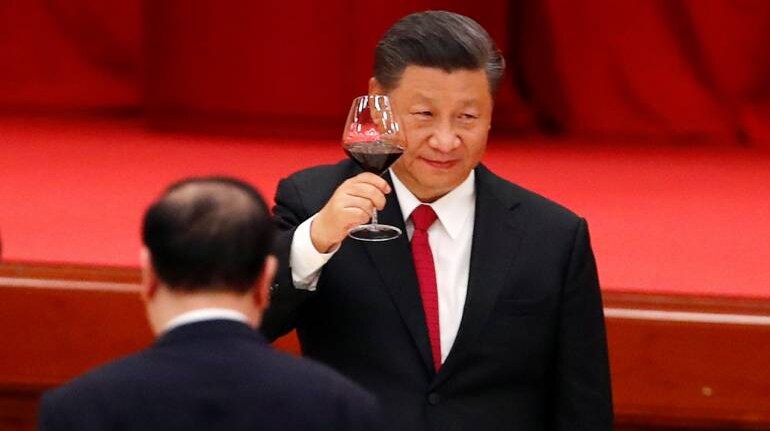
Chinese President Xi Jinping upgraded ties with a record number of countries last year as he seeks to rally the Global South to reshape the US-led world order.
Beijing elevated the way it described ties with 17 countries and territories last year, most of them from the developing world, according to a Bloomberg analysis of statements issued by the foreign ministry. That’s a pace not seen during Xi’s first decade in office. It added Maldives to the list on Wednesday.
While Washington has built a diplomacy strategy dependent on coalitions of mostly rich allies, Beijing is doing the opposite, wooing developing countries that make up the majority of the world’s population using aid, trade and investments. The geopolitical benefits are on display this week with Maldivian President Mohamed Muizzu’s first state visit to China, breaking convention with previous Maldivian leaders and handing Xi a victory over regional rival India.
Xi met with Muizzu on Wednesday and vowed to bring China-Maldives relations to a new level. The leaders upgraded their partnership, joining the other countries that elevated ties with Beijing last year, including neighboring Turkmenistan and Kyrgyzstan, Zambia and Ethiopia in Africa, as well as Venezuela, Uruguay and Colombia in Latin America.
China also boosted ties with the Solomon Islands and Nicaragua, two nations that have severed diplomatic relations with Taiwan and switched allegiance to Beijing.
Beijing even stepped up engagement with Afghanistan after the US withdrawal in 2021, formally opening diplomatic relations with the Taliban government and building ties with the ex-insurgents that fought the US occupation for two decades.
“A lot of these countries are in areas of contestation with the US and the West,” said Eric Olander, who co-founded the China-Global South Project. For those that have tilted toward China, such as Maldives, “they will be rewarded with an upgrade of diplomatic ties to lock them into China’s universe,” he added.
Beijing has different labels for its bilateral relations. It uses “all-weather strategic partnership” for Pakistan, Belarus and Venezuela to describe a friendship that remains strong under the test of various conditions. For the US, it describes ties as a “new-type major power relations.”
Ties with Singapore were formally upgraded to an “all-round high-quality and forward-looking partnership” in April, a reflection of their commitment to collaborate in areas such as digital economy and green development.
China uses “strategic” to describe many of its new relationships. This signals the two sides not only have bilateral exchanges and cooperation, but may coordinate on international and regional affairs, according to the China Institute of International Studies, a think tank affiliated with the foreign ministry.
Instead Xi made foreign dignitaries travel to him. He hosted about 70 leaders from the Global South last year, the most since 2019 based on Bloomberg calculations, mostly through two summits with Central Asian countries and a forum celebrating his flagship infrastructure-building Belt and Road Initiative.
The flurry of “active diplomacy” in 2023 suggests Xi is trying to build a strong foundation for international relations as he’s expected to prioritize domestic issues this year given China’s economic slowdown, Sun said.
Senior Chinese officials hailed China’s “enhanced international influence, stronger capacity to steer new endeavors, and greater moral appeal” at a rare Communist Party meeting late last month. They also vowed to increase China’s influence on global events and reject “all acts of power politics and bullying.”
Olander said the upgrading of ties is “more about optics and politics than it is about substance,” adding this isn’t something the West puts as much value on.
China’s trade with the 17 countries and territories made up just 3.1% of the total in 2022, according to calculations based on the latest available full-year data from the International Monetary Fund. Singapore alone accounted for 1.6%.
For Beijing, the moves are aimed at winning over more partners in an increasingly fragmented world, said Wang Yiwei, director of Renmin University’s Center for European Studies.
“By elevating ties with these countries, China is securing raw materials and supply chains for the future,” he said.
Discover the latest Business News, Sensex, and Nifty updates. Obtain Personal Finance insights, tax queries, and expert opinions on Moneycontrol or download the Moneycontrol App to stay updated!
Find the best of Al News in one place, specially curated for you every weekend.
Stay on top of the latest tech trends and biggest startup news.