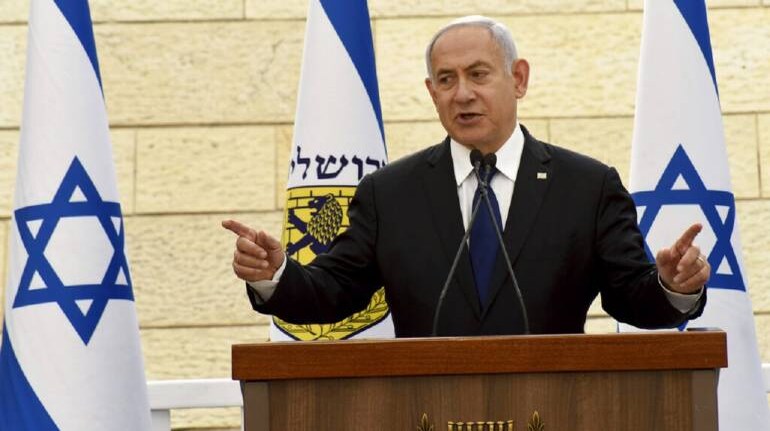
Israeli Prime Minister Benjamin Netanyahu was rushed to a hospital Saturday to undergo medical tests after experiencing “mild dizziness,” his office said.
Netanyahu, 73, arrived Saturday afternoon at the Sheba Medical Center, a leading hospital near Tel Aviv, Israel, and remained “in good condition and undergoing medical evaluation,” his office said in a statement.
A spokesperson for Netanyahu said Saturday that the prime minister was fully conscious during the journey to the hospital and subsequent tests, and that he was joking with the hospital’s staff and doctors. It was not yet clear whether he would stay the night.
Netanyahu had spent the hottest part of Friday beside the Sea of Galilee in northern Israel, where temperatures reached 100 degrees Fahrenheit, his office said in a later announcement. He felt mildly dizzy Saturday and went to the medical center on the advice of his personal physician, Dr. Zvi Berkowitz.
“Initial tests have been normal and shown no findings,” the prime minister’s office said in its second statement. “The initial assessment is dehydration. At the doctors’ recommendation, the PM is continuing to undergo additional routine tests.”
A spokesperson for the medical center did not immediately respond to a request for comment.
Netanyahu was briefly hospitalized in October after feeling pain in his chest in the weeks before last year’s election. He was filmed jogging the next morning. He was also briefly hospitalized in 2018 after suffering from a fever.
Netanyahu is Israel’s longest-serving prime minister and is currently facing one of the most challenging periods of his political career. The prime minister is on trial for corruption, and his coalition — the most right-wing in Israel’s history — has set off a political crisis by advancing plans to limit judicial oversight of the government.
The plan has set off a monthslong wave of political protest in Israel, deepened long-standing social divides, drawn strong criticism from the Biden administration and prompted widespread fears of civil war.
If Netanyahu proceeds with the plan, he risks provoking a general strike, as well as mass resignations from military reservists, who form a key part of Israel’s military capacity. If he suspends the plan, he risks angering his political allies and collapsing his coalition.
This article originally appeared in The New York Times.
By Patrick KingsleyDiscover the latest Business News, Sensex, and Nifty updates. Obtain Personal Finance insights, tax queries, and expert opinions on Moneycontrol or download the Moneycontrol App to stay updated!
Find the best of Al News in one place, specially curated for you every weekend.
Stay on top of the latest tech trends and biggest startup news.