Note to readers: Healing Space is a weekly series that helps you dive into your mental health and take charge of your wellbeing through practical DIY self-care methods.
Blame god for kickstarting the list obsession. If he created the world in seven days, clearly, he worked to a plan. Even Santa loves lists. You’re either naughty or nice and fit into one or the other category somewhere. If you have been reviewing everything you have gotten done this year or are looking towards everything you need or intend to do next year. If you make to-do lists every morning, and stick post-its around your work space, the year-end brings the mother of all to-do lists. We also like to think of it as a manifestation. We believe if we write it down, it will get done. But do these lists of things we have done and not done really work?
 We tend to write down more of what we haven’t completed than what we have, and panic about the unfinished tasks. This is known as the Zeigarnik Effect. The unconscious mind needs the conscious mind to translate the abstract into the tangible, and it uses a plan to soothe its anxiety. However, a whole list of everything we haven’t done gets confronting. It feels like a very negative space, which is why we rarely go back to our to-do lists but can keep endlessly adding tasks to them.
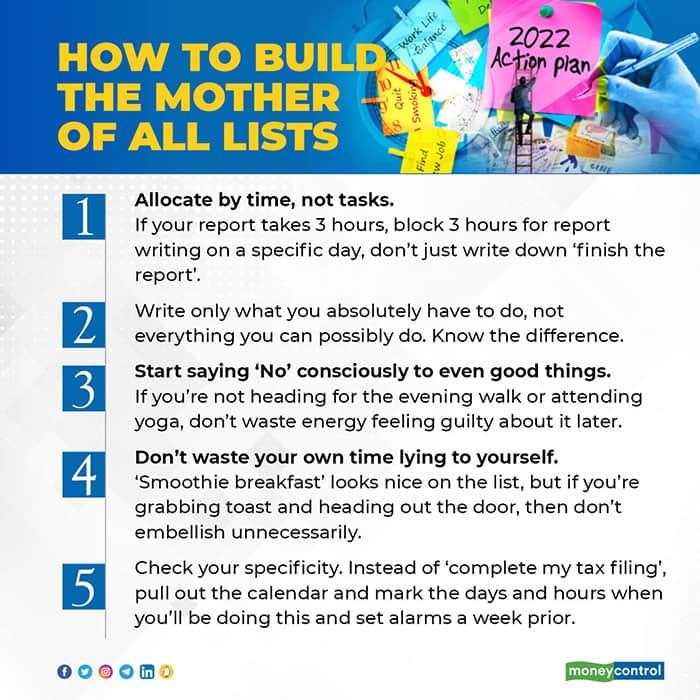
Our goals on the list can also contradict each other. For instance, if you’ve written down ‘eat healthy’ but also ‘quick working lunch’, you’re probably going to sacrifice the former for the latter. We also add everything we can think of, which is the equivalent of saying ‘yes’ to everybody who walks by your desk and asks you if you can do something for them. On a to-do list, we forget to say ‘no’ to less important things.
The items we add to year-ender or yearly review lists also seem to be too long-term, broad and intent-based, rather than specific. As long as we mean well, we don’t actually have to put effort into achieving anything on it. So, we never really have to commit to them, because there is nothing we can do about anything right in the moment. ‘Lose 10 kg by December 2022’ ‘grow income by 25% in 2022’ sounds great and seems like it is specific because it mentions a number and a deadline, but it doesn’t tie me to any course of action right now so I can afford to ignore it.
Cal Newport, author of Deep Work, recommends scheduling instead; that is, looking at how much time we have and allocating that to what we have to get done. You can also make a time budget, much like a financial budget, it shifts the focus to how much time we have as a resource and how we are allocating that. You’ve written ‘finish the report’ on the list, but you’re taking half-a-day to finish the report, so nothing else on the to-do list can get done realistically. When we focus on where we are using our time, the negatives lose the power to intimidate us. We are forced to prioritise, and when we do that, we commit. David Allen, author of Getting Things Done: The Art of Stress-Free Productivity, recommends you focus on immediate tasks, filing away what can’t be tackled immediately into a folder that you open on the specified date.
 Simply put, making lists makes our unconscious minds feel more comfortable. We relax knowing that we have put something on a list somewhere. We have tricked the mind into releasing its anxiety pattern. This, however, is not the same thing as actually getting things done. If you actually want to get something done, the realistic way is to look at how long it’s going to take to get it done, realistically schedule the time to do it, block your calendar accordingly, and then focus on the immediate tasks at hand. Building a series of ‘now’ tasks rather than a non-committal long-term list, is what clears your plate eventually.
So people who look like they’re the most organised could be worse procrastinators than you are. The list is not evidence of getting things done, just of anxiety about it.
Discover the latest Business News, Sensex, and Nifty updates. Obtain Personal Finance insights, tax queries, and expert opinions on Moneycontrol or download the Moneycontrol App to stay updated!

Find the best of Al News in one place, specially curated for you every weekend.
Stay on top of the latest tech trends and biggest startup news.