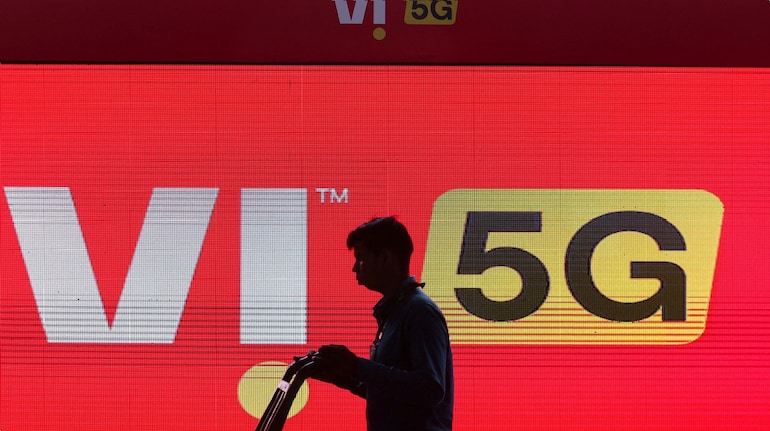
Vodafone Idea’s revenue market share dropped to an all-time low of 14.5 percent in the second quarter, losing ground across all 22 telecom circles, Jefferies has said, analysing TRAI data.
The debt-laden telco suffered a sharp decline of 140-160 basis points (bps) in metros, A circles and B circles and a 50 bps dip in C circles despite posting revenue growth for four consecutive quarters.
Jefferies attributed the decline to the slow pace of 4G network expansion and the absence of the 5G network, it said.
"VIL's widespread market share loss suggests that gains will continue to favour Jio and Bharti Airtel in the near term until Vodafone Idea completes its network investments," Jefferies analysts said in a note.
Metros A, B, and C are categories of telecom circles based on population, consumer base and revenue generation potential.
One basis point is one-hundredth of a percentage point.
While Vodafone Idea's net revenues grew 2 percent year-on-year to $4.7 billion in Q2 FY25, its active subscriber base declined by 9 percent to 180 million. The company plans to invest Rs 50,000-55,000 crore over three years to enhance its 4G networks and launch 5G services in key regions.
The cabinet recently approved a proposal to waive the bank guarantees that telecom companies were required to provide for spectrum purchases till 2022.
The government has already eliminated the need for bank guarantees for spectrum acquired from 2022.
The waiver is expected to help Vodafone Idea secure bank loans of approximately Rs 35,000 crore during the current fiscal. However, the raising of the debt has been delayed due to issues related to Adjusted Gross Revenue (AGR) and the bank guarantee waiver.
“The delayed debt raise sustains uncertainty around the pace and quantum of its overall network expansion, which has a direct bearing on market share,” Axis said in a separate note.
According to Jefferies, Reliance Jio and Bharti Airtel gained at Vodafone Idea’s expense, reporting revenue growth of 14 percent and 18 percent, respectively, outpacing the sector's overall growth rate of 13 percent.
Bharti Airtel gained 140bps market share during the quarter, with notable traction in Delhi, Tamil Nadu and Bihar, while Jio’s market share gains were more evenly distributed.
Bharti Airtel also achieved a significant 190 bps market share gain in rural-focused C-circles, underscoring its success in rural expansion. The company maintained its leadership in Metros and A-circles, reinforcing its stronghold in urban markets.
Sector-wide revenue growth reached a new peak of $32 billion in Q2 FY25, fuelled by the partial impact of tariff hikes. The average revenue per user (ARPU) increased 12 percent to Rs 211.
Analysts expect sector revenues to grow at a 14 percent compound annual growth rate, reaching $38 billion by FY26. ARPU is projected to rise further, hitting Rs 194 in FY25 and Rs 222 in FY26 as the full effect of recent tariff hikes materializes.
Jefferies highlighted that the convergence in growth rates between Bharti Airtel and Jio will likely maintain pricing discipline, as tariff differentials no longer drive growth disparities.
On December 4, the Vodafone stock was trading at Rs 8.27 on the National Stock Exchange in the morning trade, up 0.73 percent from the previous close.
Disclosure: Moneycontrol is a part of the Network18 group. Network18 is controlled by Independent Media Trust, of which Reliance Industries is the sole beneficiary.

Discover the latest Business News, Sensex, and Nifty updates. Obtain Personal Finance insights, tax queries, and expert opinions on Moneycontrol or download the Moneycontrol App to stay updated!
Find the best of Al News in one place, specially curated for you every weekend.
Stay on top of the latest tech trends and biggest startup news.