





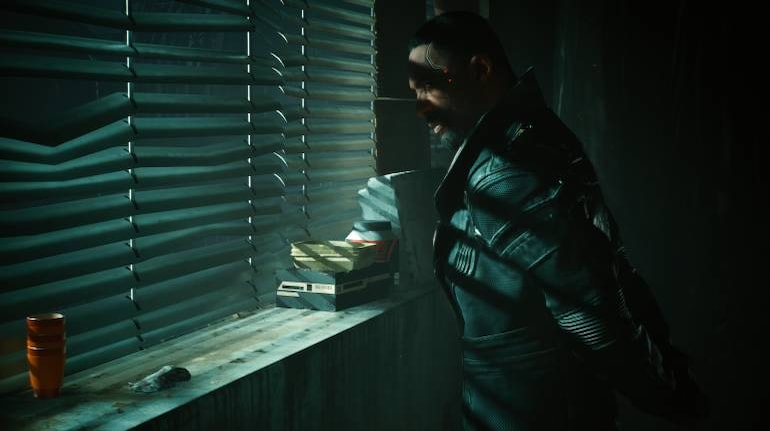
Until the end of time, the release of Cyberpunk 2077 on December 10, 2020 will remain a case study in disaster. No matter what the rest of this article says, no amount of revisionism will change that fact. Even before the game officially launched, there was controversy. Pre-release review codes went to very select publications. To put this into sharper relief, one Indian outlet got a chance to try the game before it launched. Only.
And the codes that were sent out were only for the PC version — arguably the one that ran the best. In essence, this meant that gamers who had preordered Cyberpunk 2077 for the PlayStation 4 and Xbox One would have no idea how poorly it was going to run on last-gen consoles until it was too late to cancel. How poorly it ran would be the reason that Sony would delist the game from its online storefront, after stumping up for mass refunds. And then there were the reports that despite reassurances to the contrary, CD Projekt Red developers were made to crunch solidly in the leadup to launch.
Why is the last part relevant, I hear you ask. After all, so many other professions require workers to put in extra hours — and often without extra pay — on the eve of a deadline, you may well add. And I answer: The point being made was that everyone was left discontented when Cyberpunk 2077 launched. Gamers, shareholders, platforms like PlayStation and Xbox, aficionados of the cyberpunk genre and developers alike.
So will the second coming of Cyberpunk 2077 be a classic redemption story or a case of flogging a dead cyborg horse? The parable of No Man’s Sky is an encouraging one, but for every Hello Games (the studio that spent years adding content and gameplay loops to the 2016 game that launched to poor reviews), there are many studios that would write off a failed game or shut down altogether.
Not among the latter categories, it would seem, is CD Projekt Red — a studio with some experience of fixing buggy or messy games. The much-lauded but initially buggy The Witcher 3: Wild Hunt was patched over 20 times during its lifetime, for instance.
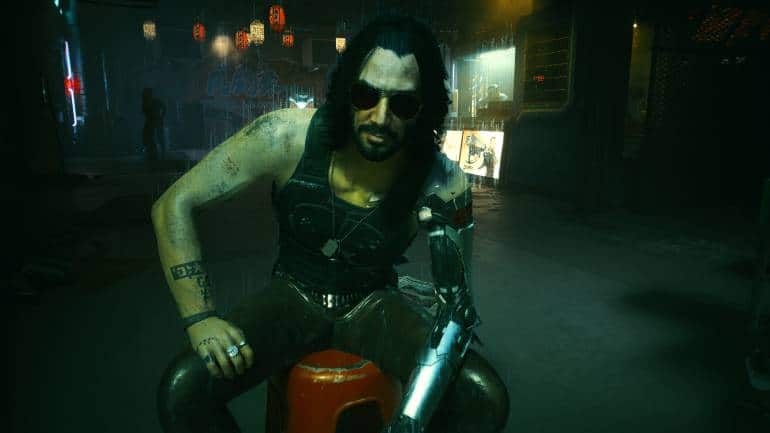
Samurai wakes up at last, but is still quite groggyCyberpunk 2077 contributed to the long tradition of promo scenes and lines of dialogue that never show up in the actual film/show/game with a contribution of its own: The famous “Wake the f*** up, Samurai! We have a city to burn” from the CGI promo. Now, the implication therein was threefold. First, that the game would feature Keanu Reeves; second, that he’d be a foulmouthed little such-and-such, and third, that Cyberpunk 2077 would be a game that would let you run amok in a city.
(Image: CD Projekt Red)
We’ll get into the third one shortly, but in its original form, the game delivered solidly on the first two. On September 21, a mammoth upgrade — dubbed version 2.0 — dropped for PlayStation 5, Xbox Series X|S and PC users. Having patched the PS4 and Xbox One versions adequately enough, CD Projekt Red’s decision to abandon the last generation of consoles might seem harsh, but it’s the right move. And it’s the move the Polish studio should have made back in 2020 as well. There was no way the older machines were going to be able to handle the game, but what’s done is done. Live and learn.
The 2.0 update brings with it a host of improvements and fixes, most notably, a tweak to the police AI that turns the force smarter and a lot less forgiving, vastly improved driving and vehicular combat, and new skill trees and cyberware. There are other features including new music, improved NPC AI and a few UI modifications, but that’s about it. And from the sounds of things, this is going to be your lot for the foreseeable future.
The million eurodollar question then is, “Is it a good game now?”
Since its launch nearly three years ago, I have spent a combined 120-or-so hours on Cyberpunk 2077. These hours are distributed across the PS4 Pro on which I completed the game at launch, the PS5 on which I played version 1.5 back in February 2022 and on the PC (a top-of-the-line Alienware Aurora R15), where I am currently playing version 2.0. The technological boost, for me anyway, has been quite remarkable: From a machine that just about ran the game to one that runs the game on the absolute highest graphics settings (Ray Tracing - Overdrive) with ease and has plenty of gas left in its tank.
The first thing anyone is going to notice about the game in its current avatar is how it looks. Of particular note is the lifelike appearance of reflections (whether off mirrors, puddles or smoother sections of wall) made possible by an NVIDIA 4090 GPU and a top-end i9 processor. It got to a point where I began studying real-life reflections for comparison. Still, I’d like to go on the record at this point and state that even at launch and on last-gen hardware, the game largely looked good.
Portraits of Night City: A #Cyberpunk2077 photo essay(1/n) pic.twitter.com/kKn8B61afD — karan pradhan (@karanpradhan_) February 4, 2021
Of course, there were the occasional ghastly NPCs that seemed to have been teleported in from 1998 (where they had presumably left their facial features), but overall Night City looked like a great place to spend a few dozen hours. Then there were the bugs, the glitches, random frontal nudity and T-poses.
As someone who grew up playing videogames in the era before internet-borne patches could fix games post-launch, these were an inconvenience, but not much more. And sure, there was an instance or two of having to restart the game and retread some ground on account of a crash, but it was extremely rare.
While Cyberpunk 2077 v2.0 has fixed most of these, I have to say none of them prevented me from experiencing all Night City had to offer. The engaging central storyline and variety of interesting substories kept me invested through it all. In 2023, I certainly appreciate the AI and quality of life improvements version 2.0 has brought with it, but my fundamental issue with the original game remains. And that is the game’s schizophrenic identity. It harbours aspirations of being an open-world sandbox game, and yet, offers very little to do outside of the clearly signposted missions, sidequests and gigs.
It wants to tell an engaging story, but loses the plot by having you stand around for ages waiting for someone or the other to contact you. This brings me back to the third part of the aforementioned trailer’s implication. When Johnny Silverhand tells you there’s a city to burn, I’d imagined there would be more to do, and I’d have more agency. I could run around blowing things up and evading the police, but beyond a bit of temporary amusement, where’s the fun in that? That Night City still remains sparsely populated with a number of NPCs largely going through animation loops that reset after a while serves to further pull you out of any immersion provided by the frankly top-notch narrative.
All that said, if you haven’t played Cyberpunk 2077 before, version 2.0 remains the best way to play what is on the balance of things, a good game. No more and no less. Of course, this is before we factor in the story DLC that launched on September 26.
 (Image: CD Projekt Red)Phantom Liberty does justice to William Gibson’s vision
Bruce Bethke may have coined the term ‘cyberpunk’, but it was William Gibson who gave it an identity of its own. Certainly, the genre was birthed by the likes of Philip K Dick, Harlan Ellison and others who formed the New Wave of science fiction in the 1960s and 1970s, but Gibson’s work remains seminal in fleshing out what we know today as cyberpunk. When Cyberpunk 2077 was announced, I was expecting to see his vision brought to life. And to an extent it was.
A near future in which larger-than-life corporations call the shots, humans are augmented with tech implants, netrunners use the cyber technology in suitably futuristic ways, abuse of narcotics and stimulants is widespread and of course, neon lighting is omnipresent — these were all part of the experience. But where the game fell short was in its portrayal of the squalor, the danger and the desperation depicted in Gibson’s Sprawl trilogy. The base version of Cyberpunk 2077 barely scratched the surface on those counts.
That’s where Phantom Liberty blows the roof off the place. And then some.
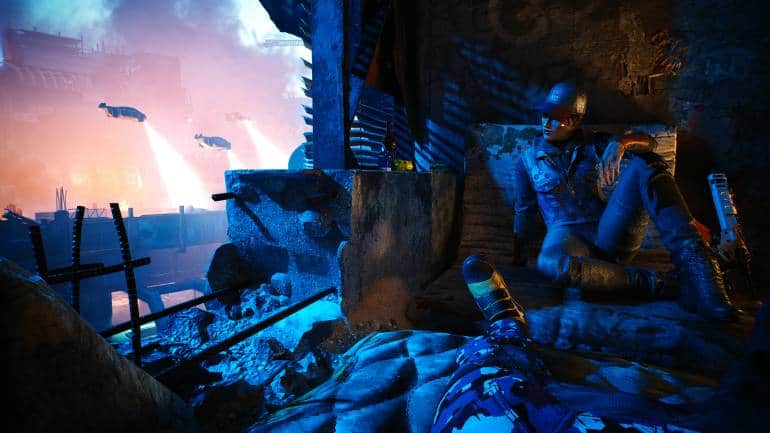
The chunky (takes around 18 to 19 hours to finish the main story with a smattering of gigs and side missions) DLC throws you into a brand new section of Night City known as Dogtown. This haven of lawlessness is home to all sorts of dangerous outlaws, shiny skyscrapers standing amid the ruins of decrepit structures and shattered dreams, filth and grime, and plenty of addicts. Run by Colonel Kurt Hansen and his Barghest militia, this is the first area in Night City that I found myself looking over my shoulder at every turn.
Things kick off with the shooting-down of Space Force One by Hansen’s men, and a mission to rescue President of the NUSA Rosalind Myers (played by Kay Bess). Phantom Liberty throws you in at the deep end with high stakes and even higher levels of peril — evident in the variety, tenacity and ferocity of the various enemy types you face. As the first mission in Dogtown finally begins to wind down, you are introduced to sleeper agent Solomon Reed (played by Idris Elba). The entire affair turns into a game of espionage, where stealth and discretion play a far greater role than they ever have in Night City. Whereas in the base game, you could brute force situations with the power of lead, in Dogtown you could be in for a protracted gun battle if you err on the side of incaution.
Gun battles are just one of the key areas where Phantom Liberty has experienced massive upgrades. First off, enemies are varied (featuring some pretty interesting bosses like the Chimera), motivated and very tactical in how they flank and attack you. Then there’s the fact that they come at you in almost unending waves, and often, you have to figure out a way to get out of the fight and disappear undetected. Every mission feels incredibly intense and after the experience of the very first mission of the DLC, the paranoia of Hansen’s militia rolling up on you never goes away.
Elsewhere, upgrades are visible in your abilities — where a whole new tier of skills opens up, quest design and the quality of writing. Underlining the perfect interplay of writing and quest design is the mission titled ‘You Know My Name’ (aptly named after a James Bond theme; one of the best, in my opinion). If the infiltration of Konpeki Plaza in the base game got you enthused about a spy, just wait till you try and break into Hansen’s Black Sapphire skyscraper. And even though they play very different characters, Elba too seems like an upgrade on Reeves in the “celebrity in a videogame” category. As Reed, his gritty, intense and largely understated performance is up there with his portrayals of Stringer Bell in The Wire and Stacker Pentecost in Pacific Rim (if not quite as powerful as Commandant in Beasts of No Nation).
 (Image: CD Projekt Red)Time to visit/revisit Night City
If you’ve never played the game before, you are in for an absolute treat. And if you’ve played the base game before, you still have no idea of the gaming delights that await you in Phantom Liberty. And so before you visit or revisit Night City, it’s time to revisit my thesis question: Is the saga of Cyberpunk 2077 a classic redemption story? In comparison to No Man’s Sky, no, it is not, because as explained above, the fundamental issues of the game remain.
However, does it need to be? Absolutely not. As it stands, Cyberpunk 2077 has been elevated as a package by Phantom Liberty, which in turn is elevated even further by ‘You Know My Name’. If anything, the game finally lives up to its title and the Gibsonian legacy that comes with it. And I can’t think of any richer praise for this cyborg horse that has just been given a new lease of life.


Discover the latest Business News, Sensex, and Nifty updates. Obtain Personal Finance insights, tax queries, and expert opinions on Moneycontrol or download the Moneycontrol App to stay updated!
Find the best of Al News in one place, specially curated for you every weekend.
Stay on top of the latest tech trends and biggest startup news.






